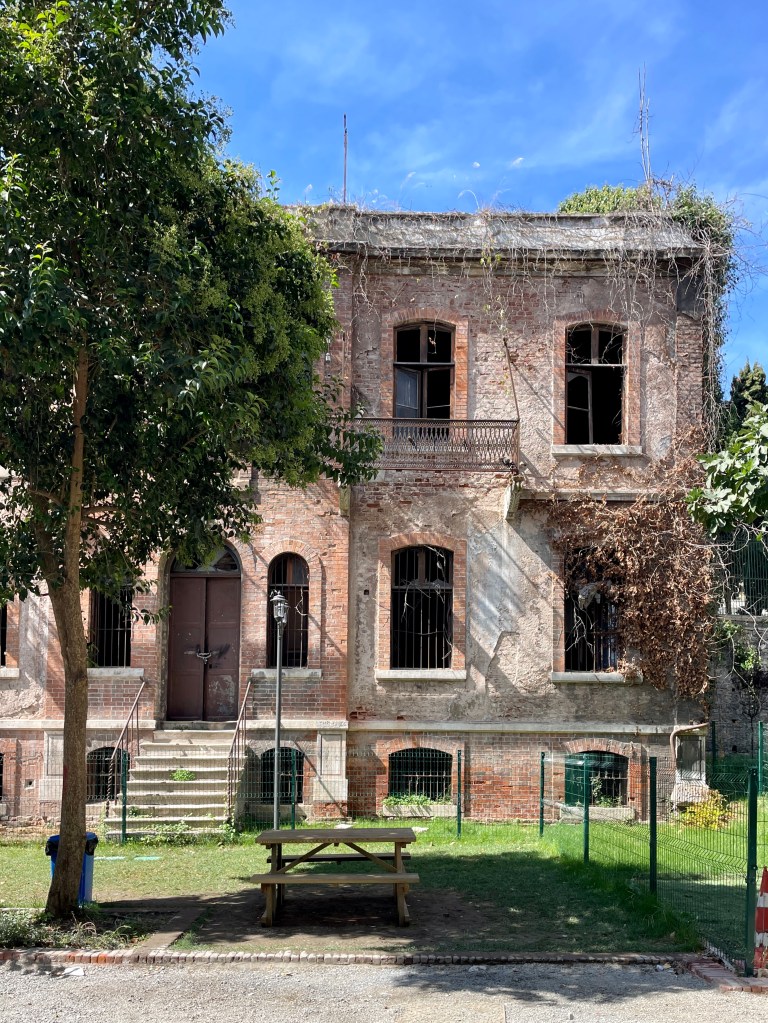
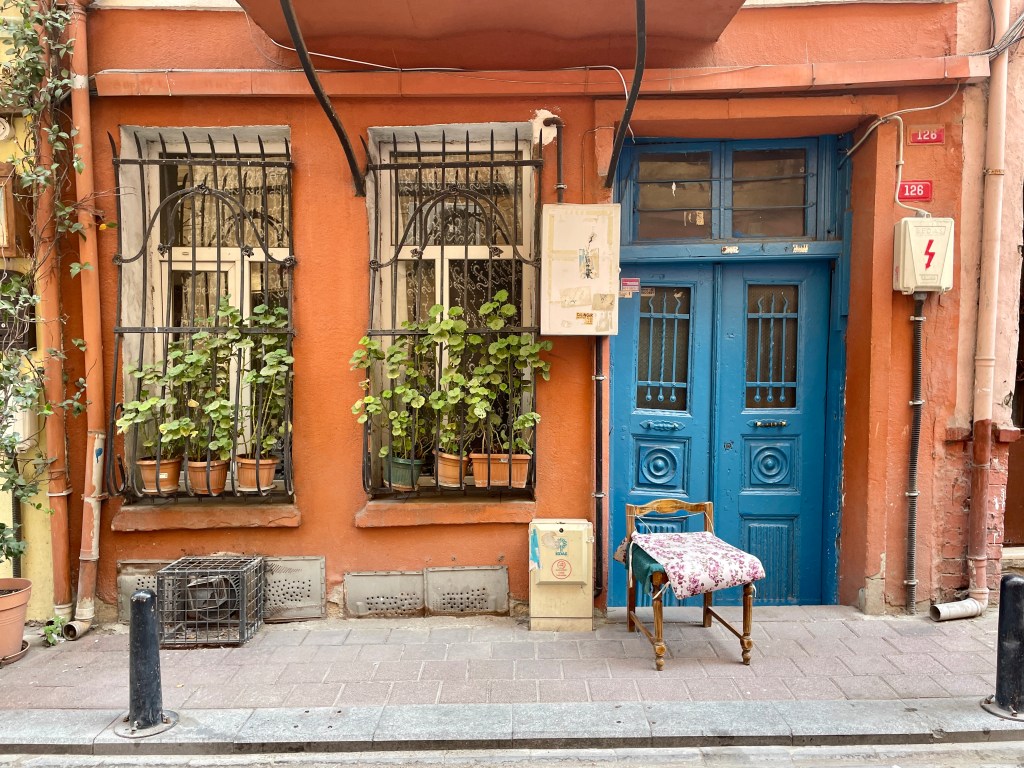
Ne var, ne yok?

“Ne var, ne yok?” Turks use this phrase casually to ask “how’s it going?” or “what’s happening?”. In actuality, the phrase translates to “what exists, what does not exist?”. Just as very little in Turkey was what it seemed, this question has proved telling as I reflect upon my time spent there.
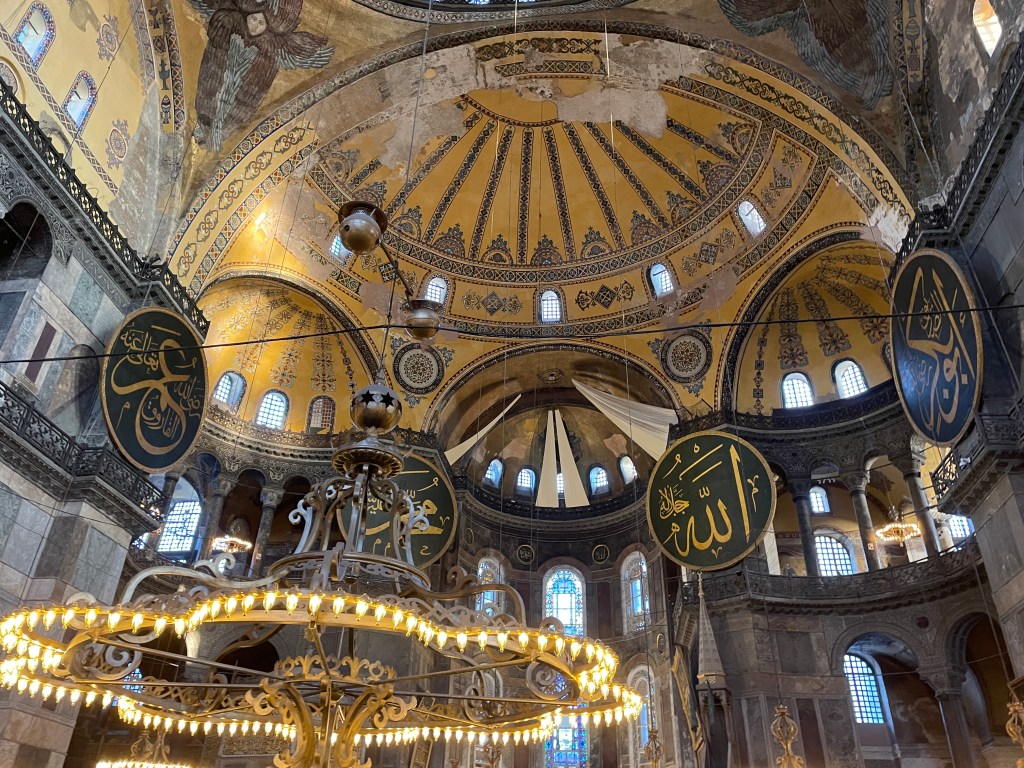
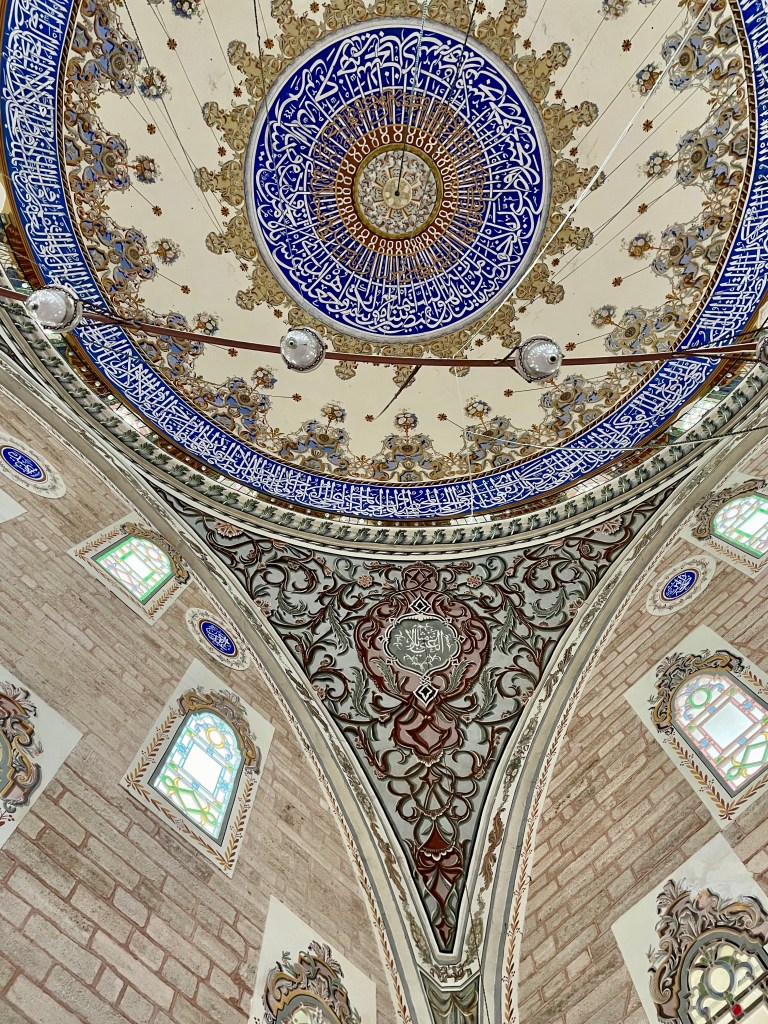
What does exist? Turkey is a diverse country full of welcoming people who are happy and proud to share their rich cultural traditions. At nearly every turn, a stunning vista – from fields of sunflowers to the turquoise Marmara Sea to ancient ruins alongside the highway – Turkey is gorgeous. Ancient history from so long ago it will stop you in your tracks. Stunning mosaics. Vaulted mosque ceilings which shimmer like the night sky. Outrageously delicious food – kaymak, kofte, and pide. And the Grand Bazaar – oh my word – the textiles.

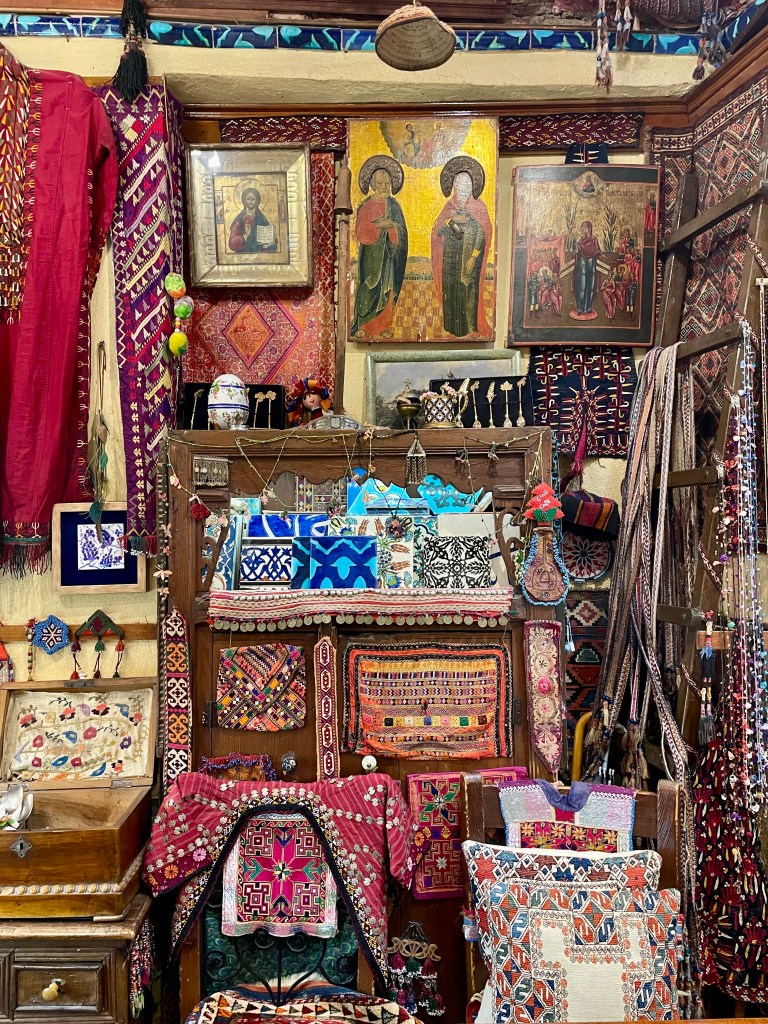
Turkey is a fish-out-of-water experience. From the call to prayer to tractors on the roadways to midnight rumblings of earthquakes (was the ground shaking or is it just me?), Turkey will jostle you. “I had come to Istanbul, a city with which I had many romantic associations but little practical experience” (Elif Batuman, New Yorker).
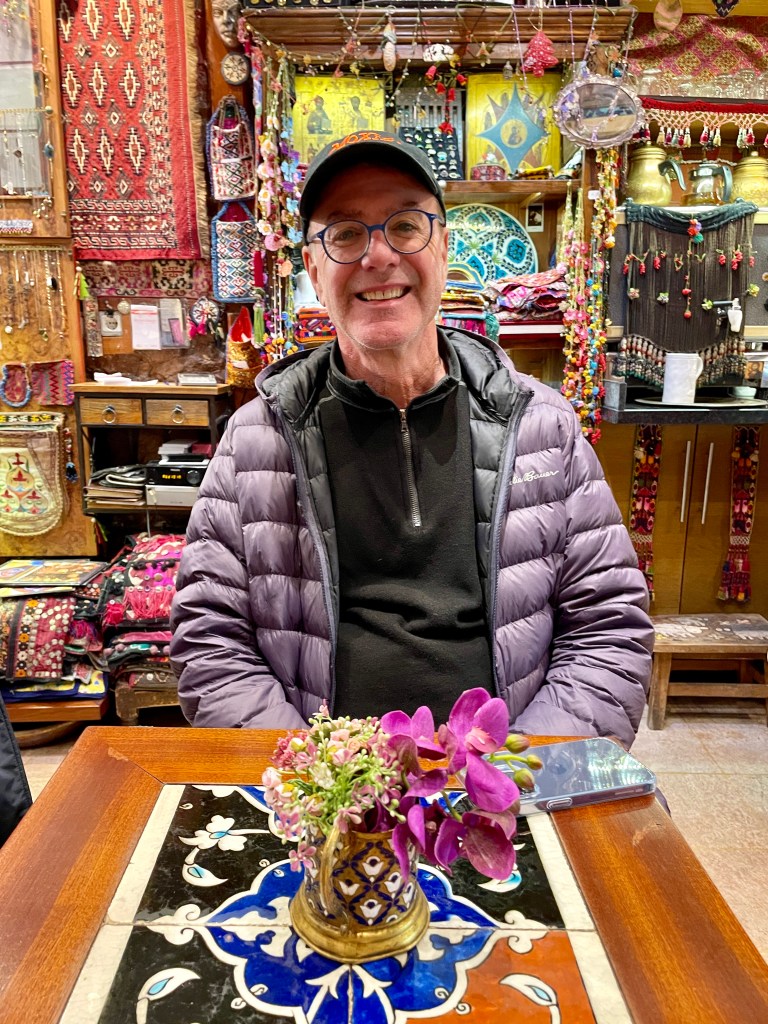
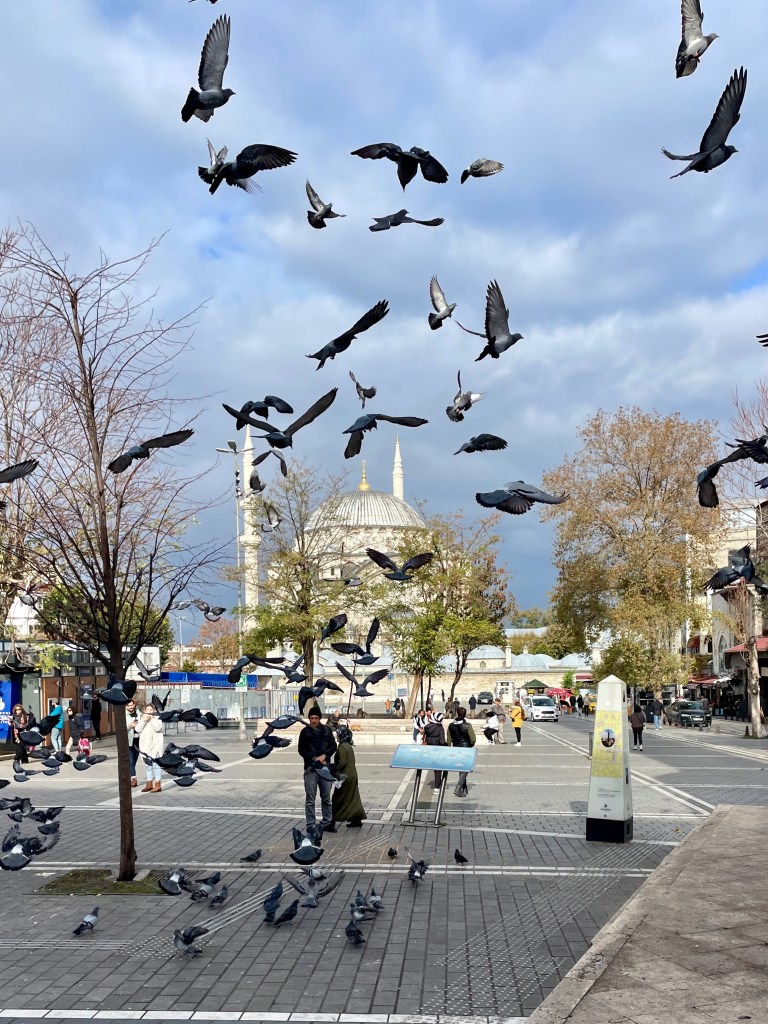
What does not exist? A system of rule, a sense of collective imperative for the greater good, common sense which aligns with Western philosophy, rational thought surrounding animal welfare. Currently, economic stability is lacking, too. In my two years in country, I dealt with enough circular bureaucratic madness to drive a person to drink. I won’t go into many details but my experience in Turkey was made stressful right up until the bitter end due to a lack communication between the ever-changing bureaucratic “laws” and the actual reality of everyday life. I walk away feeling that I have some understandings of the “system” but I sure don’t respect it. Mark my words, there are many reasons that Turkey will never be invited to join the EU.
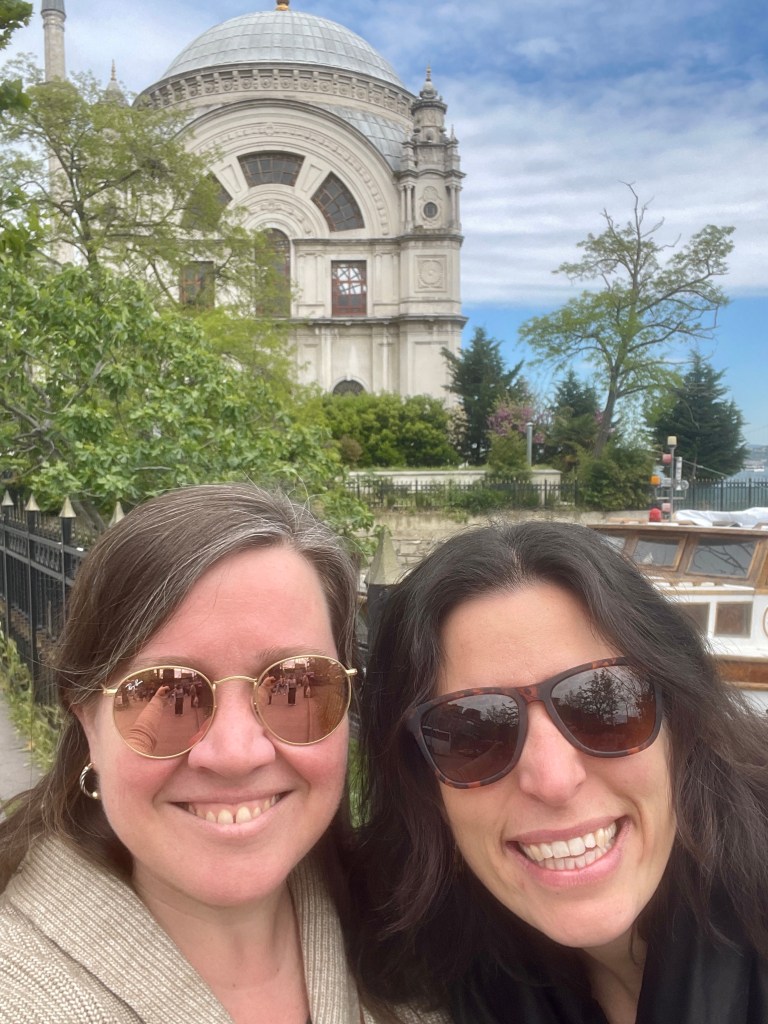
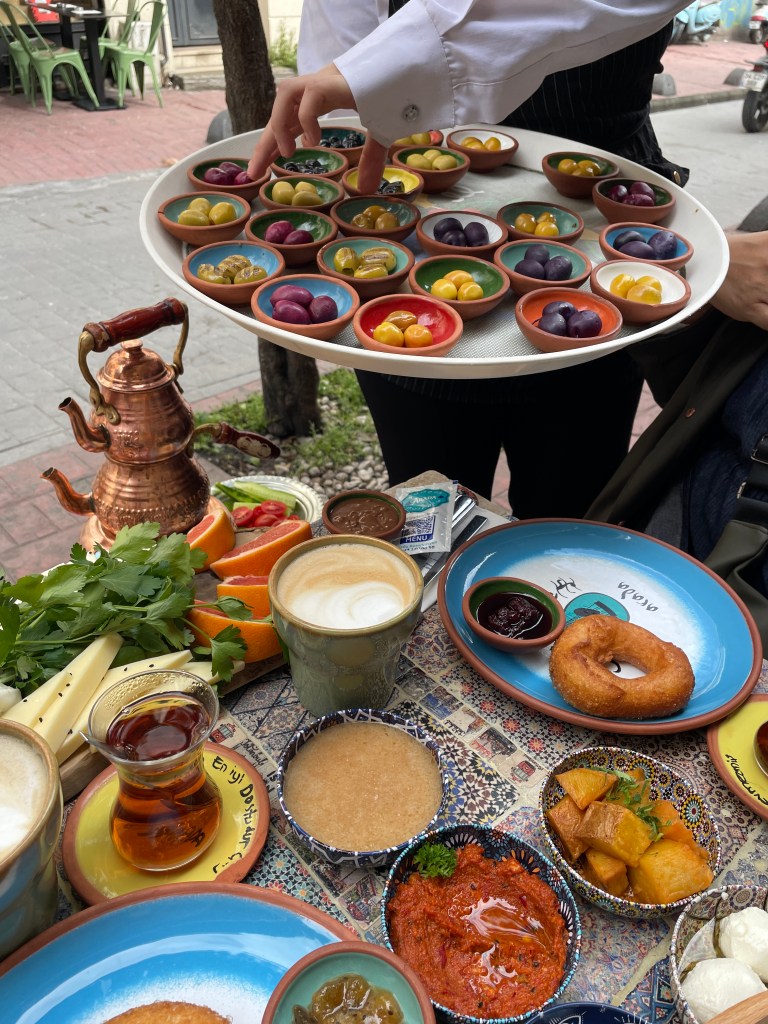
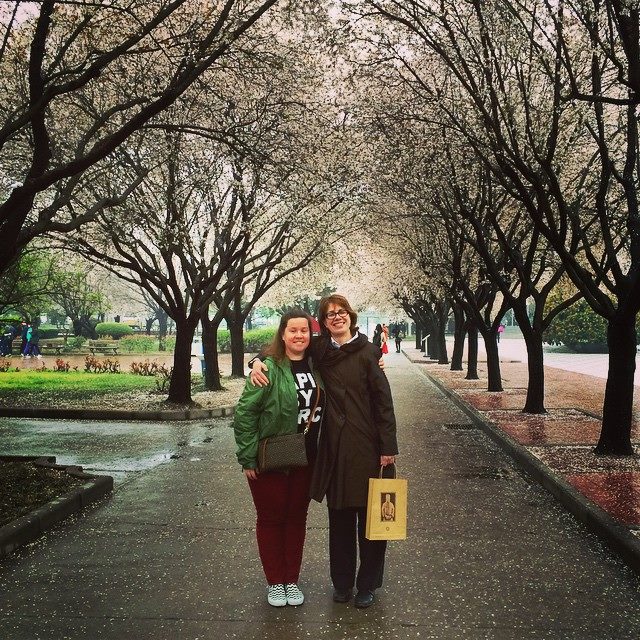
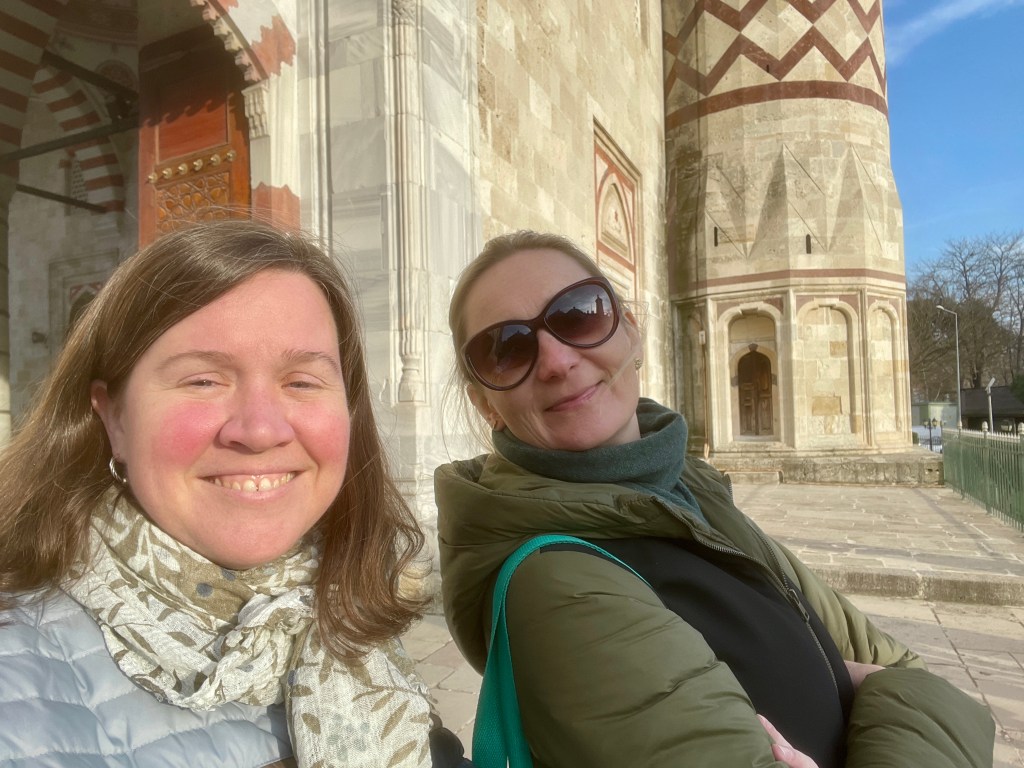
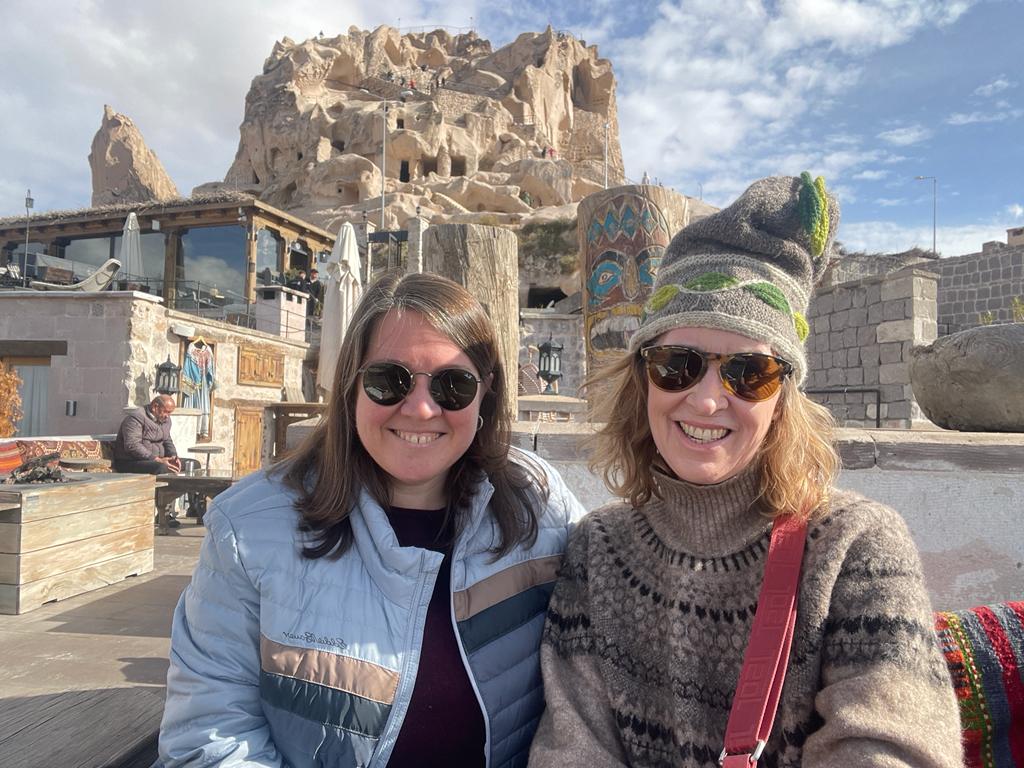
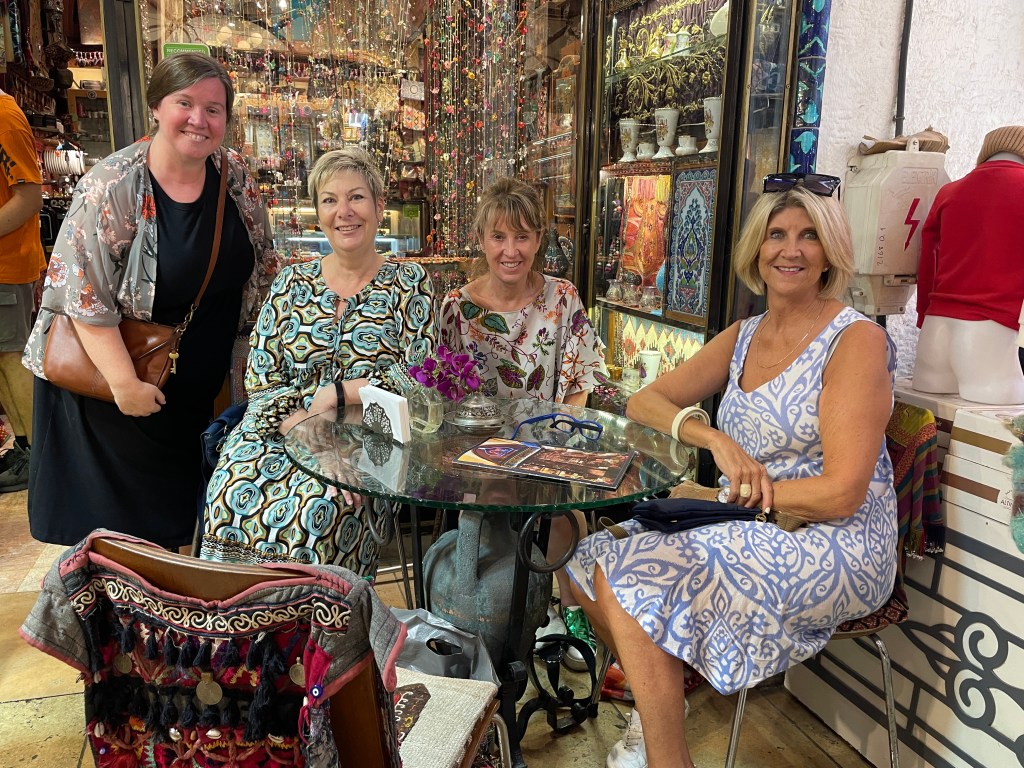
What will I remember? Delicious Turkish breakfasts, the trip to Edirne with Kasia, Indian food nights with Tracey and Zach, exploring Cappadocia with Michele. My beautiful friends who opened their lives and their homes to me in this country that they love so dear. I will miss them terribly.
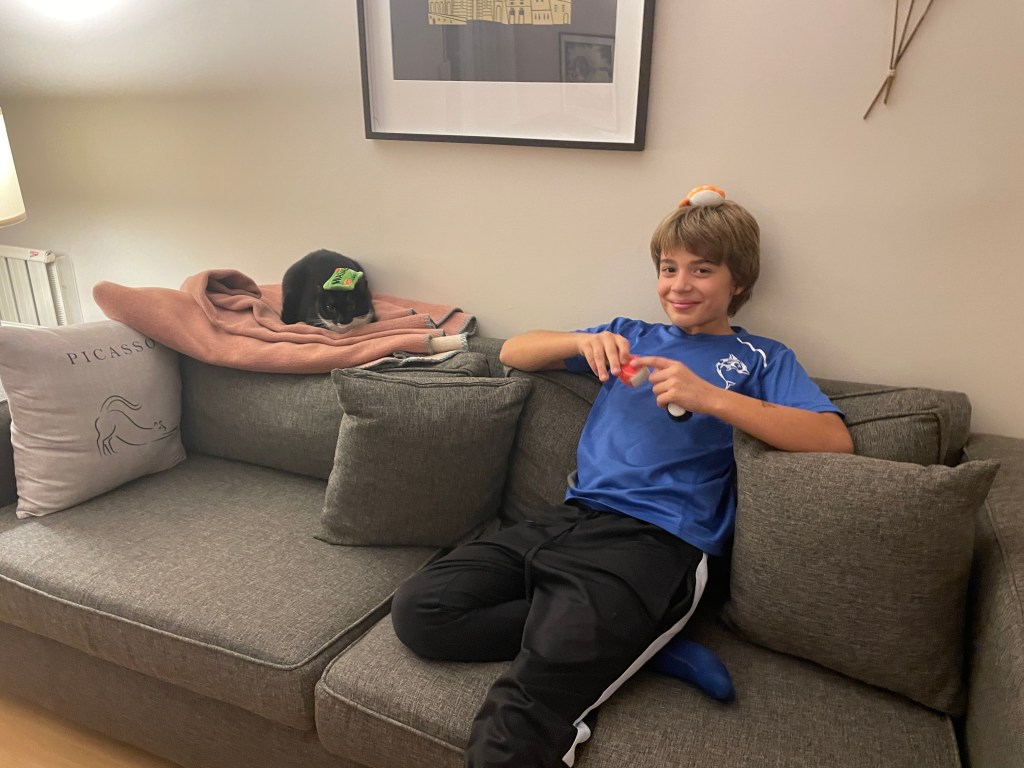
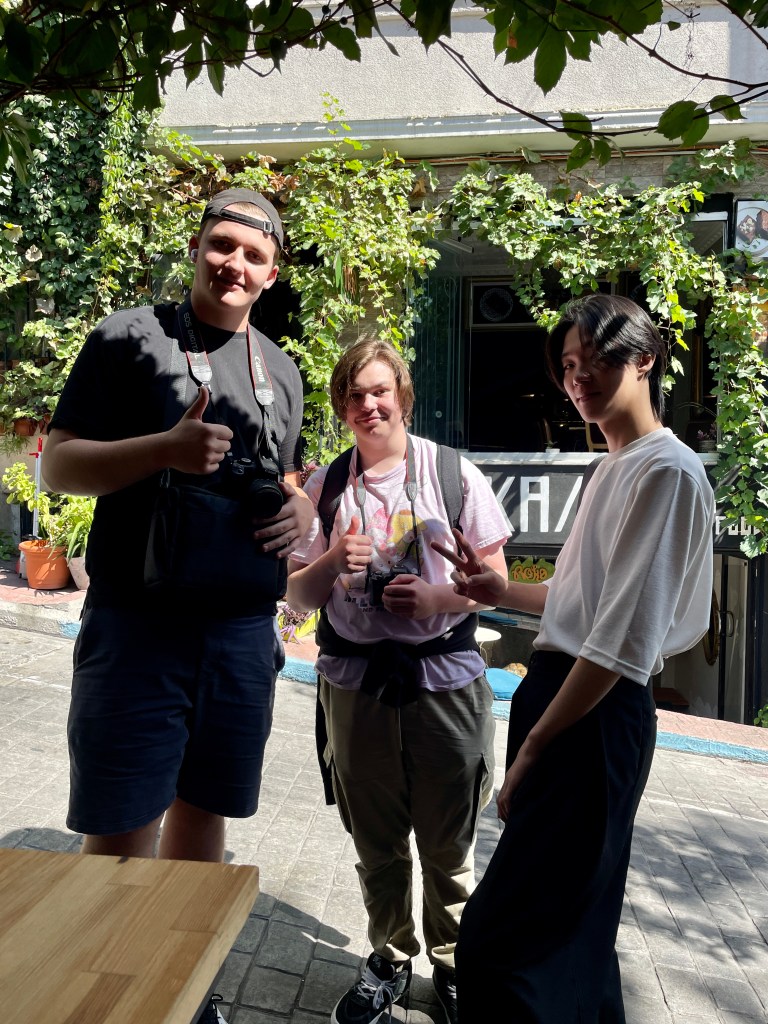
Zach and Mol, best buds
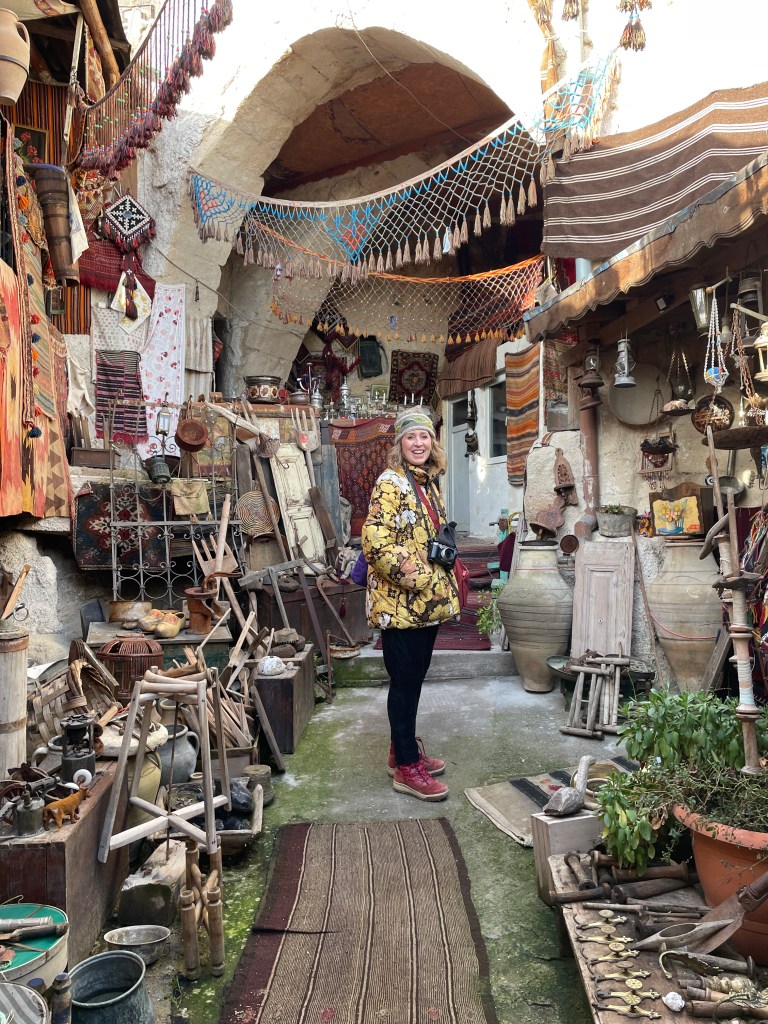
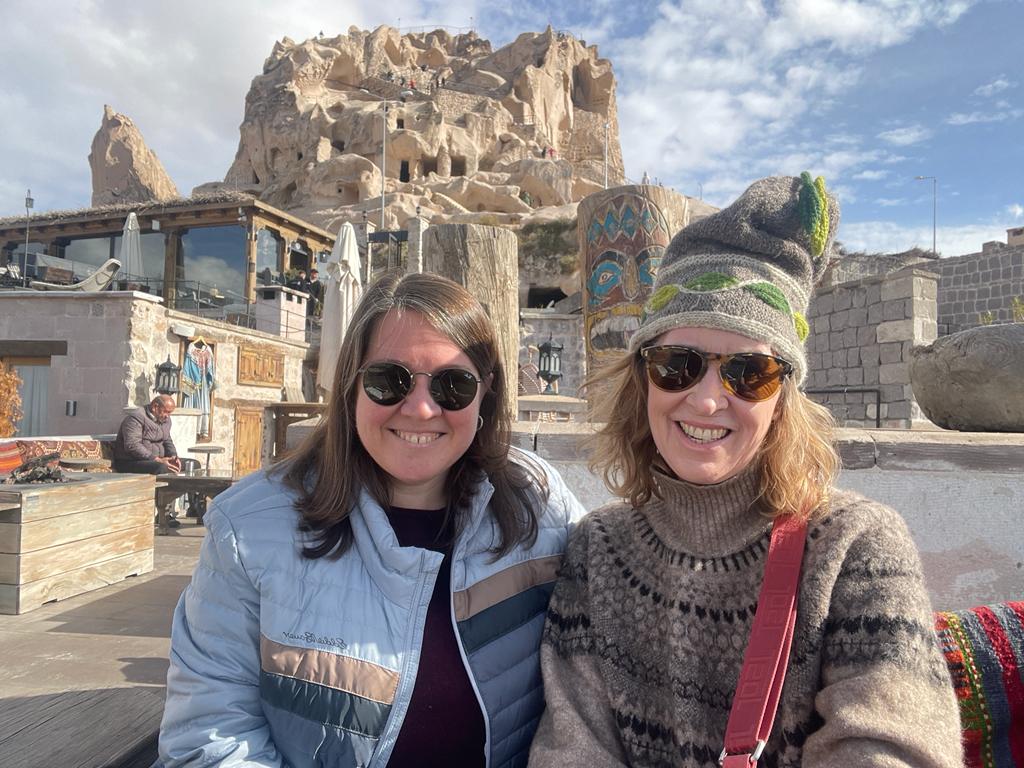
Cappadocia with Michele – January 2024

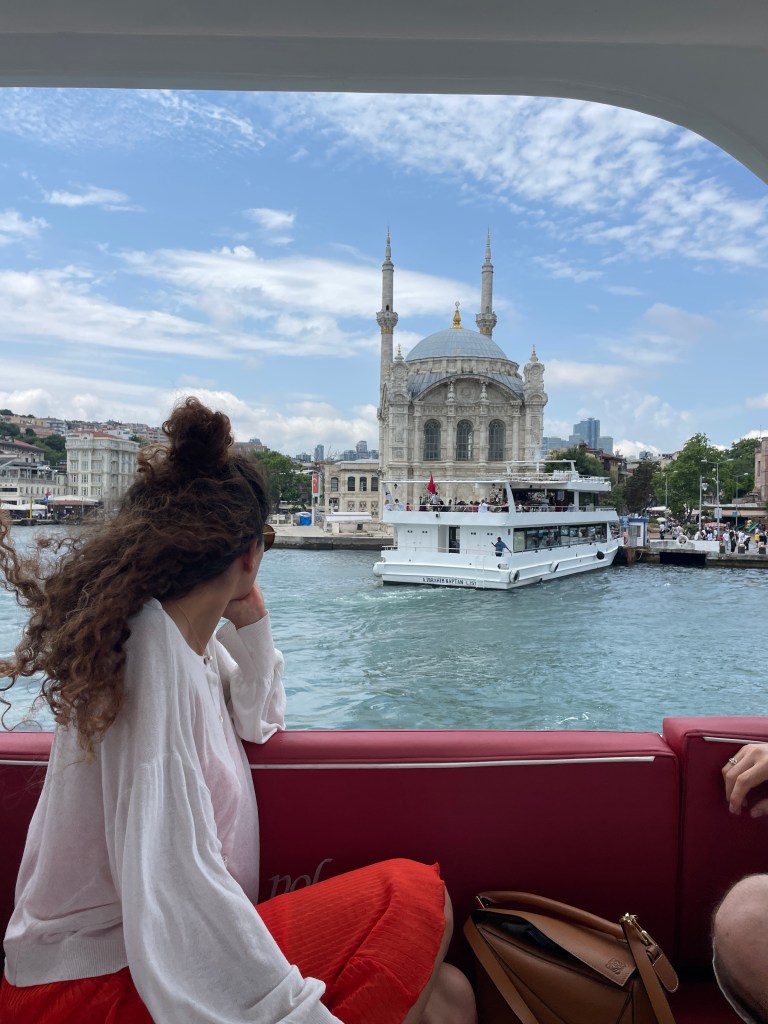
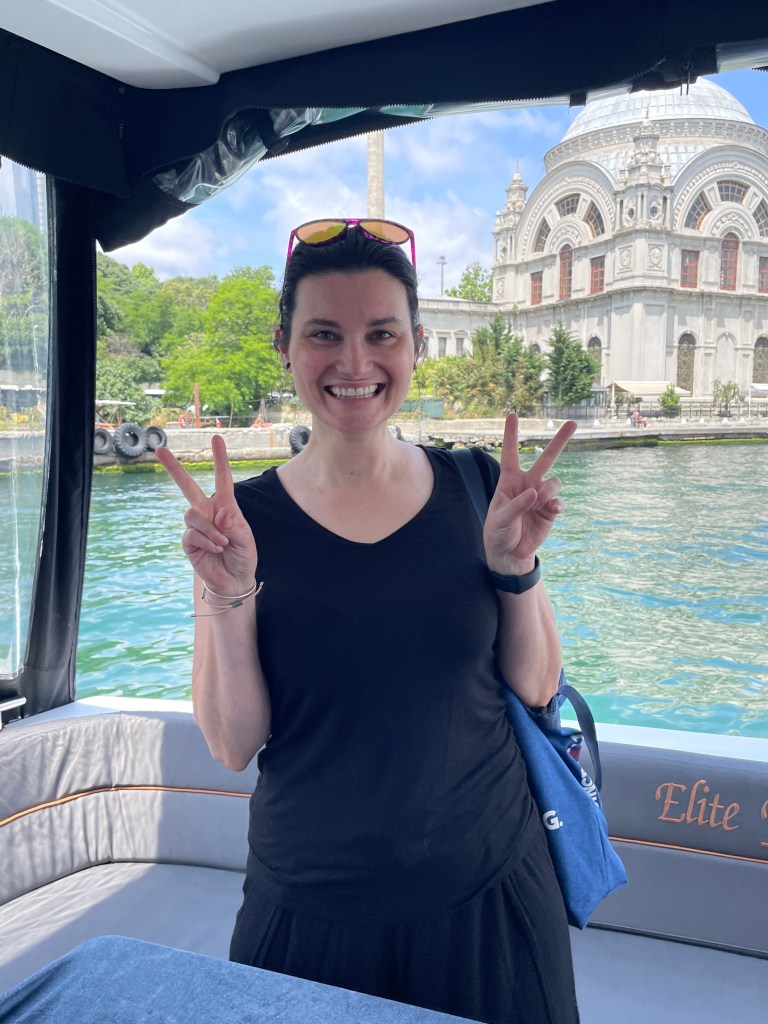
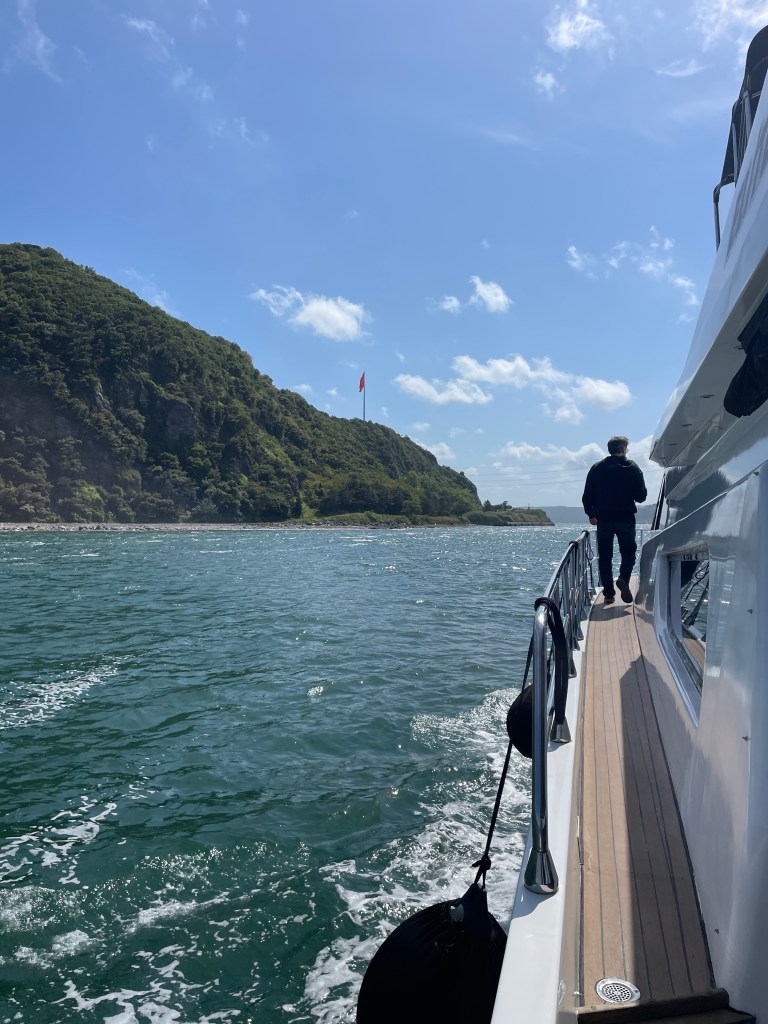
Boat trips on the Bosphorus, First Fridays at Bira with the B-town crew, and visits to so many gorgeous mosques.
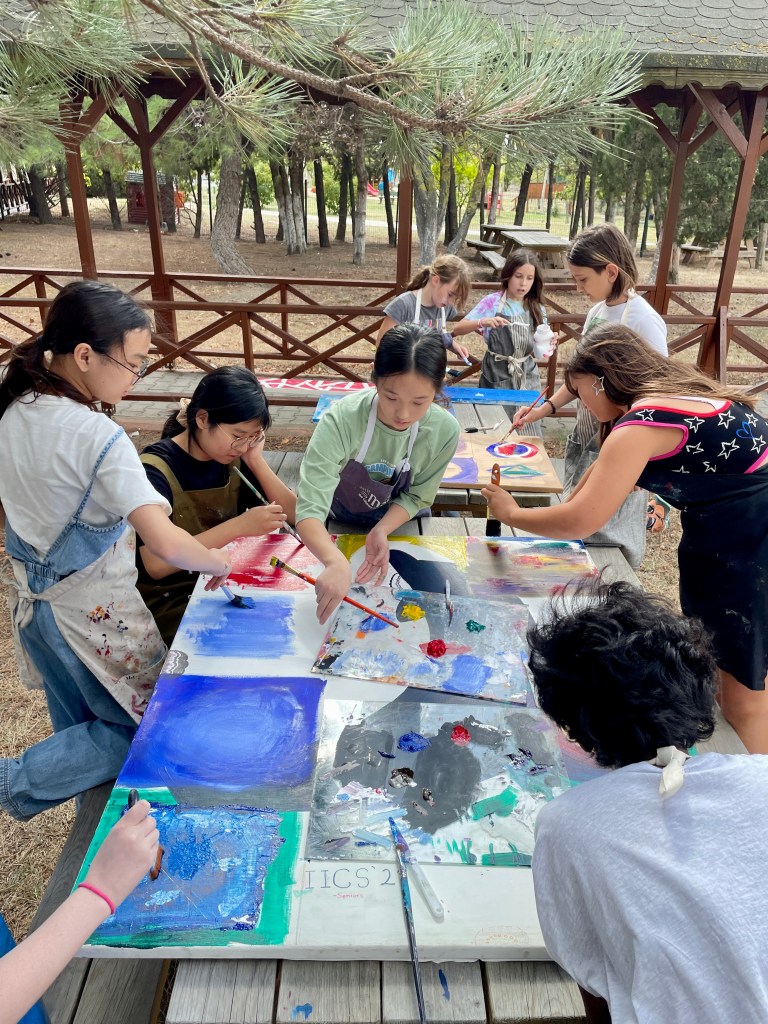
My beautiful students, especially my dedicated little Art Club. We had a wonderful time.
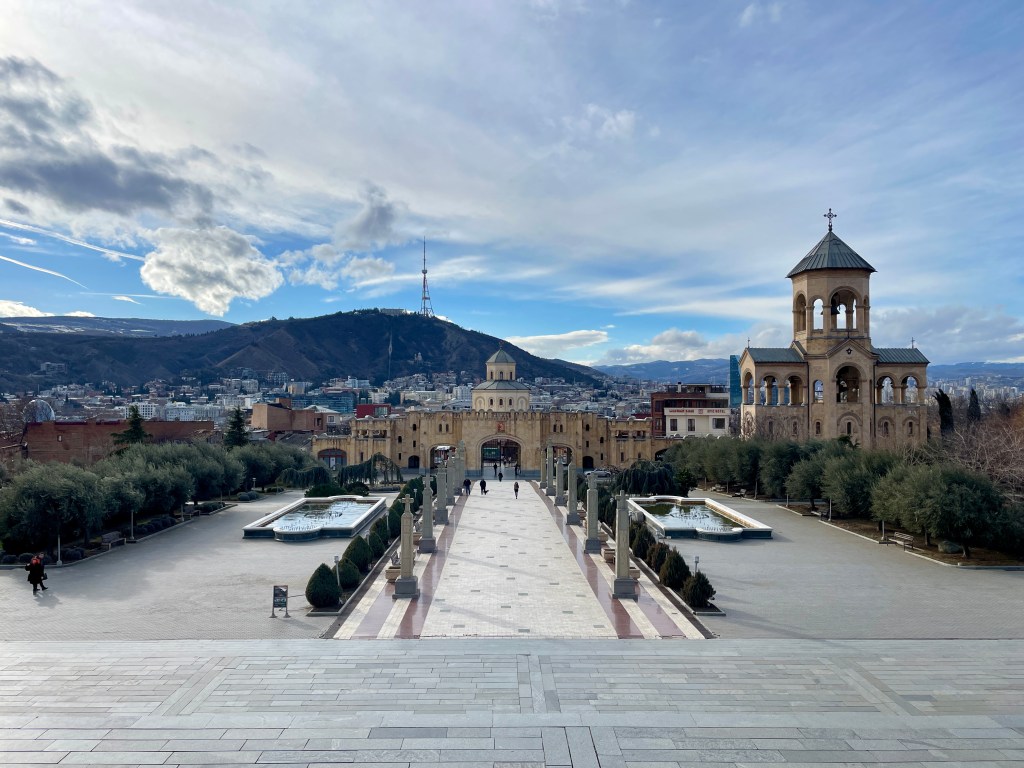
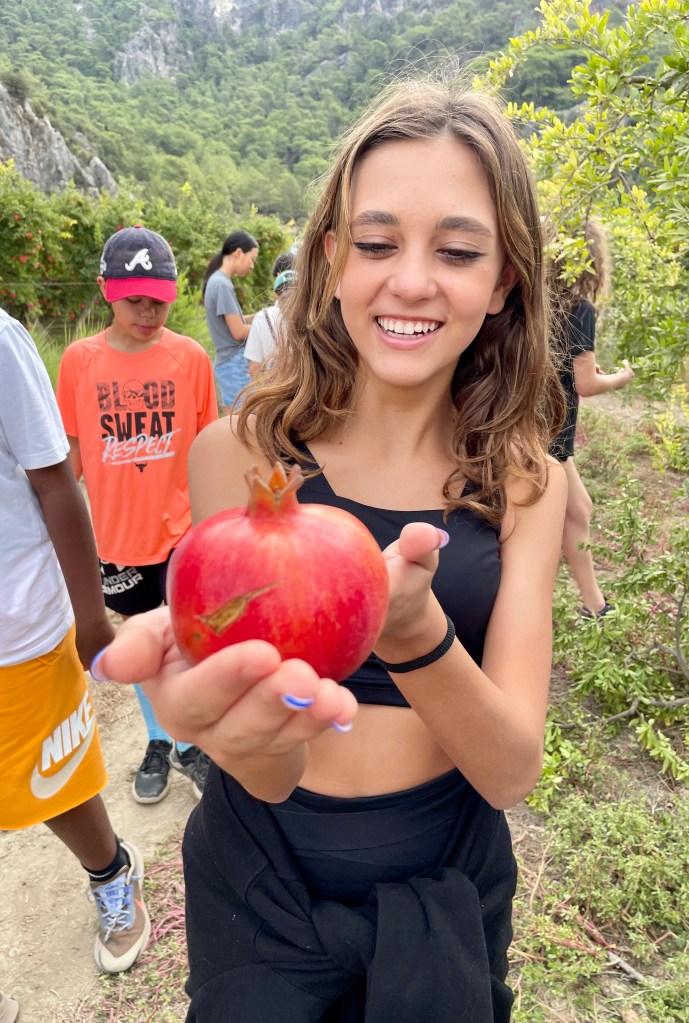
The trip to Dalyan with my students, visits from loved ones, and adventures to places like Georgia and Florence.
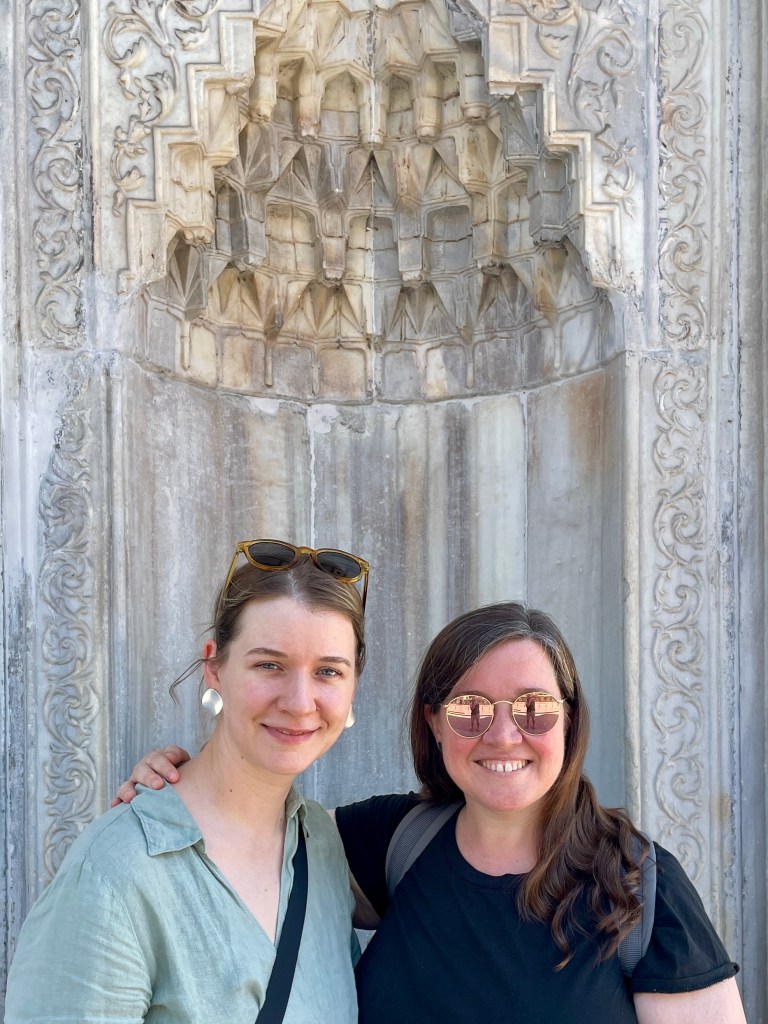
Isabel Allende writes, “there is no definitive separation as long as there is memory.” I am thankful to be leaving with wonderful memories, many of them shared with beautiful friends and some of them held close just for me.
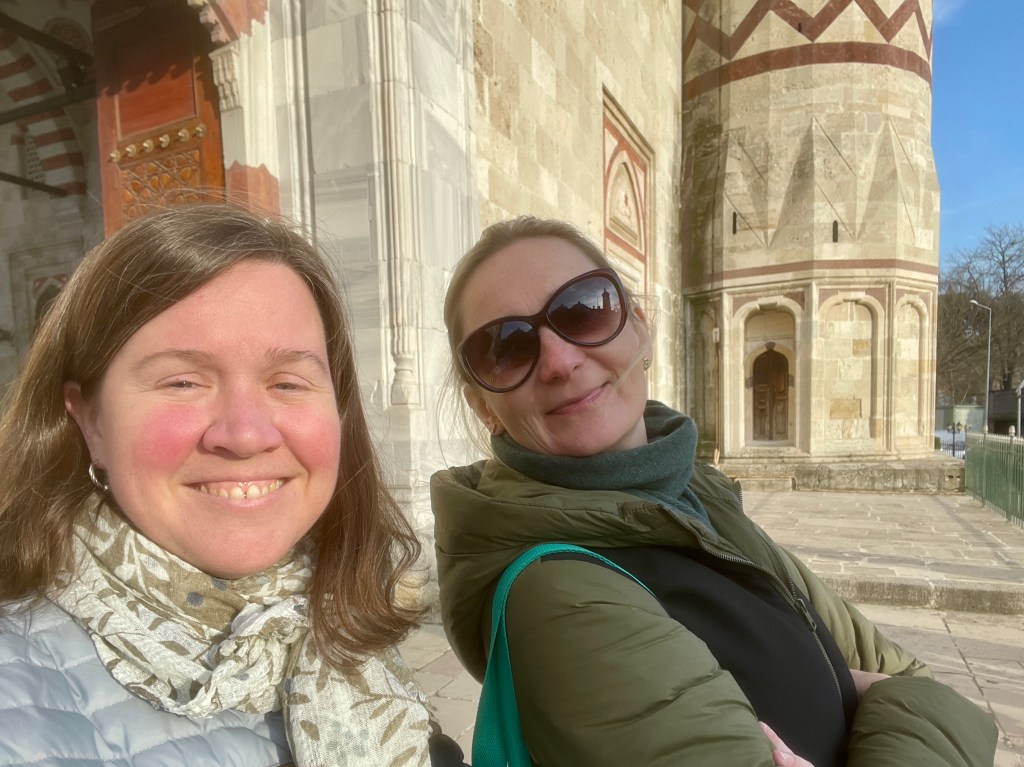
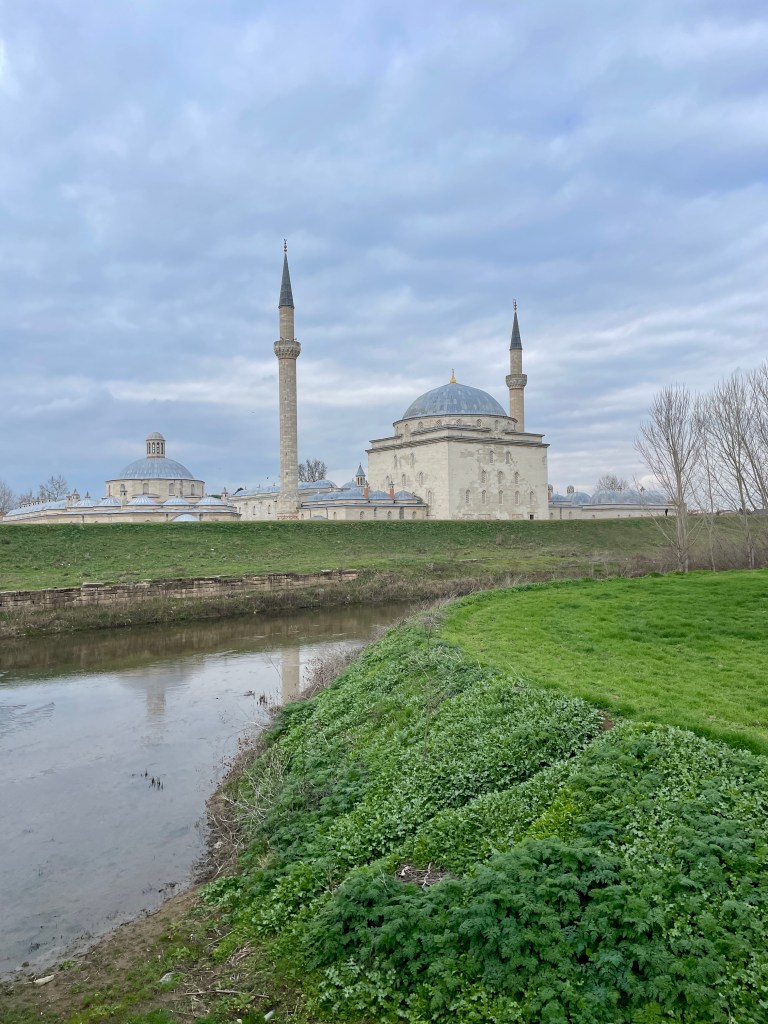
Kasia and I on our camii tour of Edirne

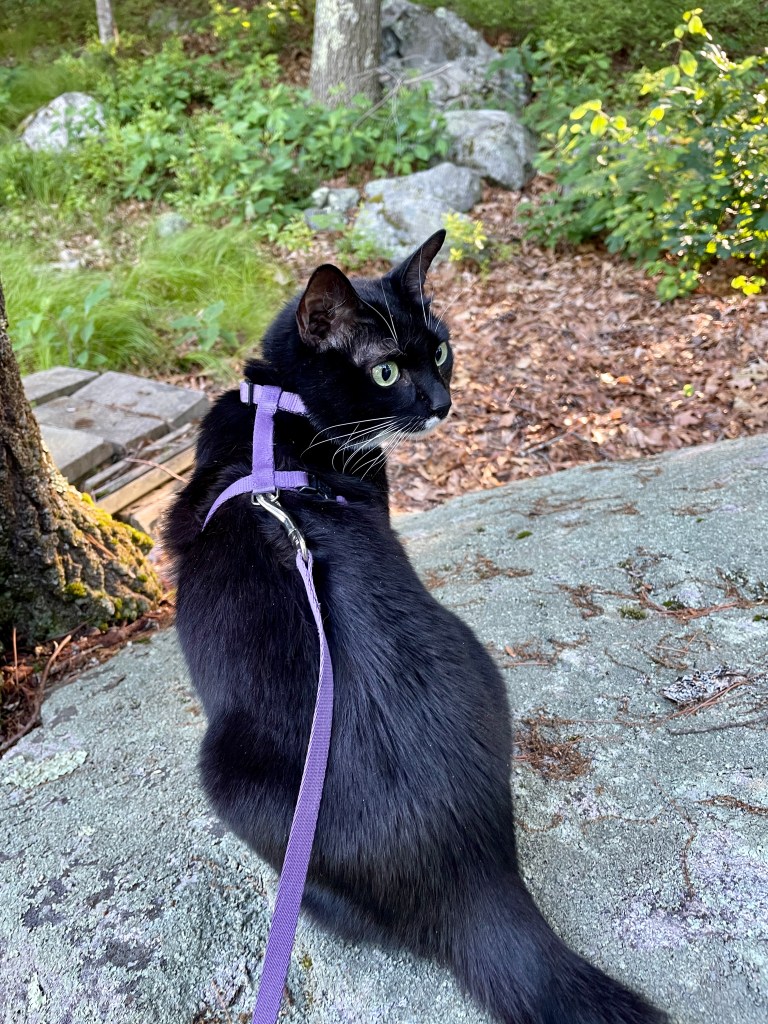
As for now, my sojourn in the US this summer has begun in earnest. Moloko made it out of Turkey thanks to my amazing friends Deniz and Nilufer. In reflecting, her safety and mine are the only thing that really matters. Everything else is just material items, drama, and details.
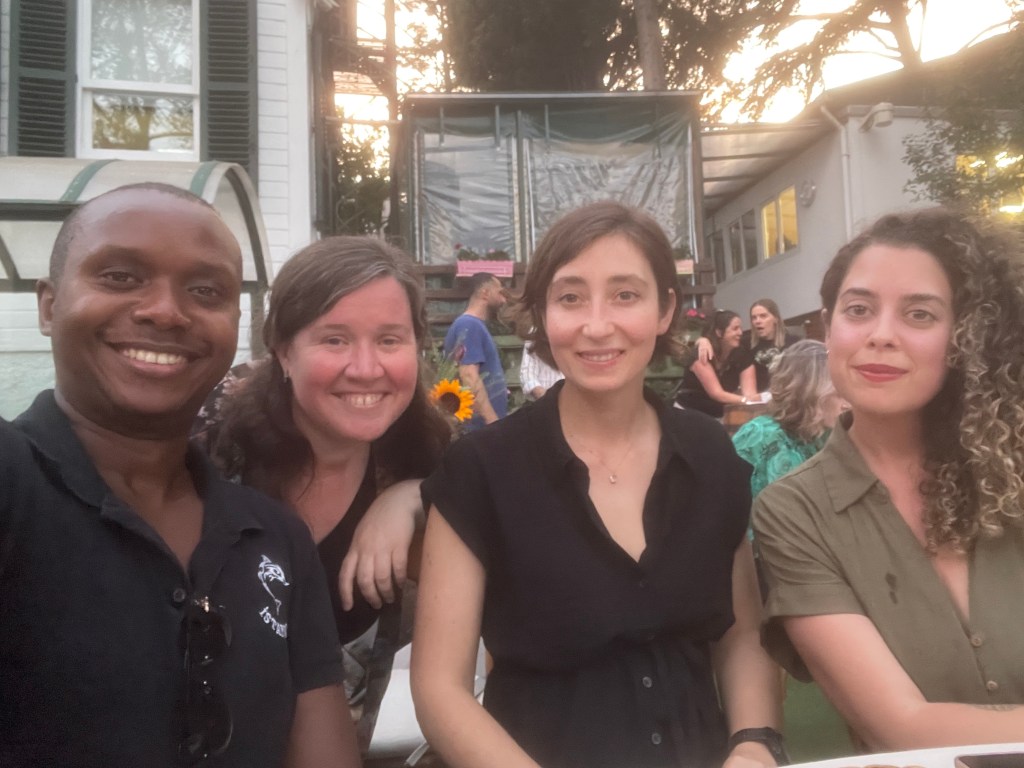
Evans, Nilufer, Deniz, and I at the Staff Farewell Party

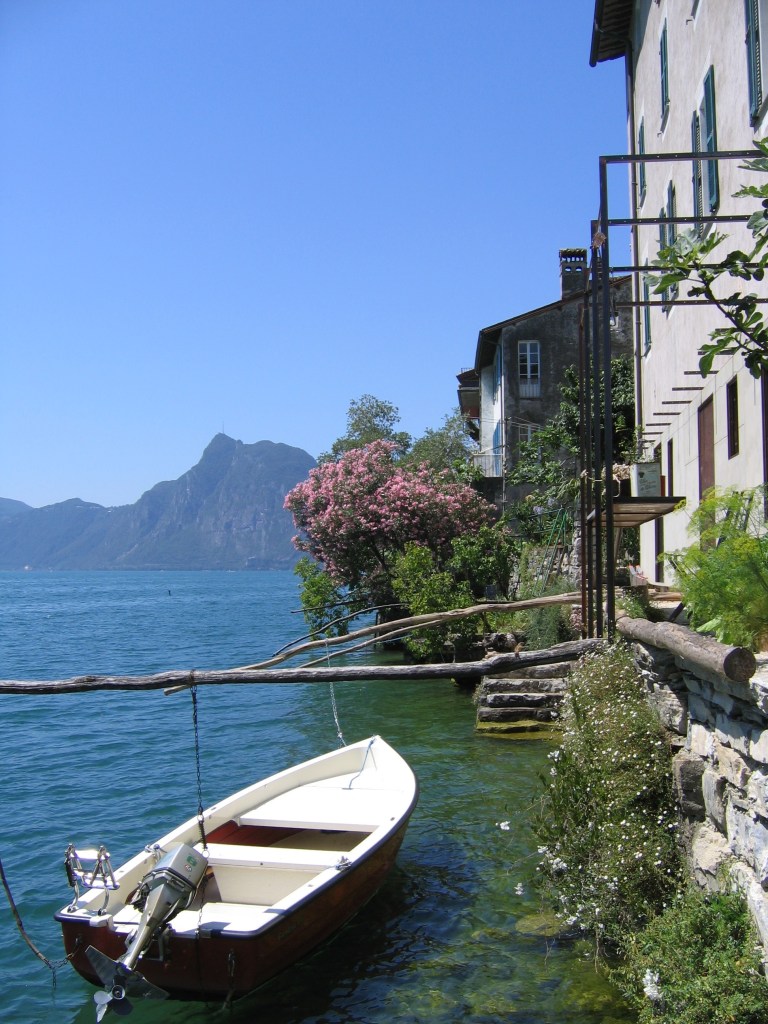
I’ve come to learn that I need to live in society which outlines its expectations more clearly. My time in Switzerland will bring many rules, some wacky (no toilet flushing after 9pm) and some useful (clear steps for visa applications). I look forward to sharing my journey in Lugano with you, starting in August.

I’m off to France to teach painting for most of July. I’ll return for family time down the Cape in August. I feel so blessed to lead this existence and I hope many us cross paths over the next few months. The time has come to put my adventure in Turkey to rest. İyi akşamlar hocam. Goodbye, teacher.
Bursa + İznik

Traveling around Turkiye is simply the best. This country is set up to be hospitable to travelers thanks to unique regional culture, easy smiles from the locals, and affordable transportation. I chose Bursa and İznik as destinations for the travel planned for my aunt and I. Both spots are former capitals of the Ottoman state and easily reachable within a few hours from Istanbul via bus.

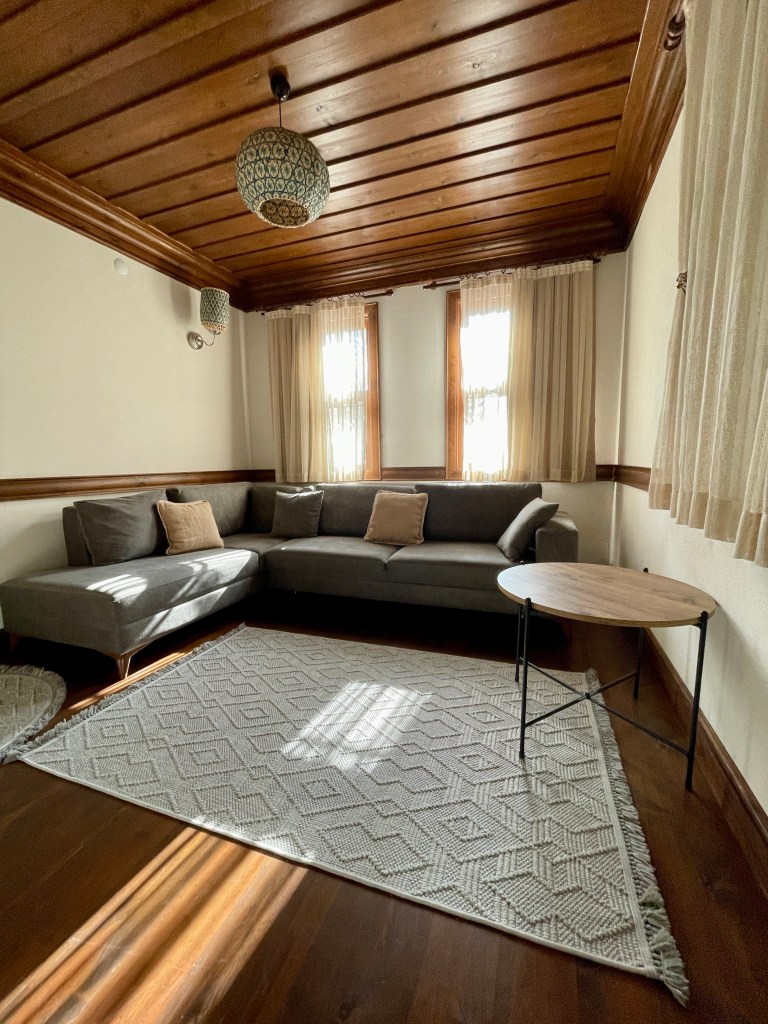
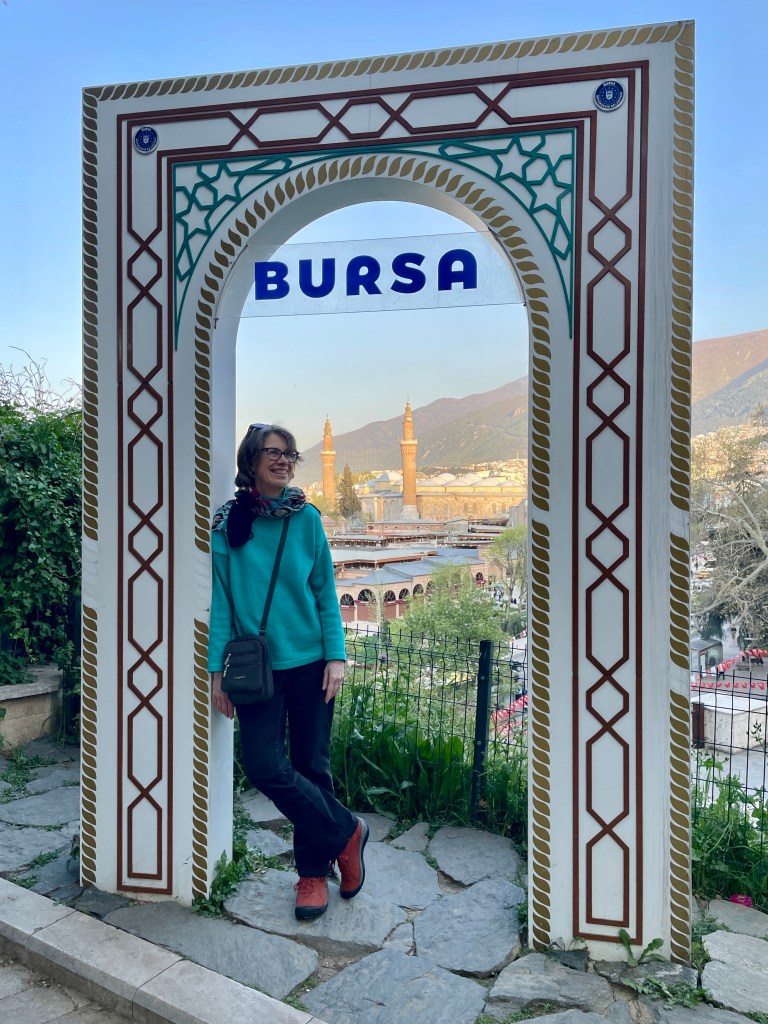
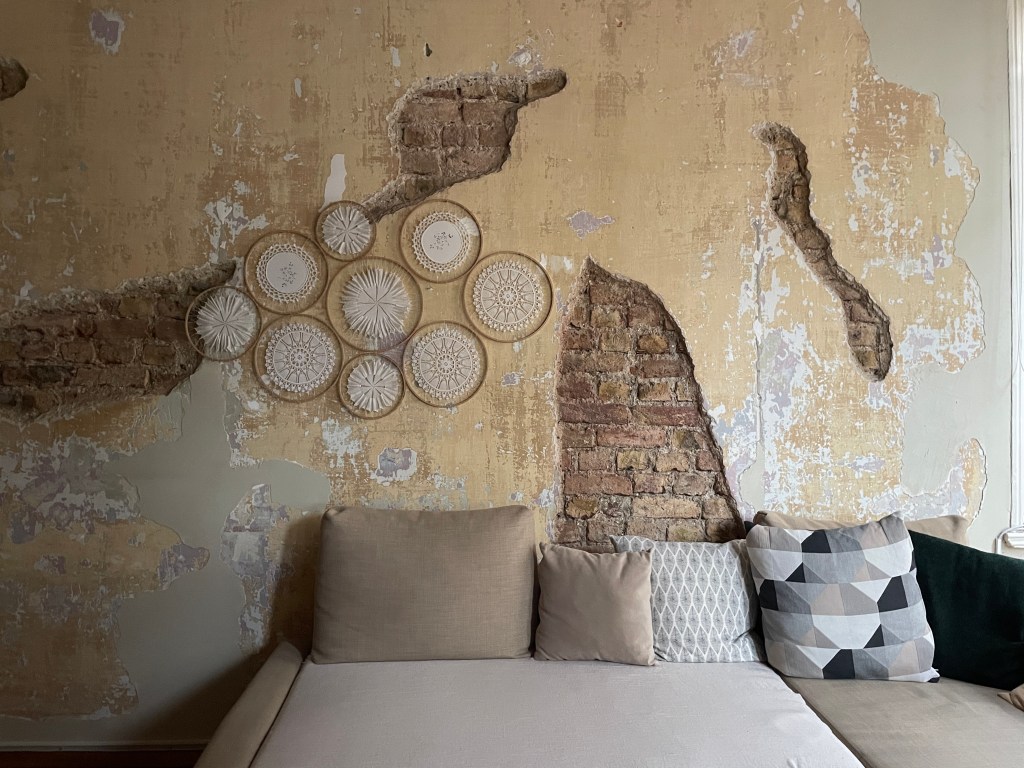
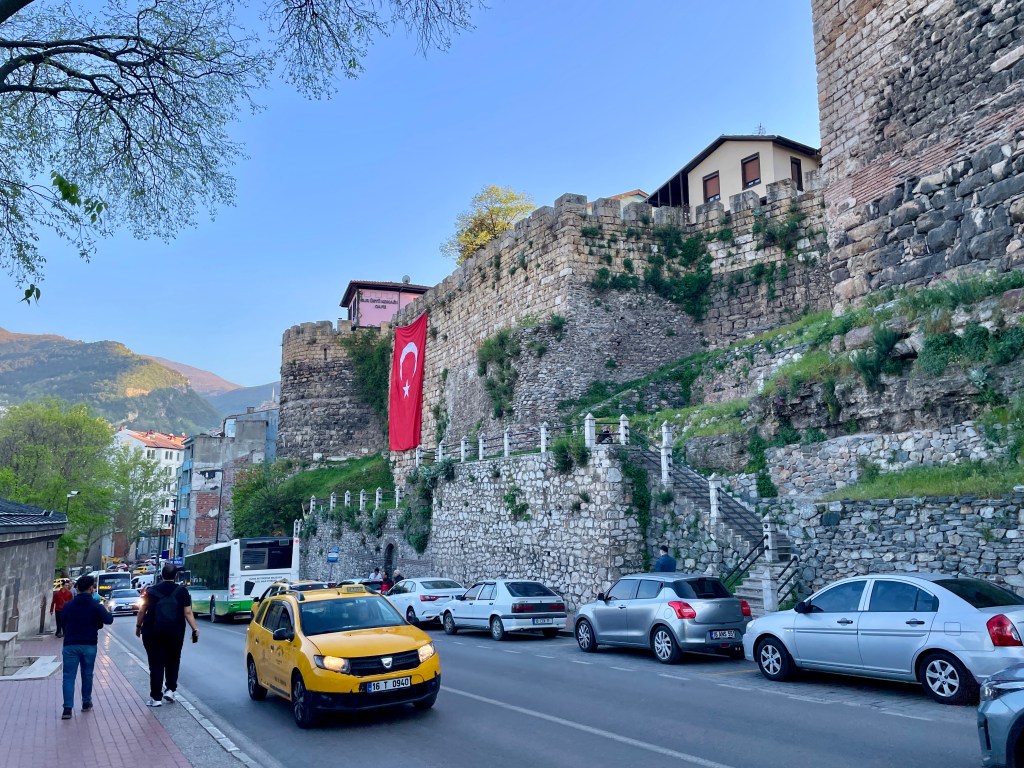
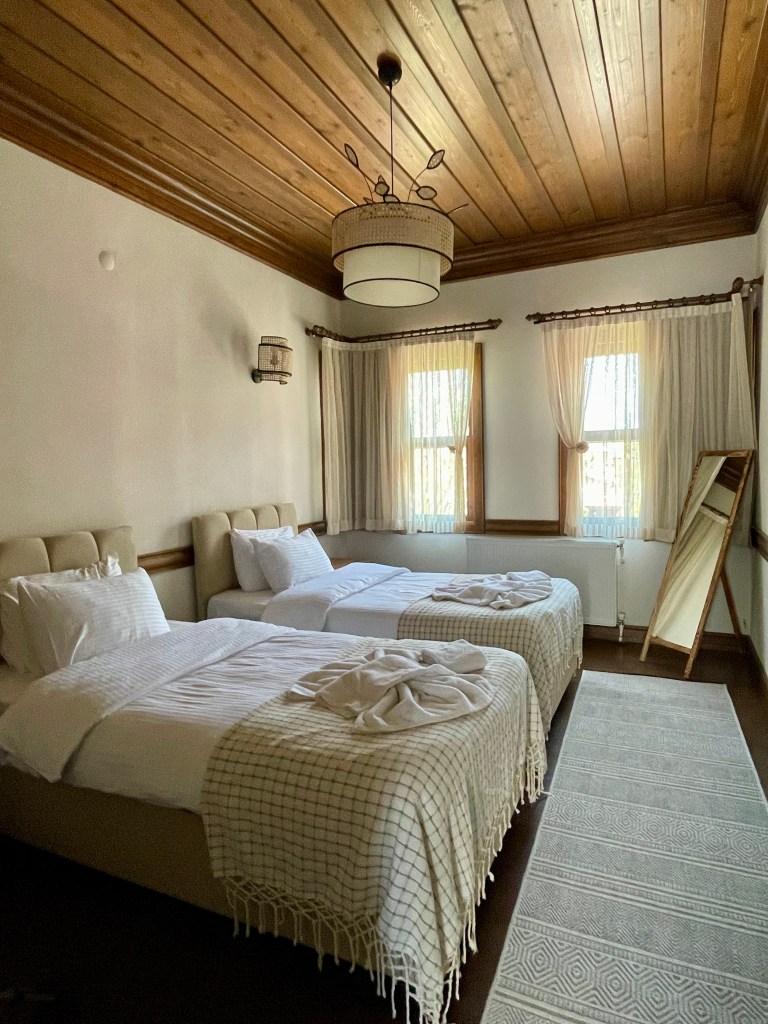
Bursa was up first, the fourth largest city in Turkiye. Known originally for its textiles of silk and lace, Bursa is today the center of the Turkish automobile manufacturing industry. Mountains hug the city to the southeast and green space can be found throughout the city. Incredibly, human settlement has been present in the region since 5200BC. Wishing to stay within Bursa’s historic center, I located an Airbnb in a restored Ottoman home. The property sat on the hillside just above the historic Ottoman city walls.

Our spacious abode turned out to be a stroke of luck. As we were in town on the first day of bayram (Eid), most Turks were at home celebrating the holiday with family. It’s always difficult to tell what will be closed and what will be open on holidays in Turkey.

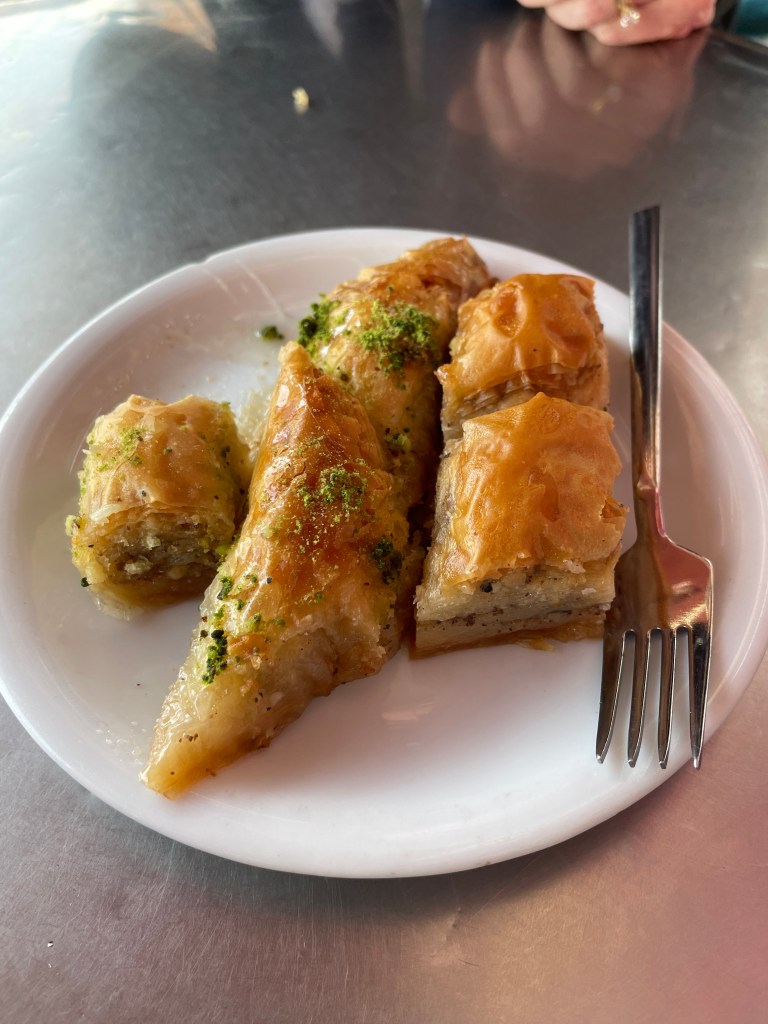
Hearing lots of foot traffic outside our home, we ventured out midday to see what the locals and tourists were up to. We sampled some baklava at a local cafe – it was the “sugar” eid, after all – and confirmed that the marketplace and historic sights were closed for the holiday.

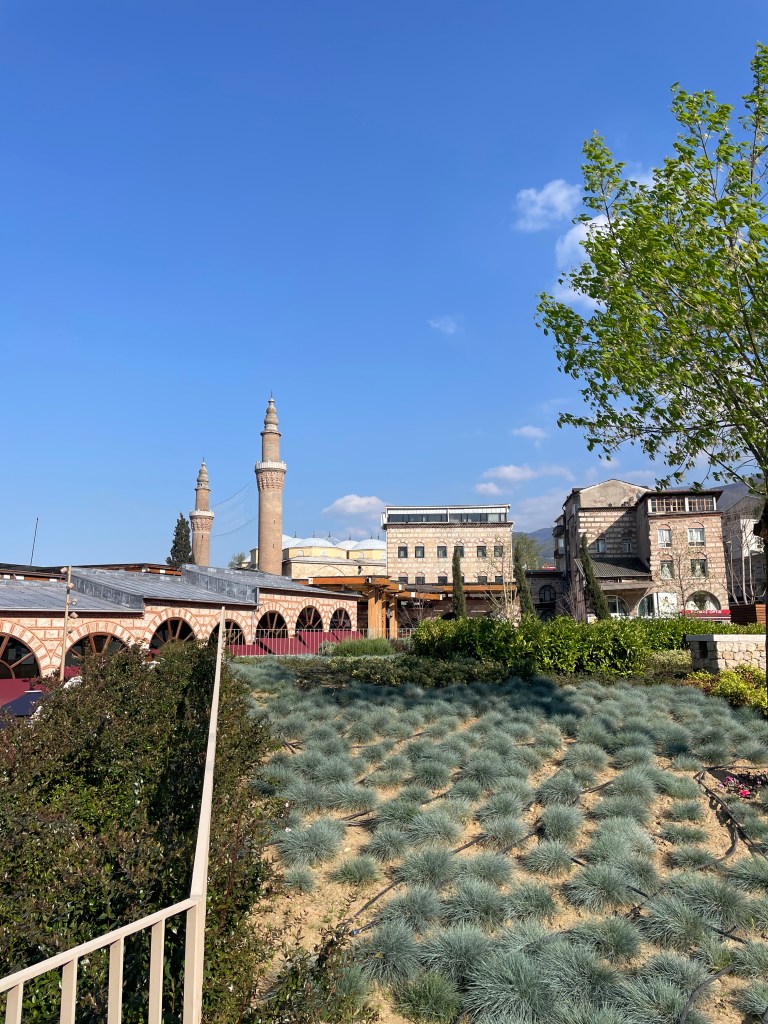
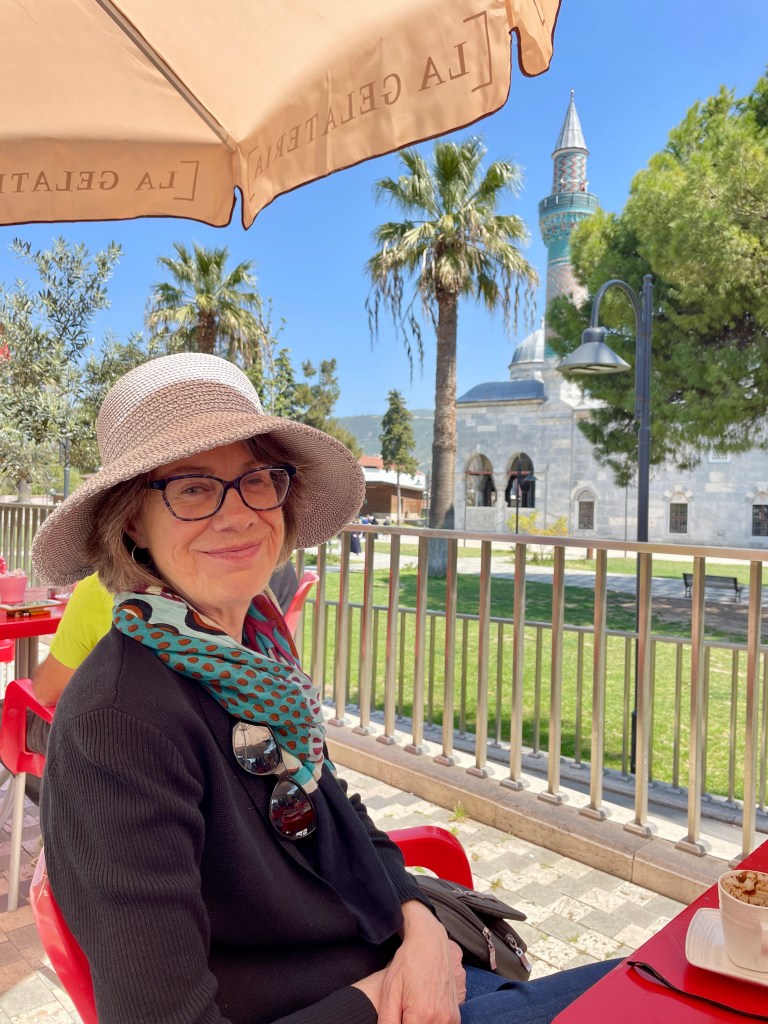
Luckily, we had ventured out the night before to see the open air market, the Grand Bazaar, and the Ulu Cami (Grand Mosque of Bursa). Here is Suz enjoying her Instagram moment with the foothills of Uludag in the distance.

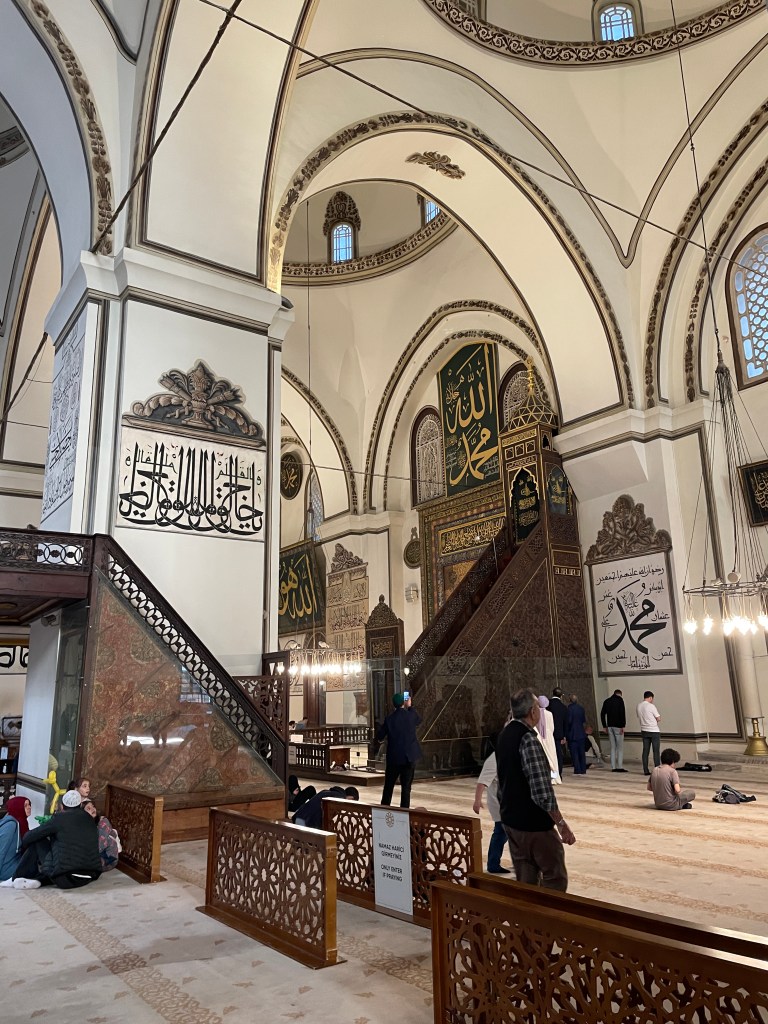
The Ulu Cami was built in the historic Ottoman Era but reads very contemporary. Reminiscient of the Eski Cami in Edirne, the walls featured calligraphic graffiti inside of the mosque (above, left). The effect was stunning. Children hollered at they raced around the carpeted floors and people sat in groups talking softly. I enjoyed Bursa and would love to return someday, particularly to explore the mountains surrounding the city.

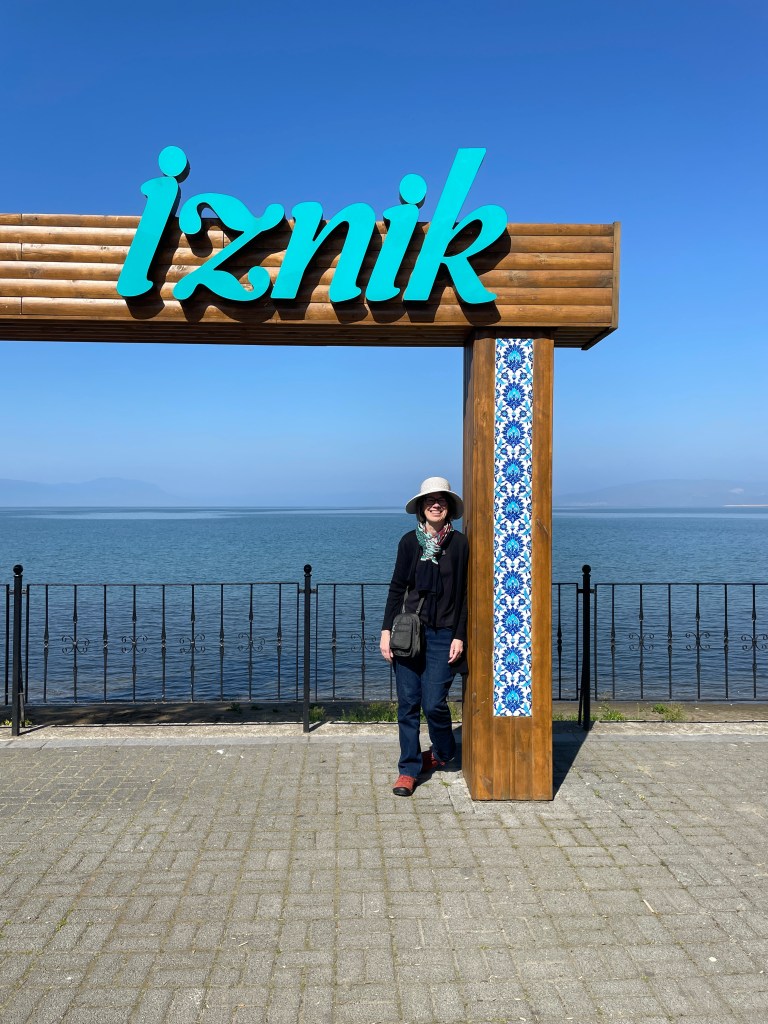
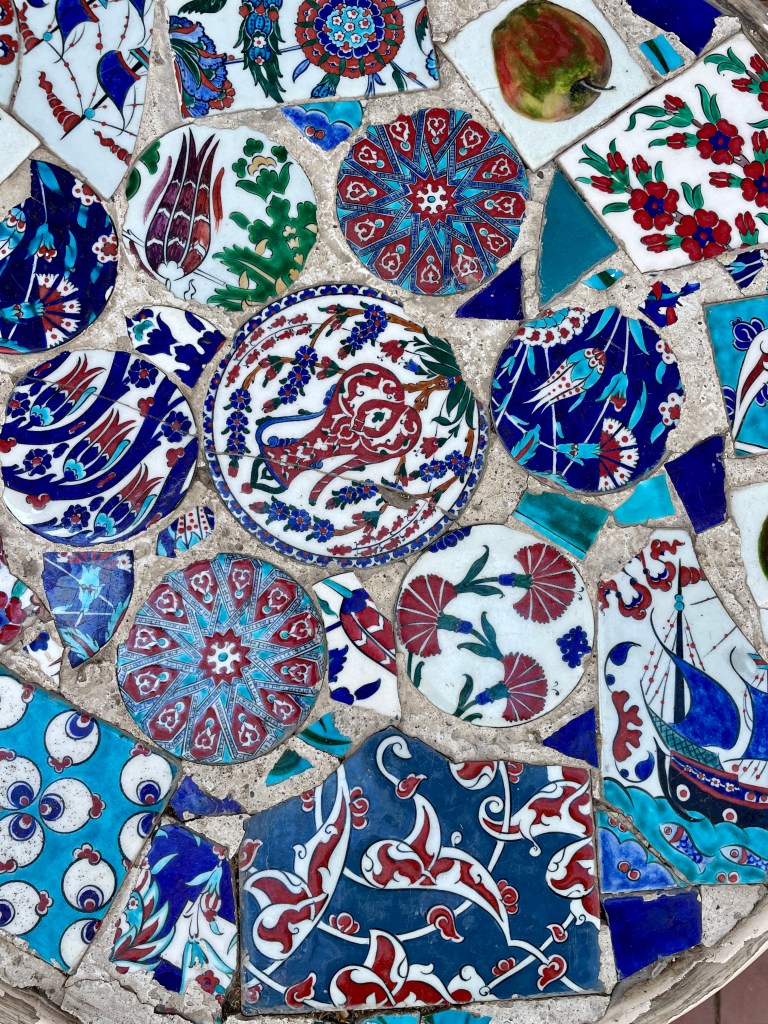
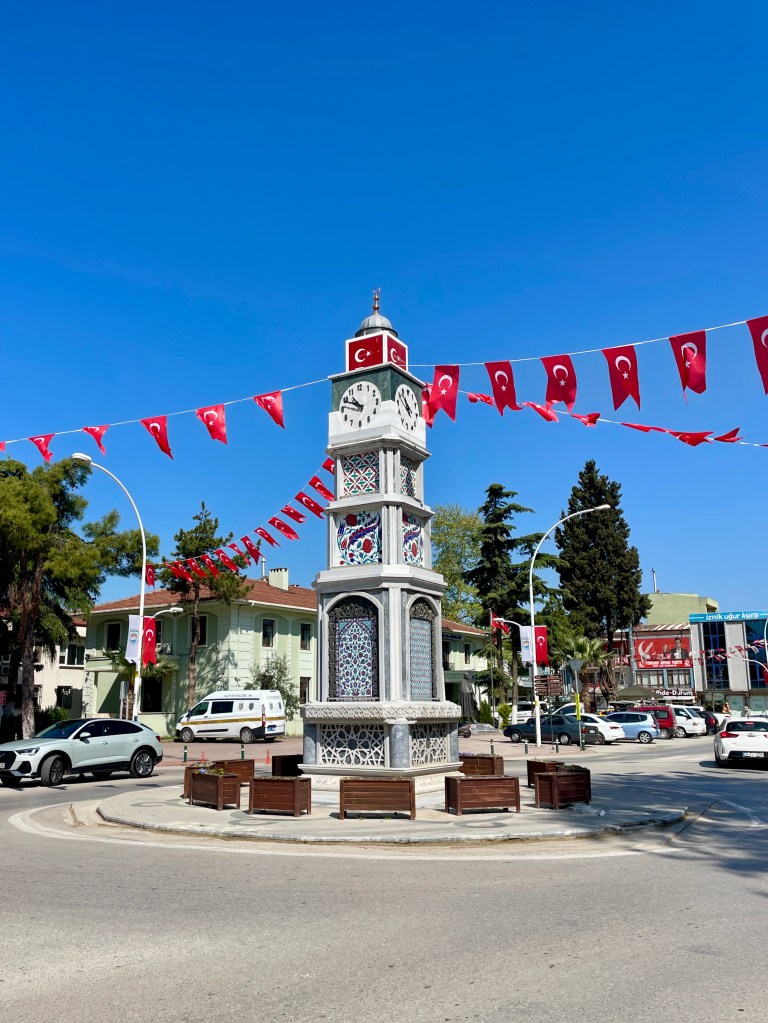
Our second stop was İznik. Once known as Nicaea, the town is known as birthplace of the Nicene Creed (325AD). The town has also long been considered to be the center of ceramics in Turkey. Known for producing the 20,000 ceramic tiles which adorn the ceiling of Istanbul’s Blue Mosque, İznik today draws tourists with its ceramic studios, mosques, and lakeside location. The vibe here is similar to that of coastal southwest Turkey with less alcohol on offer (taps seem to dry up as you move into the middle/eastern regions of the country).

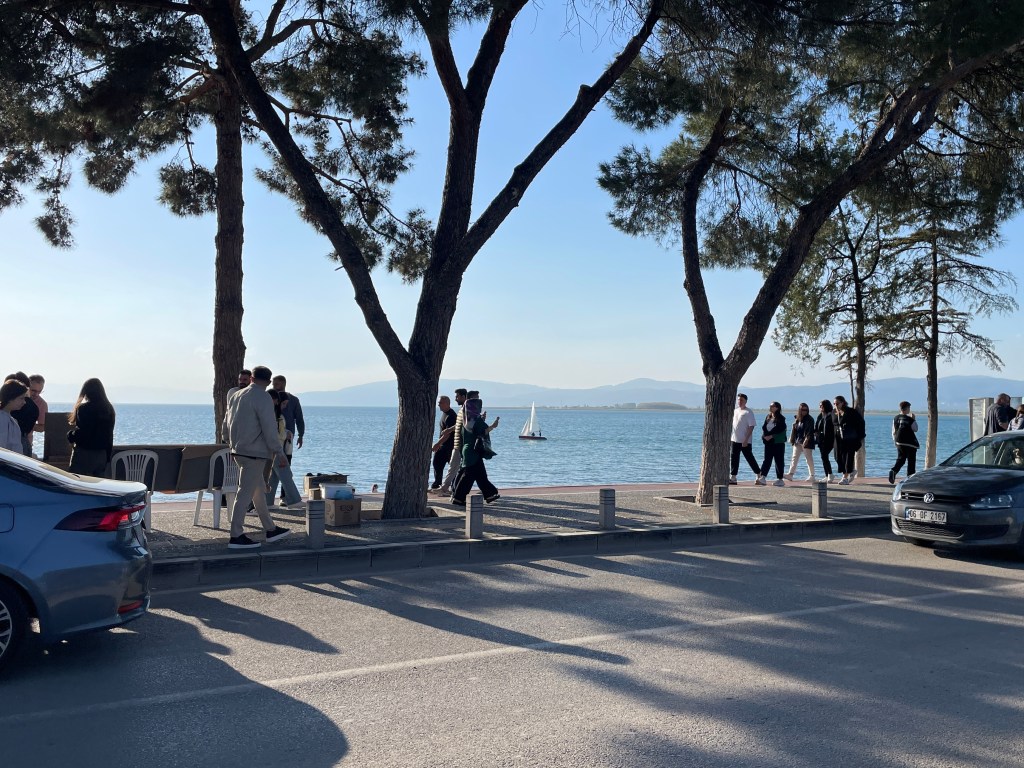
The whole town was walkable from our hotel by the waterfront. Having arrived from Bursa by Uber on the early side, the holiday mentality provided us the chance to look around before the crowds arrived.

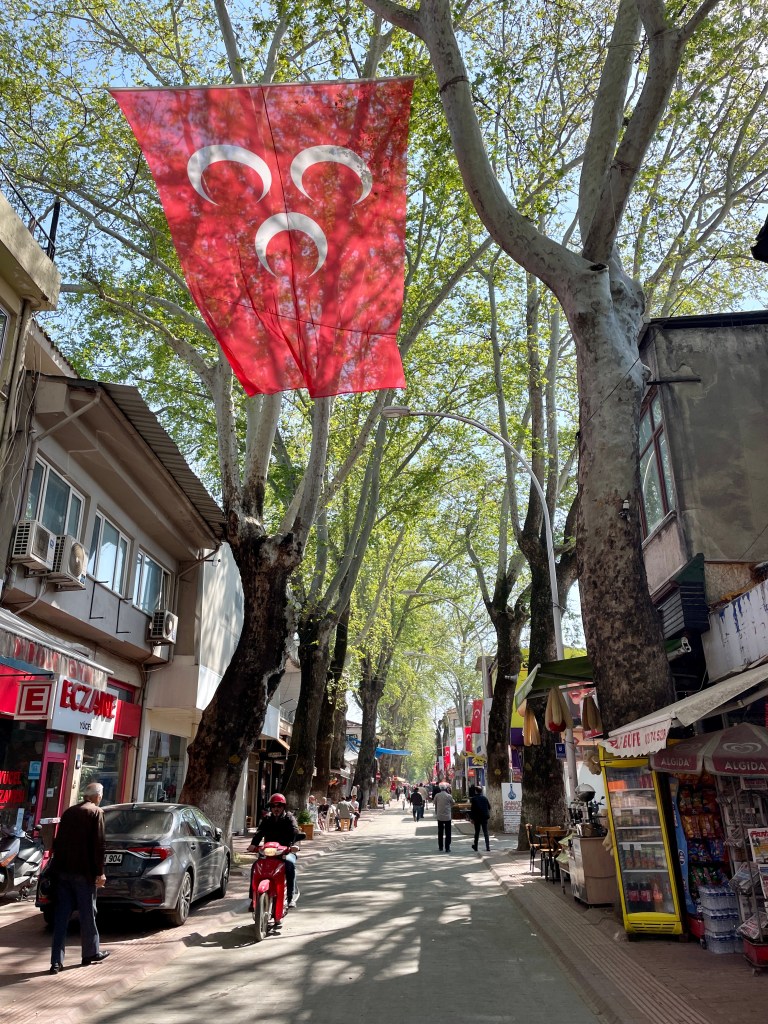
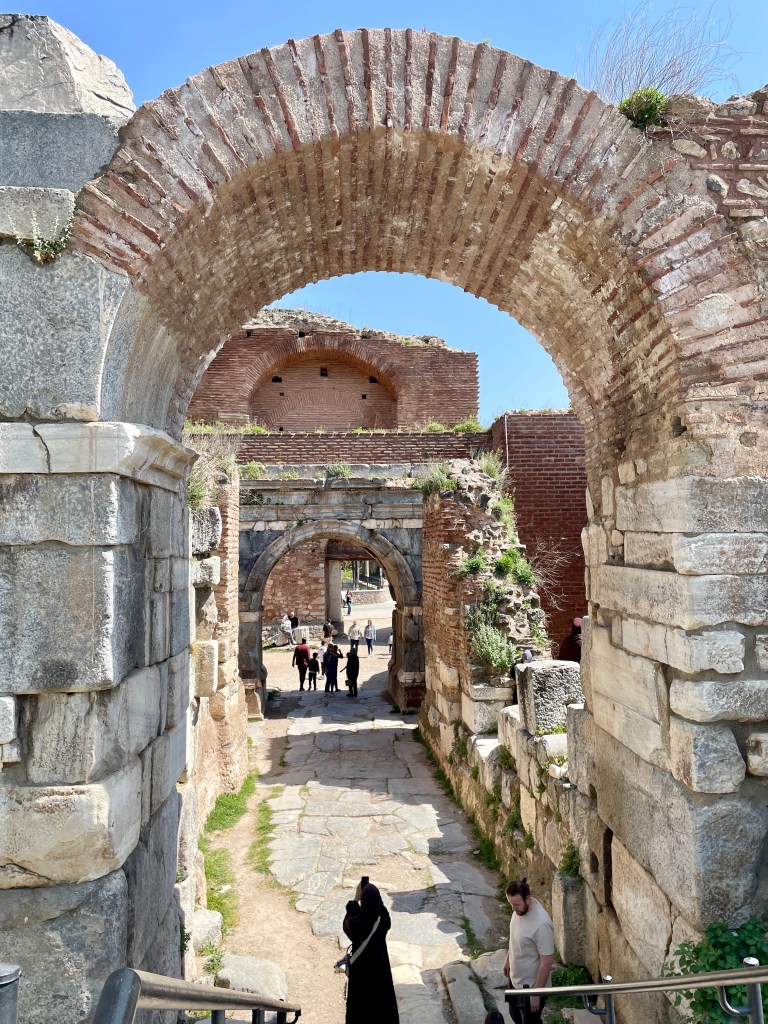
Most of the ceramic shops and studios fall along the main tree-lined street (above, left). The road caps off at the İznik Castle Walls (above, right). Many modest local homes are enmeshed within the fortress walls which ring the downtown.

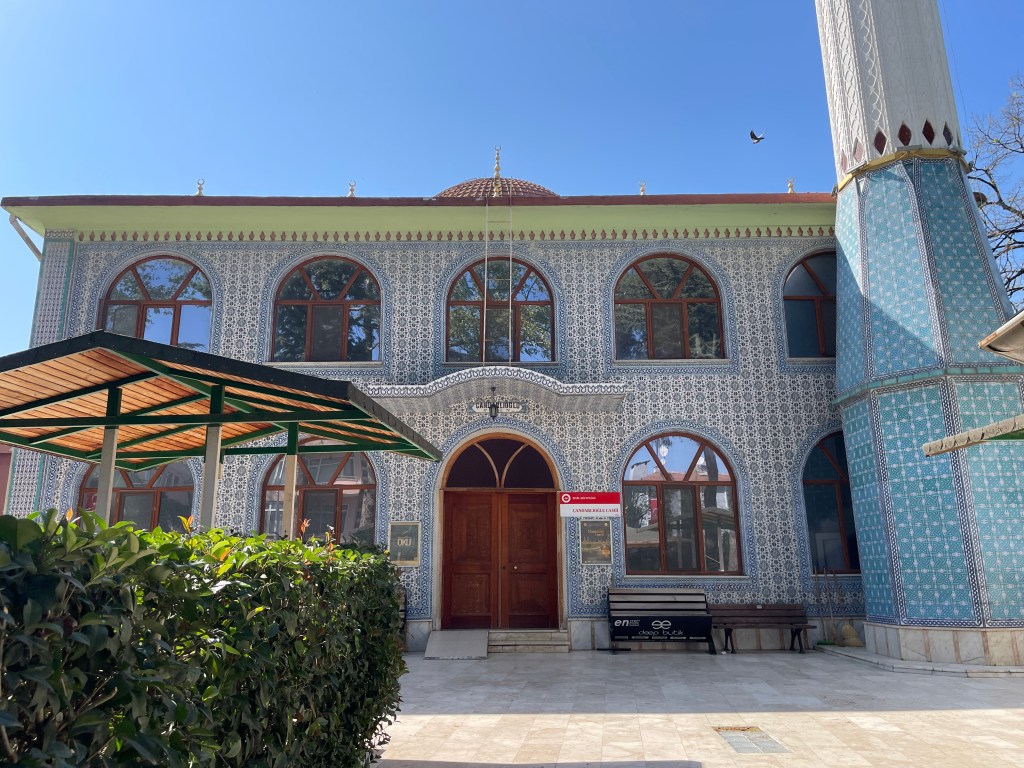
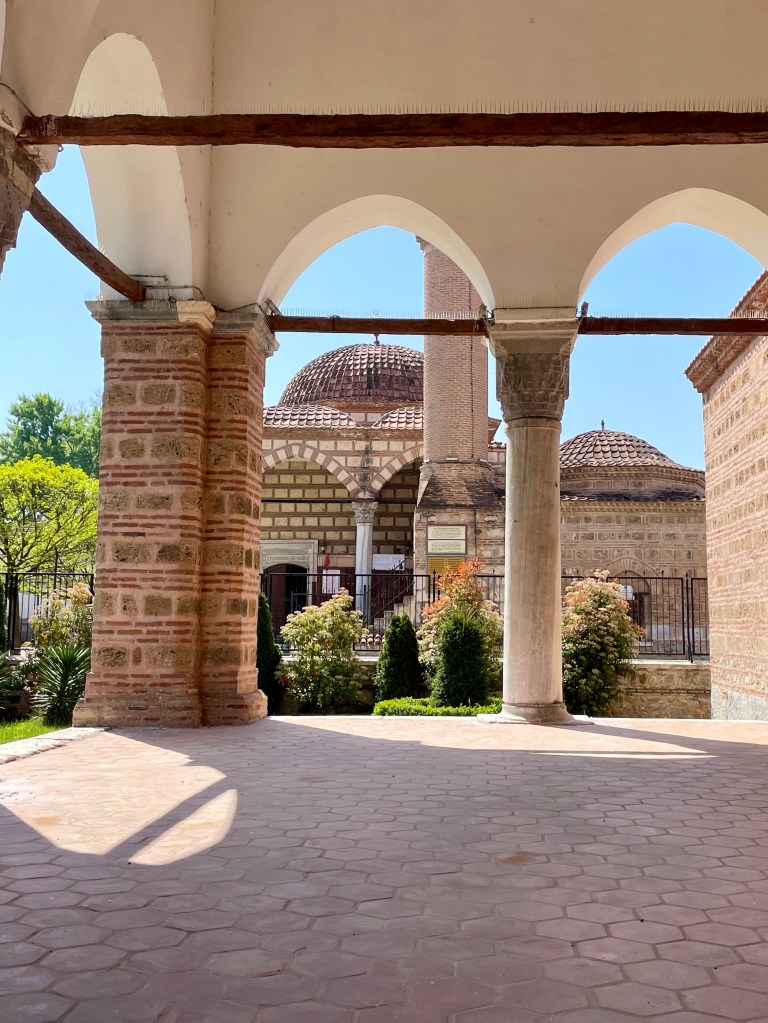
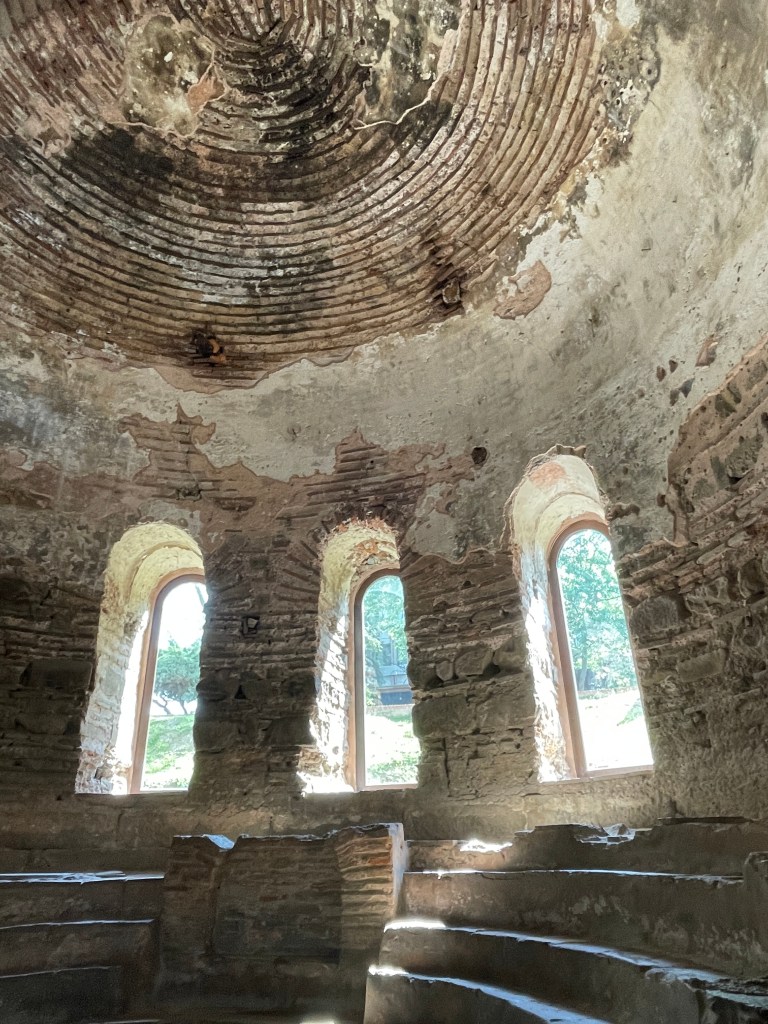
I was excited to find that the Turkish Islamic Arts Museum was open, despite the holiday. Located just across from the Green Mosque, the museum outlines the history of ceramics, textiles, and metal within the region in perfect bite-sized pieces – no more than 30 minutes needed to take it all in. İznik also features it’s own Hagia Sophia, a gorgeous Byzantine Church with origins dating back to the 4th century. The church is now a working mosque and I found the oculus and the stadium seating intriguing.

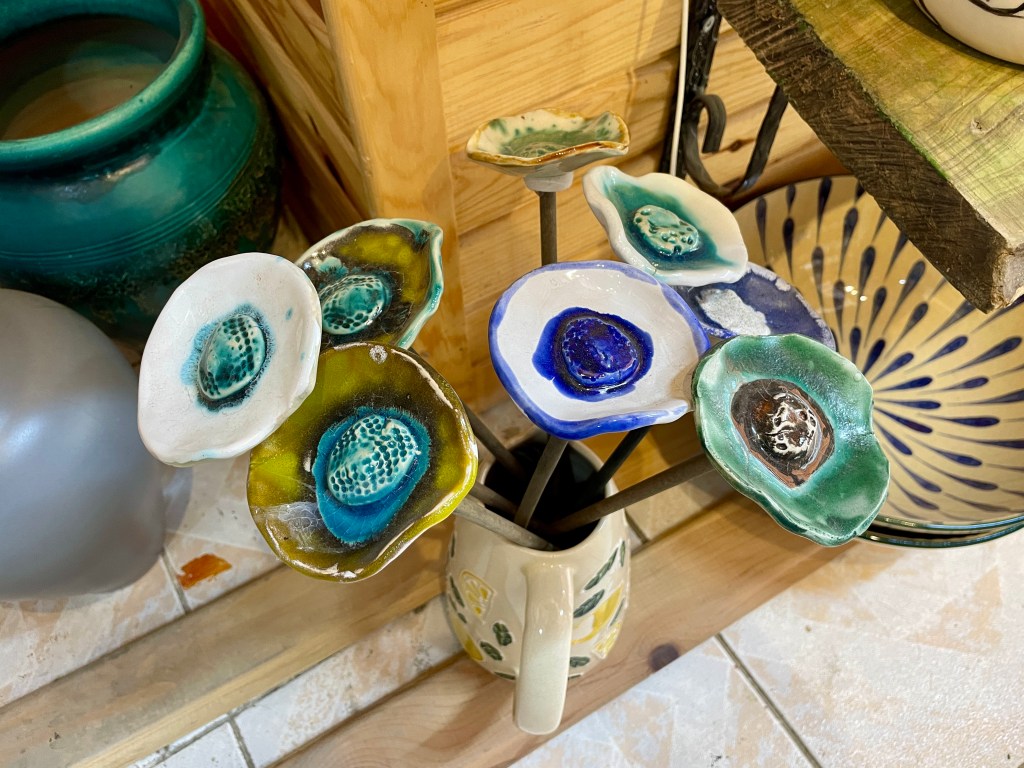
Suz and I had fun exploring the many shops featuring ceramics throughout the downtown. We happened upon a few with original ceramic designs (one working with terracotta instead of porcelain) and spoke to a few of artists themselves. Other shops featured pottery made from molds, which could be equally charming.

Before we knew it, the time had come to return to Istanbul. Soon Suz was back in Maine with her beloved pups and I returned to school to finish my final semester in Turkey. I’m so glad we could have this time together and explore more of what Turkey has to offer, outside the big city of Istanbul. As always, our days by the lake went too fast 🙂

Travels with My Aunt

New landscapes, new customs. The accumulation of memories. A long life is not a question of years. A man without memories might reach the age of a hundred and feel that his life had been a very brief one. – Graham Greene, Travels with My Aunt

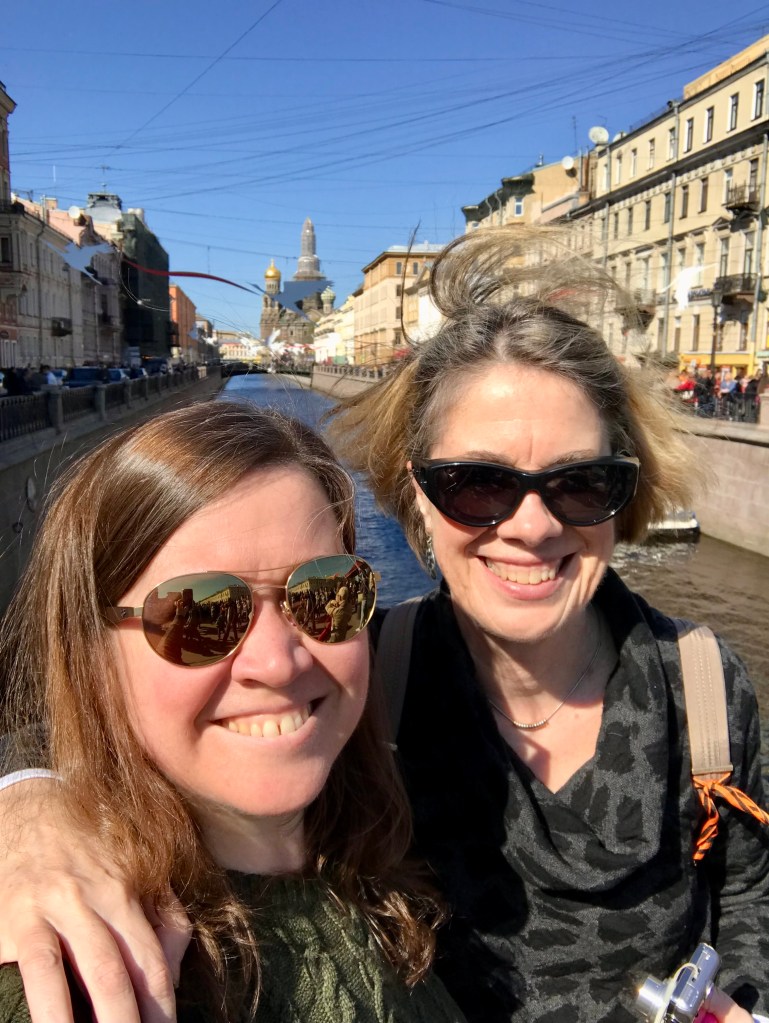
Carpe diem, indeed. My aunt Susan (affectionately known as Suz) has certainly seized the opportunity in her travel existence. Over the past decade, she’s come to visit me in each country in which I’ve lived – South Korea, Russia, and now Türkiye.

Traveling solo from her small town in Maine, I greatly appreciate her effort to visit and always enjoy our time together. Suz is an appreciator of the Arts, often taking me to the Museum of Fine Arts Boston for my birthday when I was young.
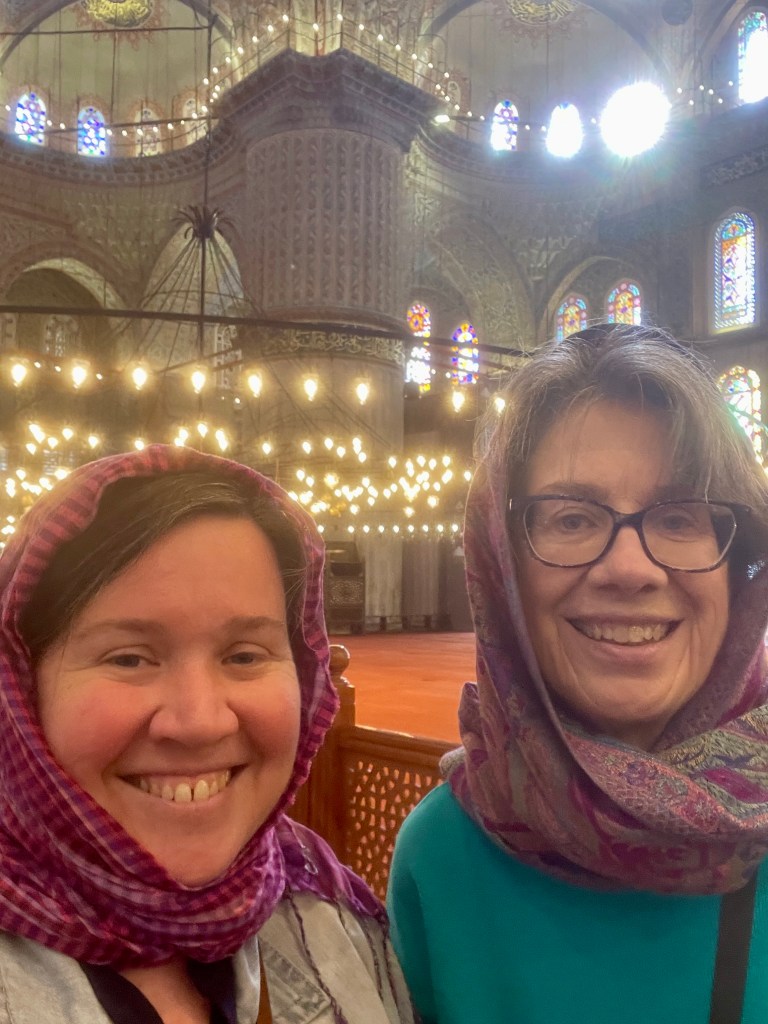
Istanbul, Türkiye (April 2024)

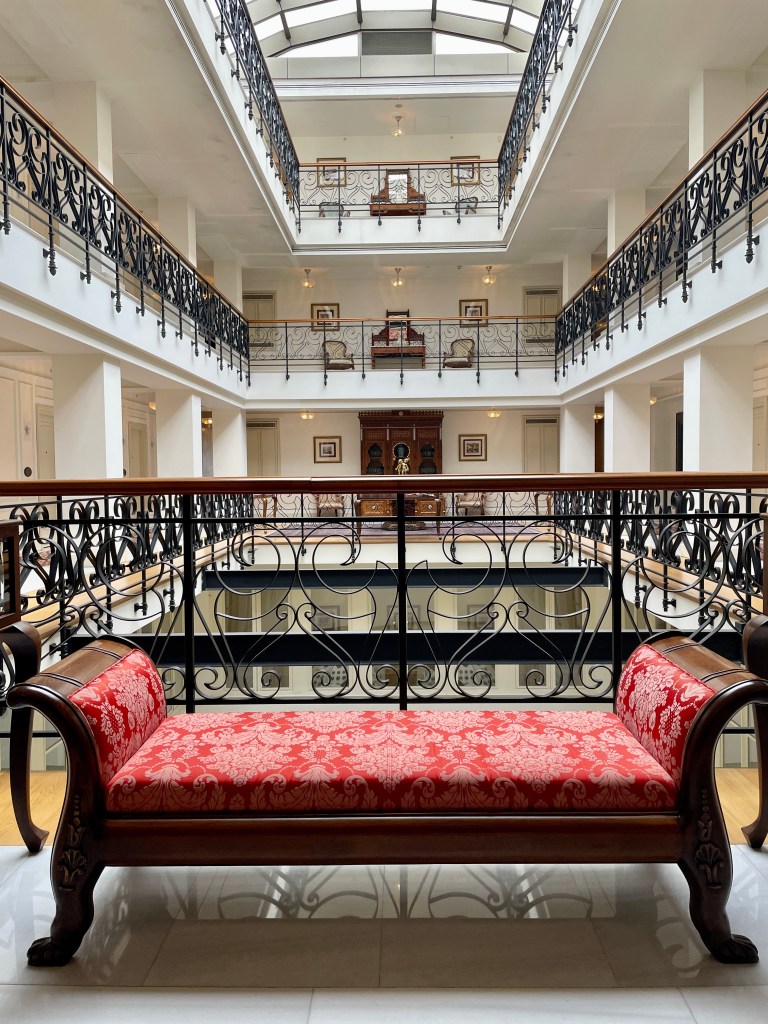
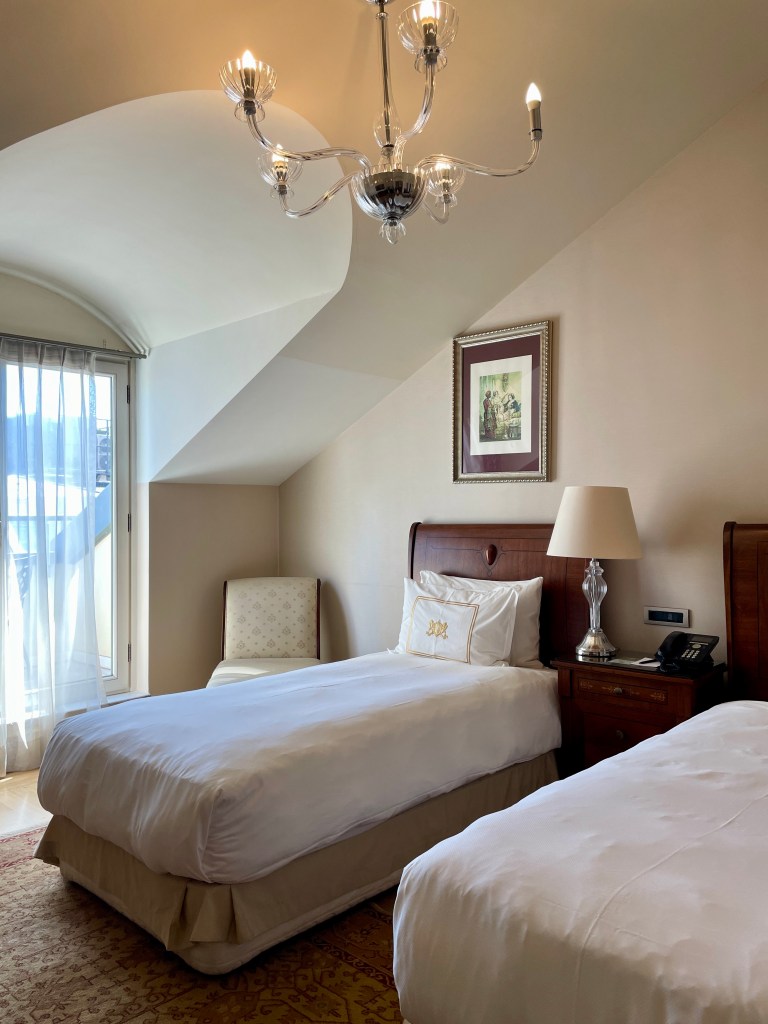
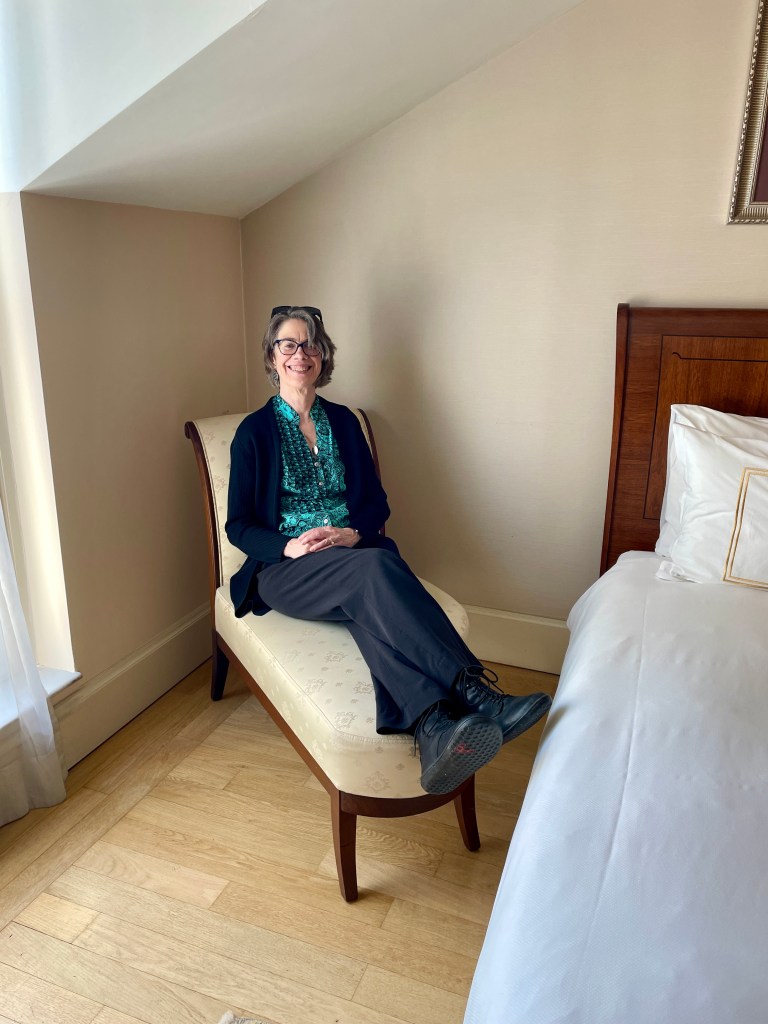
We started off the visit on a swanky note with a stay at the Pera Palace Hotel. Though I’ve been for Sunday tea, I had never spent the night.

The Pera Palace Hotel has provided respite for many visitors to Istanbul. Famous guests include Agatha Christie, Ernest Hemingway, and Jacqueline Kennedy Onassis (we stayed next door to her room). It seemed all too fitting to learn that American writer Graham Greene had featured the hotel in his 1969 novel, “Travels with My Aunt”.

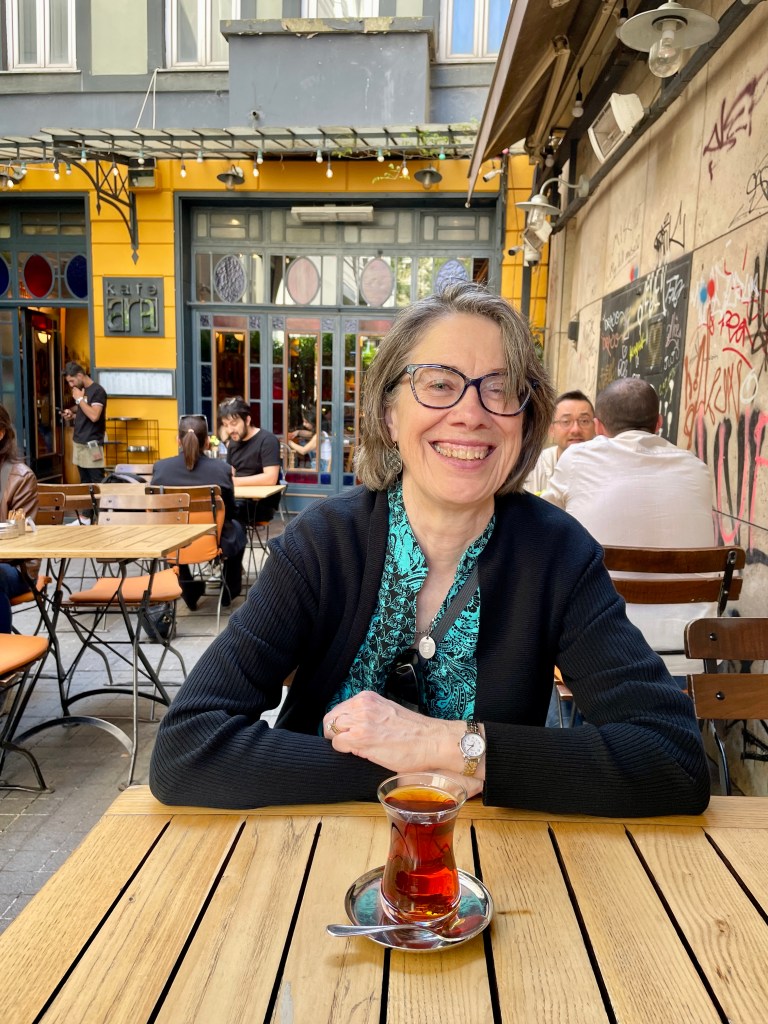
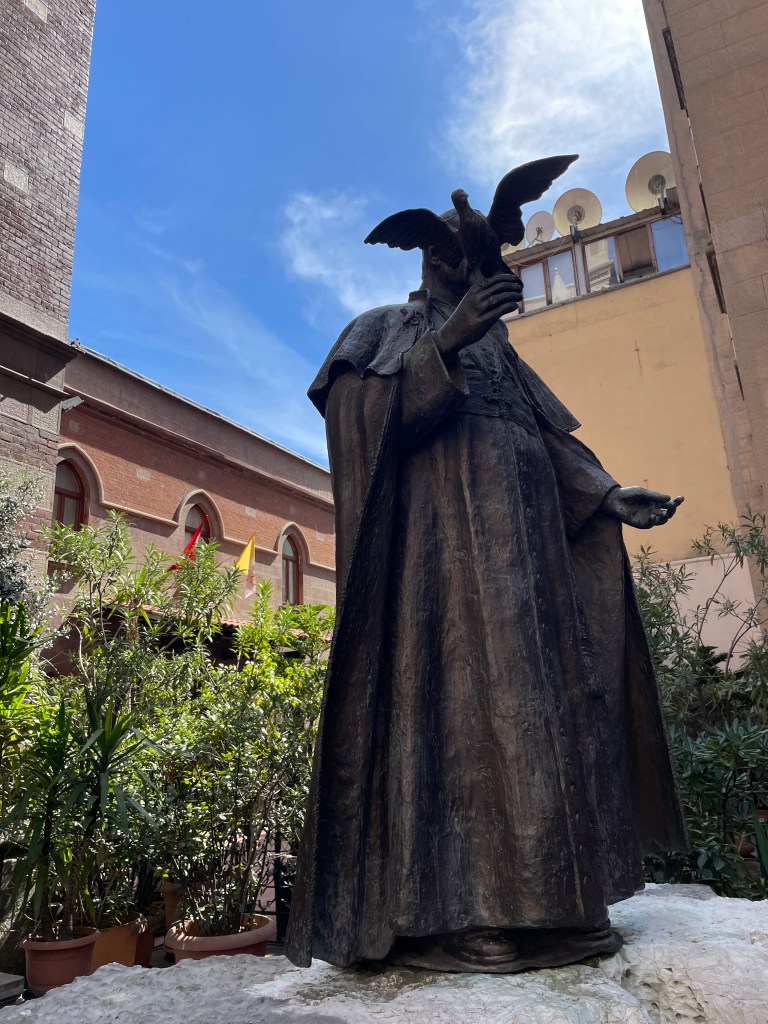
The hotel proved a fantastic spot to get our feet wet downtown – we drank çay at sidewalk cafes, did some shopping, and visited one of the few Catholic churches in Istanbul (certainly the largest) – St. Anthony of Padua.

April is simply the perfect time to Istanbul. The warm spring sun was quite a foil for the nor’easter Suz left behind in Maine. Trading snow for tulip season proved the perfect antidote.

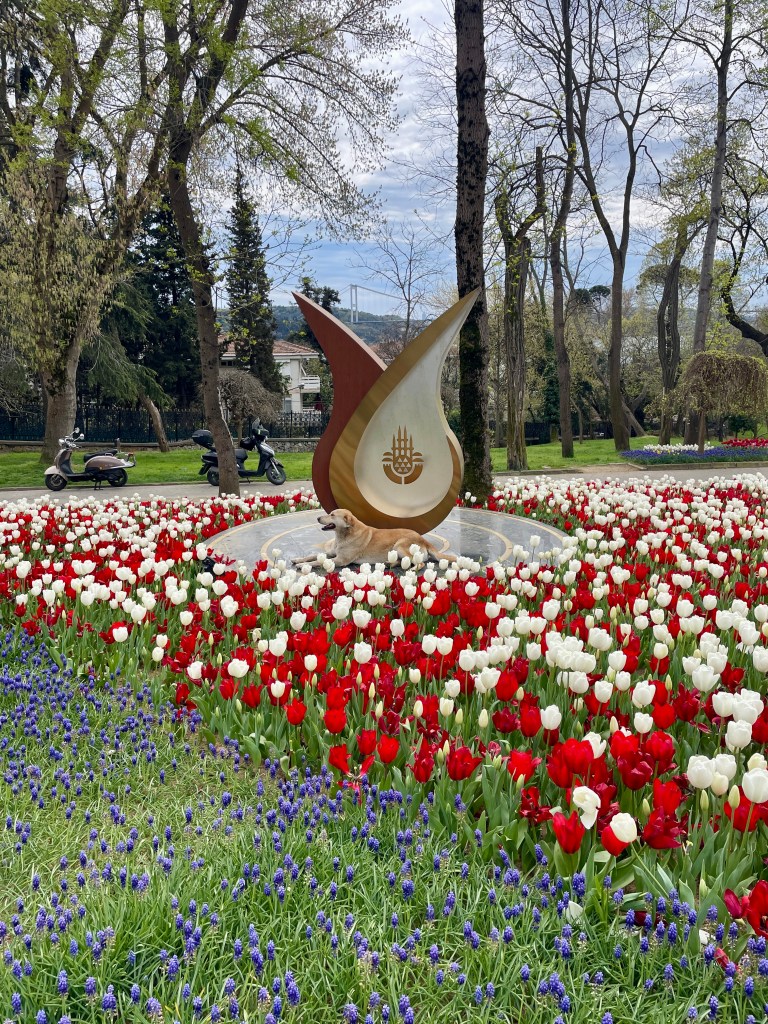
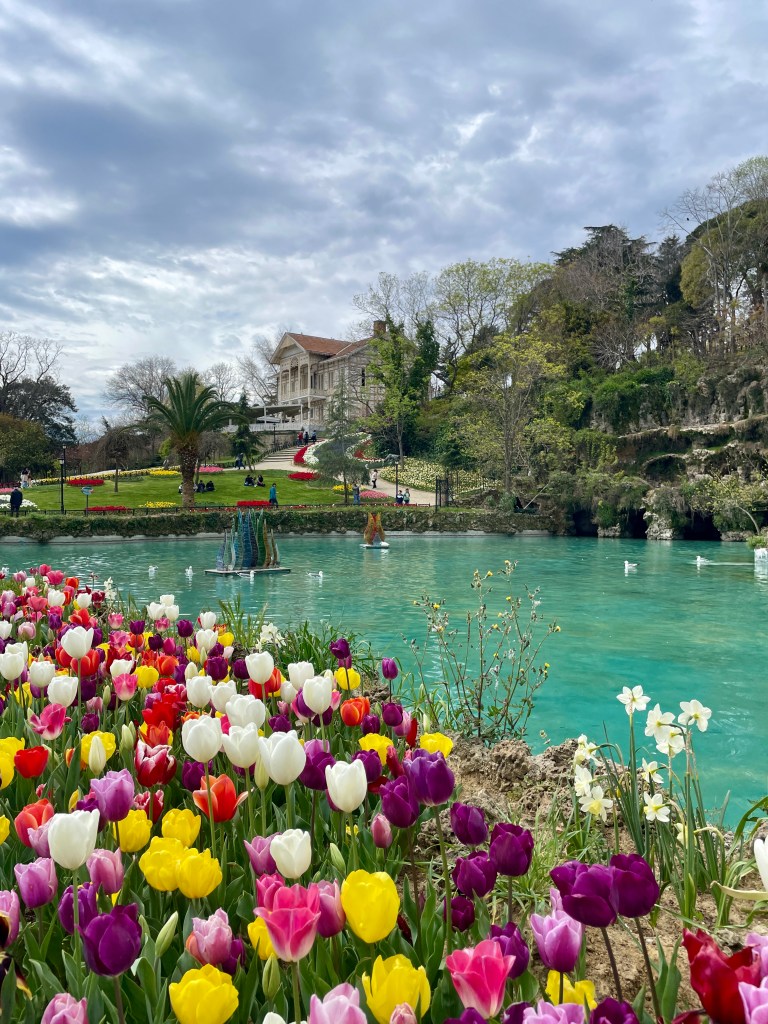
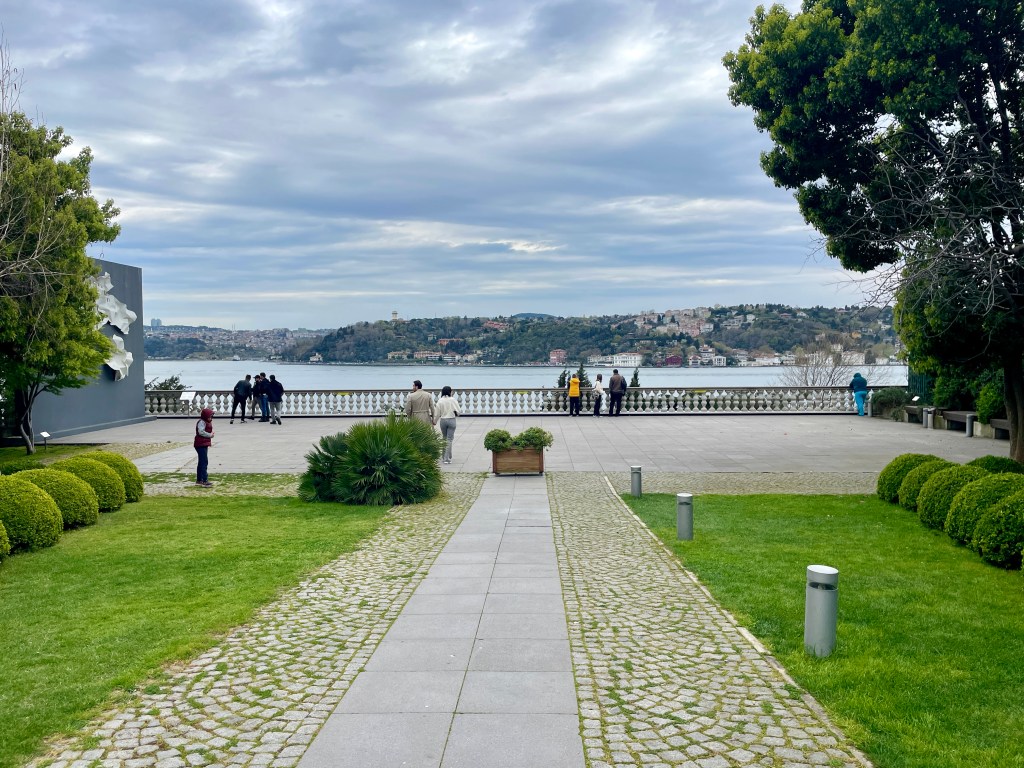
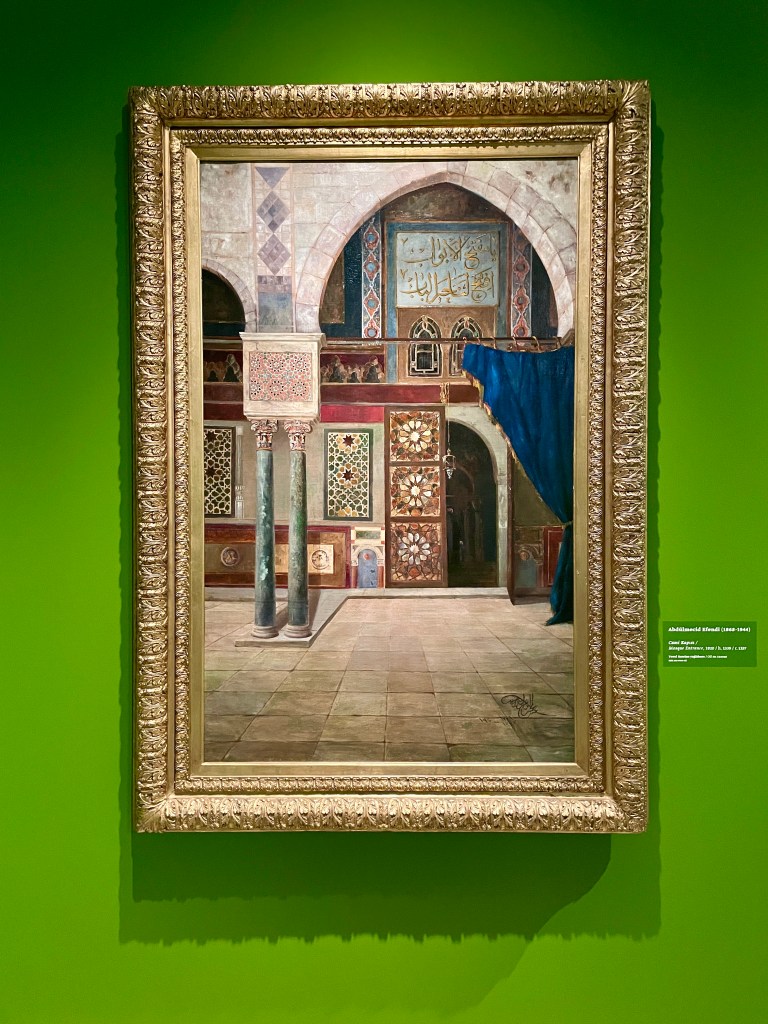
Emirgan Park was our first stop, soaking in the gorgeous carpet of tulips blanketing the park. We were happy to trade the hustle of the city for quiet meditation, possible only early in tulip season, before so many visitors decend. We also took in the Sakıp Sabancı Museum, learning of the Modernist path pursued by Turkish painters in the late 1800s. A stunning terrace view of the Bosphorus can be seen from the museum’s front yard.

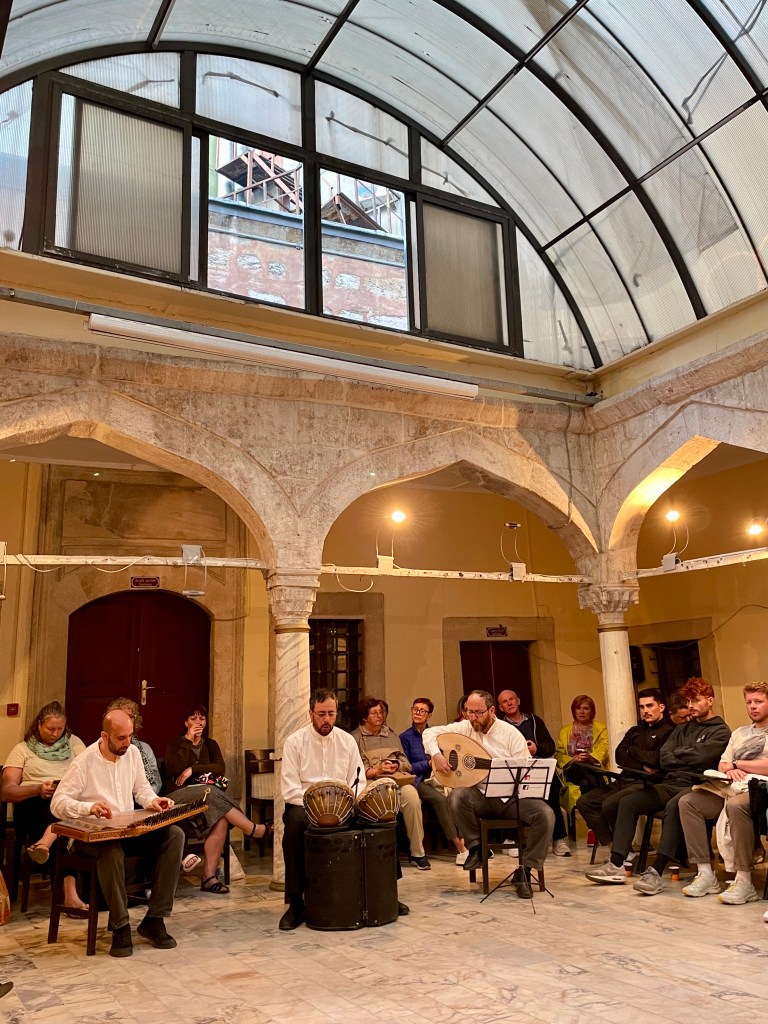
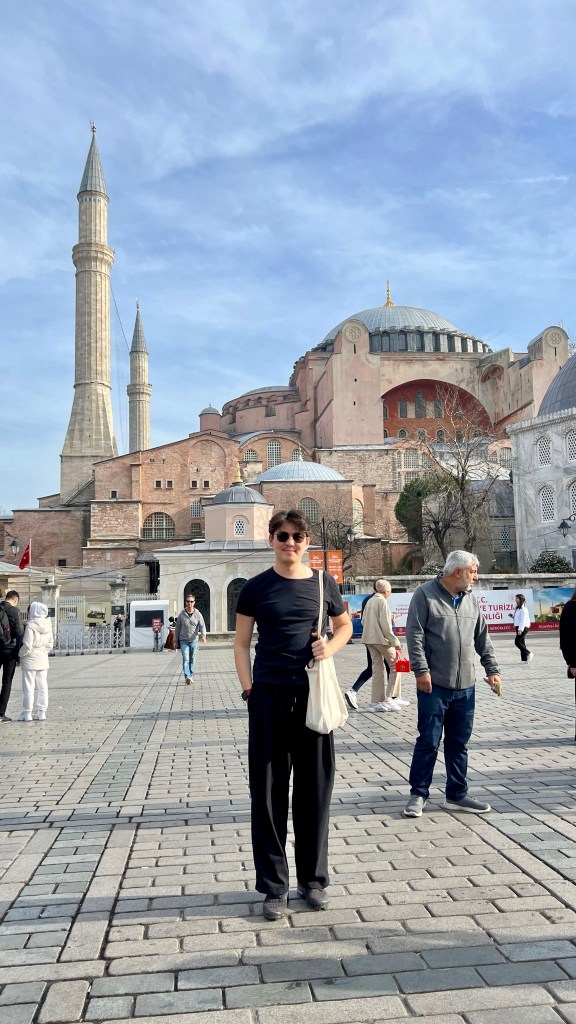
After our time at Emirgan Park, we shifted to a hotel in Sultanahmet (Hotel Arcadia Blue). Ideal for it’s proximity to the major sights (I’m currently recovering from a bit of knee surgery), we explored the Hagia Sophia, the Blue Mosque, and even took in a whirling dervish show featuring local musicians.

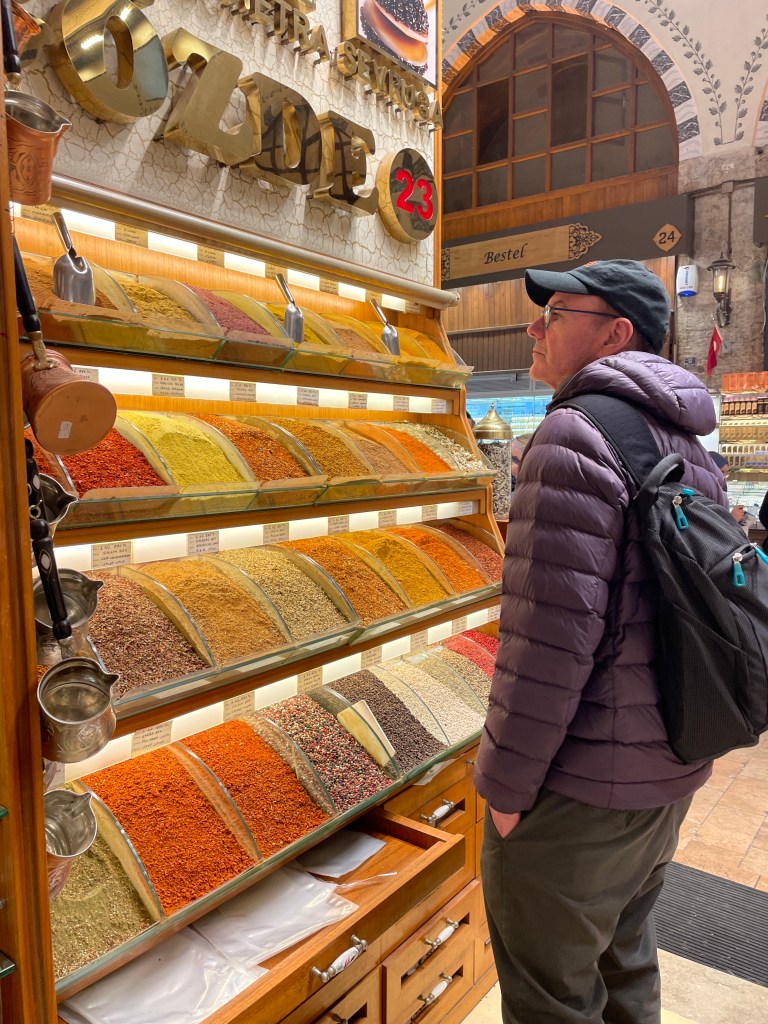
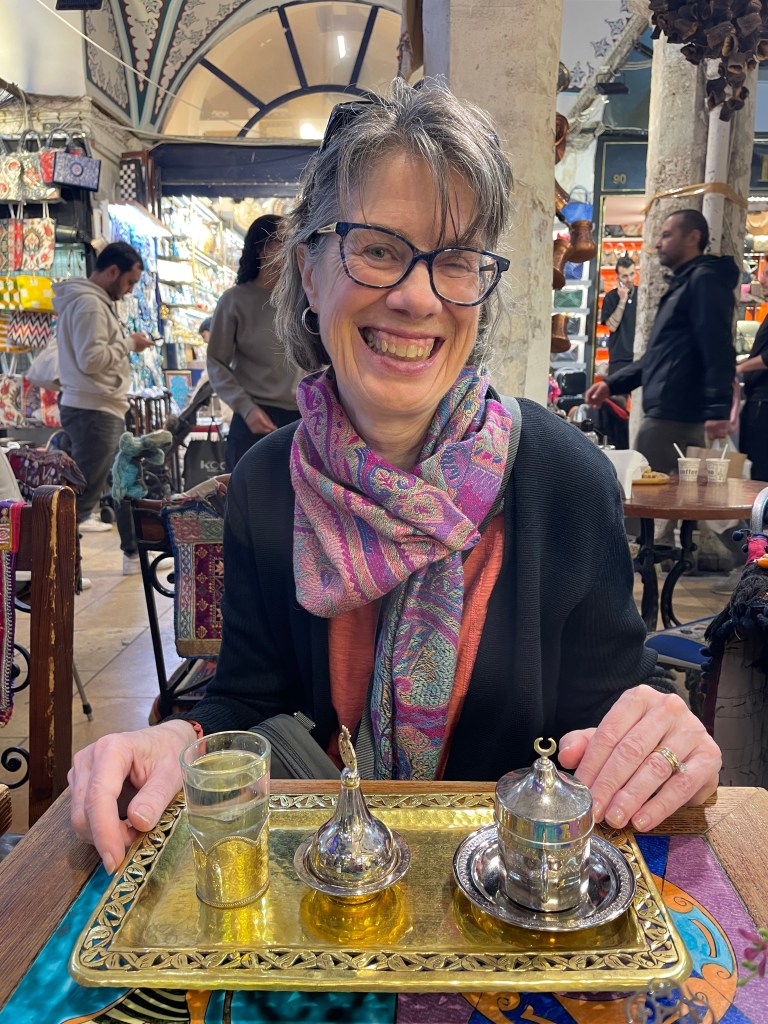
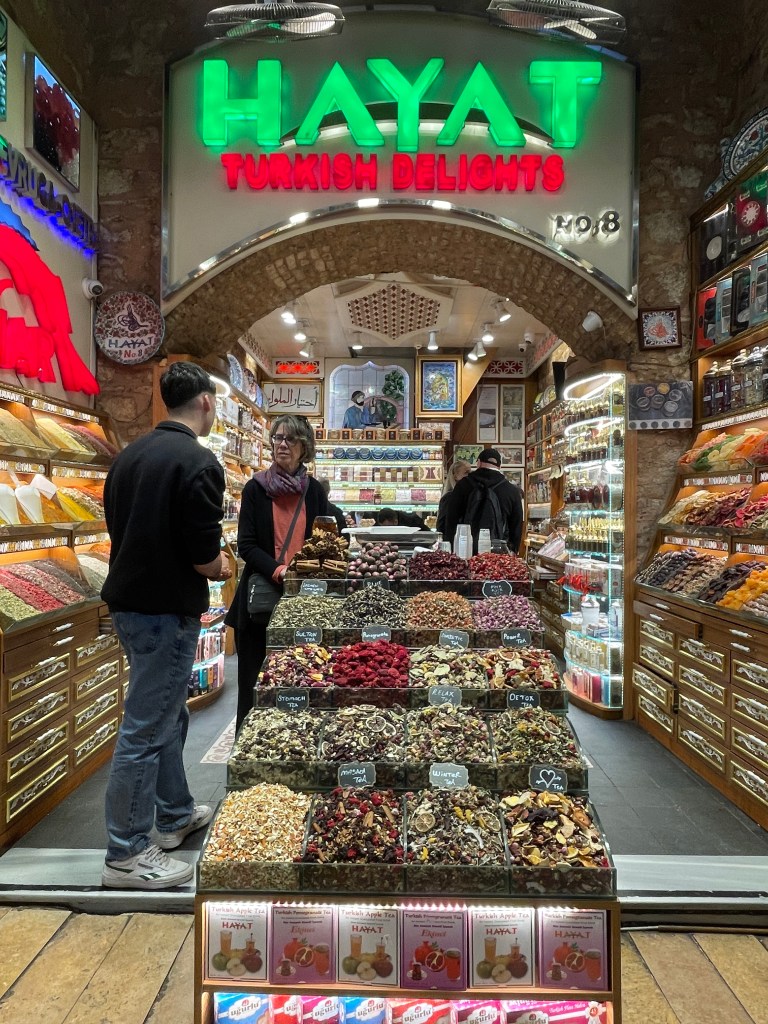
As always, the Grand Bazaar was a highlight (Suz took to Turkish coffee like a pro). We also enjoyed our time at the Spice Bazaar (Mısır Çarşısı). Many fine Turkish treats are currently en route to Hallowell, Maine!

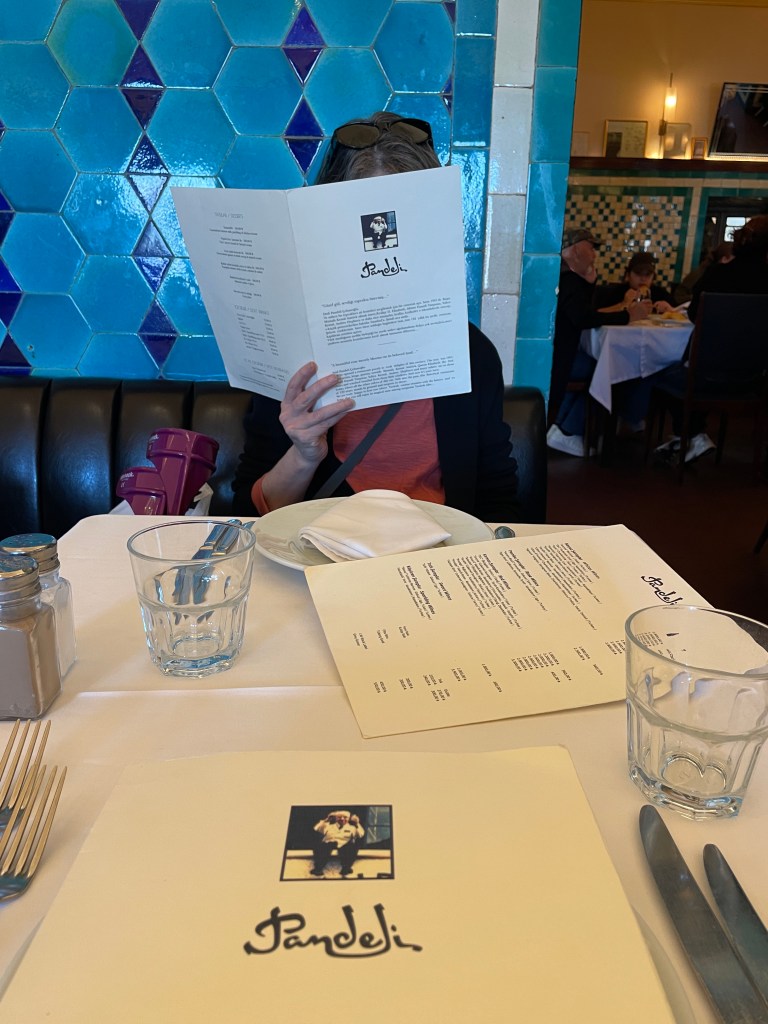
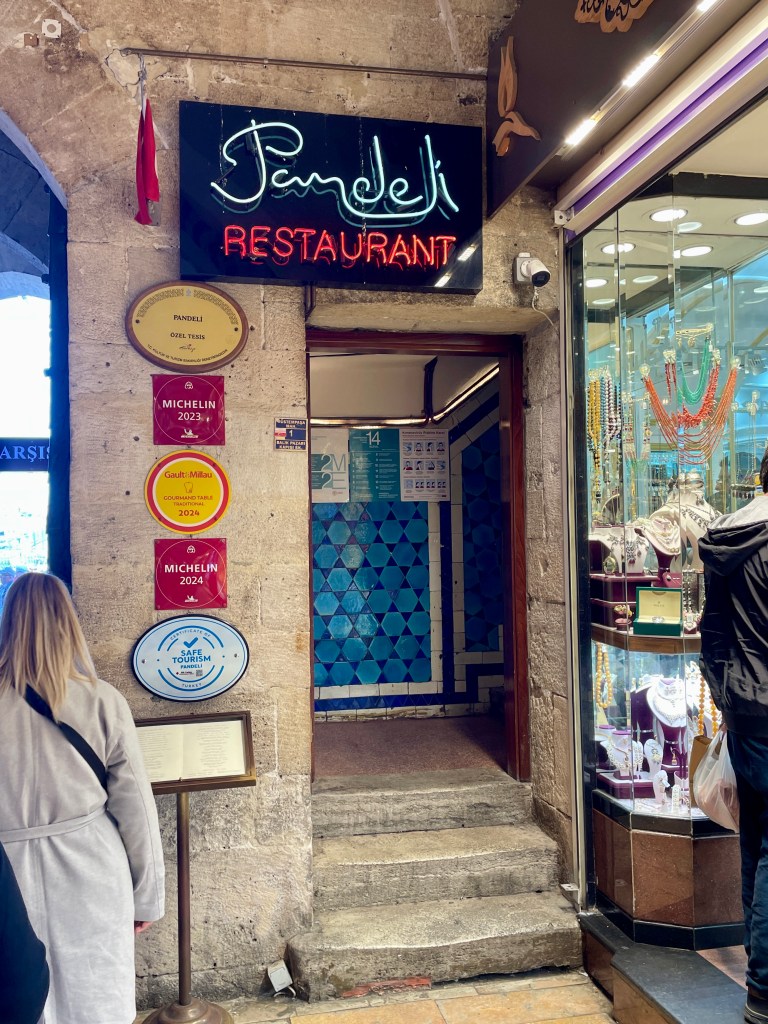
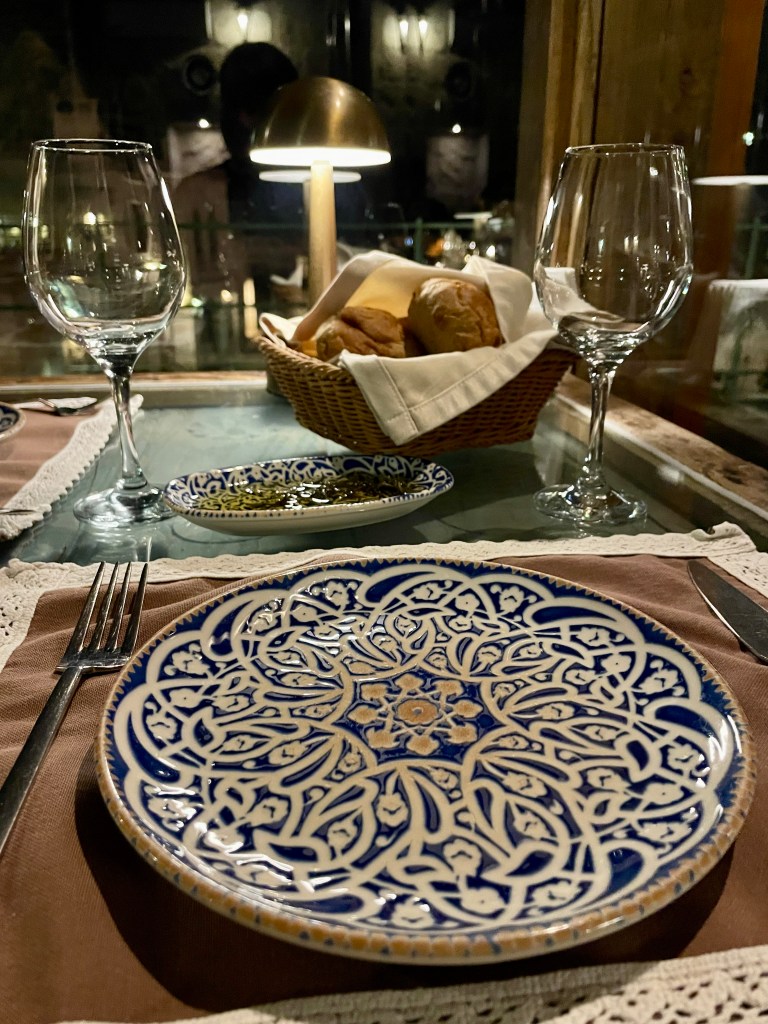
On the recommendation of my friend Monique, we checked out Pandeli Restaurant. Tucked away above the unassuming Eminönü entrance to the spice bazaar, the restaurant has been in business since 1901. While famous guests like Queen Elizabeth II and Audrey Hepburn have enjoyed lunch in these quarters, the menu remains affordable and delicious. The famous blue tiles added to the ambiance.

Our time downtown soon came to a close. With the bayram holiday (Eid) quickly approaching, it was time to clear out of Istanbul and see more of the Turkish countryside. We were off to Bursa and İznik.

Edirne

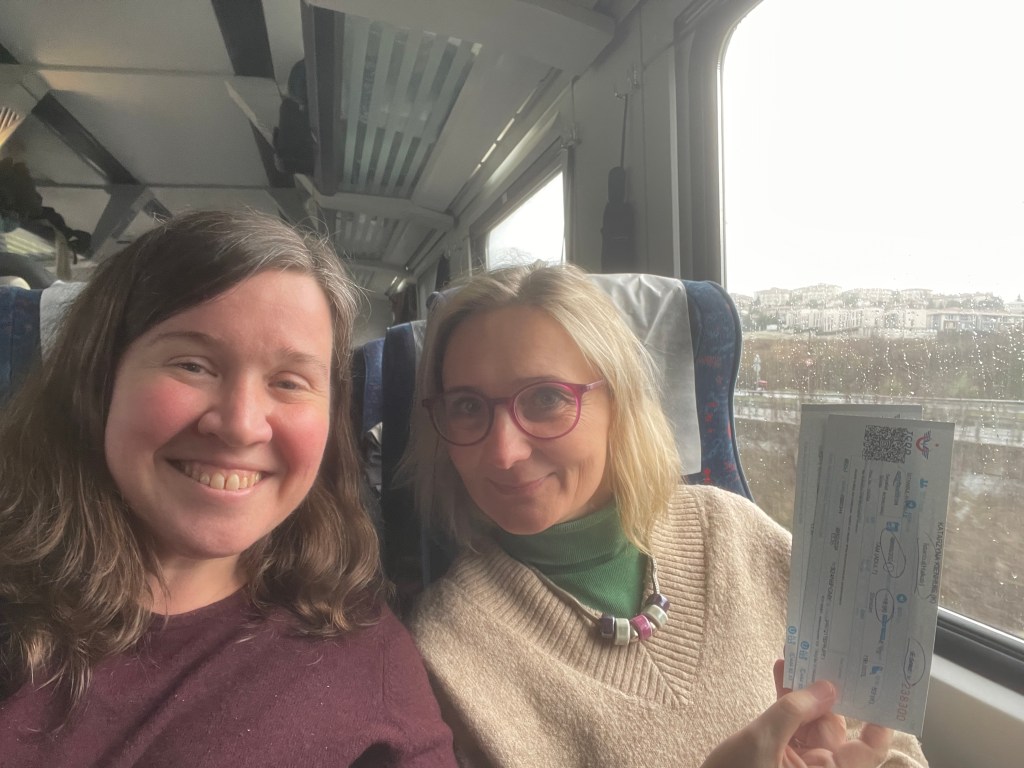
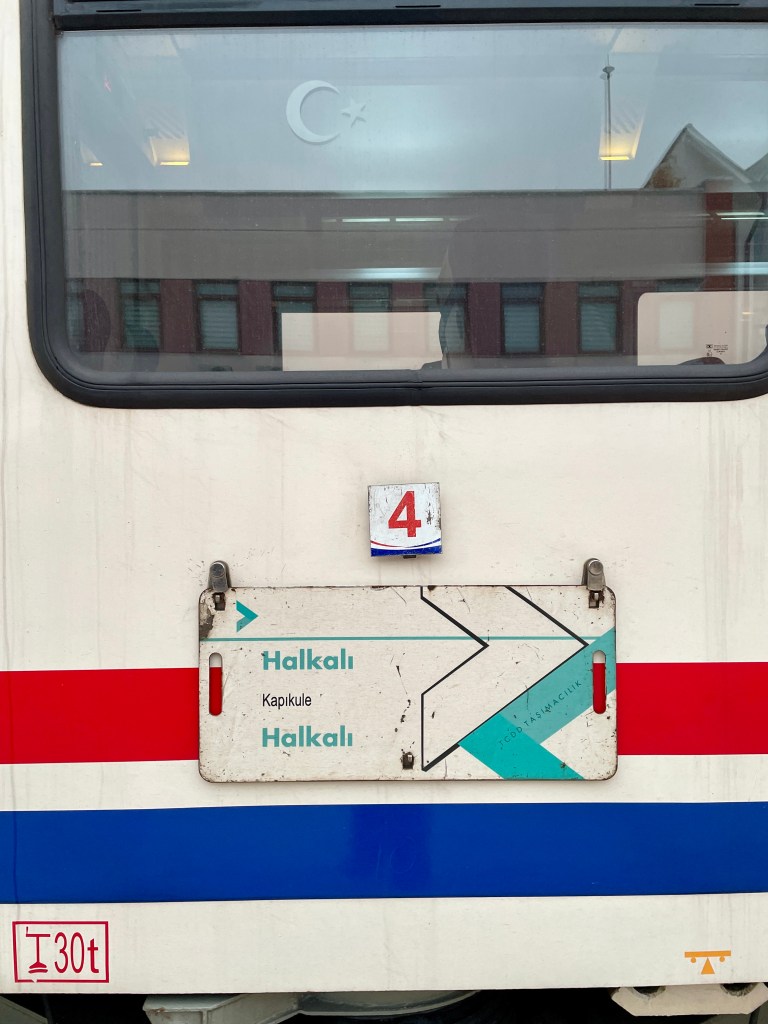
Last weekend, my friend Kasia and I took a train journey to the northwest of Türkiye, right on the Bulgarian border. Both fans of history and architecture, we had been talking about making this trip for months. With a newly opened railroad stop in our little park and Kasia’s determination to purchase the tickets (never a simple endeavor in Turkey), we finally made it happen!
A light rain fell upon us as we boarded the train at Ispartakule. We quickly entered the Turkish countryside, sidling by my school on the Bulgaria-bound tracks. As is often the case, the train took extra long stops at multiple stations, arriving in Edirne about an hour late. With a roundtrip ticket cost of 370 Turkish lira ($12 USD), one really can’t complain.

A gorgeous morning greeted us on our first day in Edirne. Finishing breakfast at the West Door Hotel (I’d give it three stars for its central location), we set out on foot. A former capital of the Ottoman Empire, prior to Constantinople, Edirne boasts a number of gorgeous mosques, a health museum, and a number of Roman ruins. We chose the Selimiye Mosque as our first destination.

Edirne town center with Roman ruins in the foreground and the Eski (Old) Mosque behind.

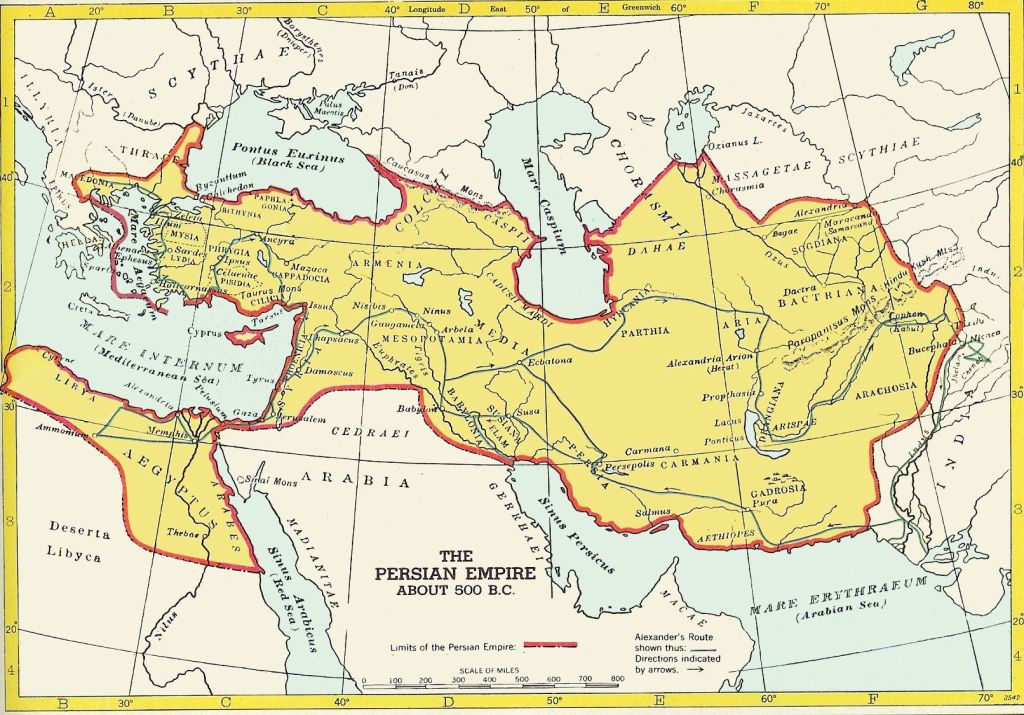
Edirne’s “modern” history begins in 510BC when the Persian Empire ruled this land. The Byzantine Empire followed and Edirne remained under Byzantine rule after the empire split from the Romans in 395BC. Macedonian Phillip II (the father of Alexander the Great) took over as ruler in 340BC.

Edirne is located in area labelled “Thrace” in the upper lefthand corner of the Persian Empire

Fast forward a few millennia to the 14th century and the Ottomans were in charge of much of southeast Europe, North Africa, and West Asia. In 1395, Edirne was named the capital of the Ottoman Empire.

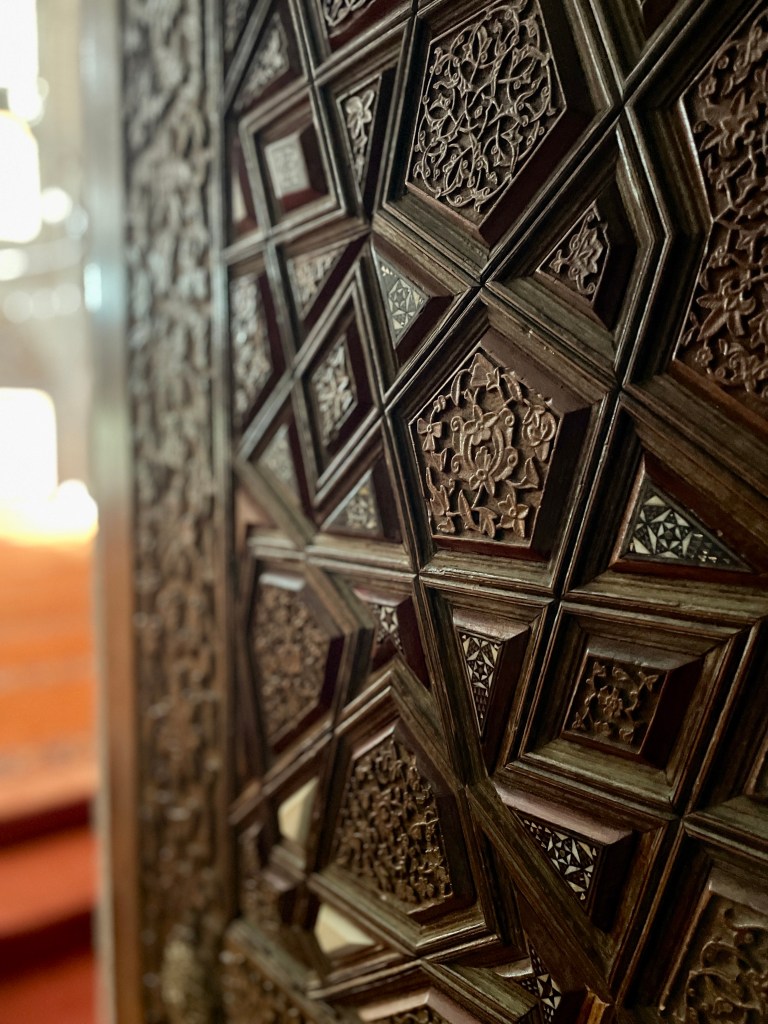
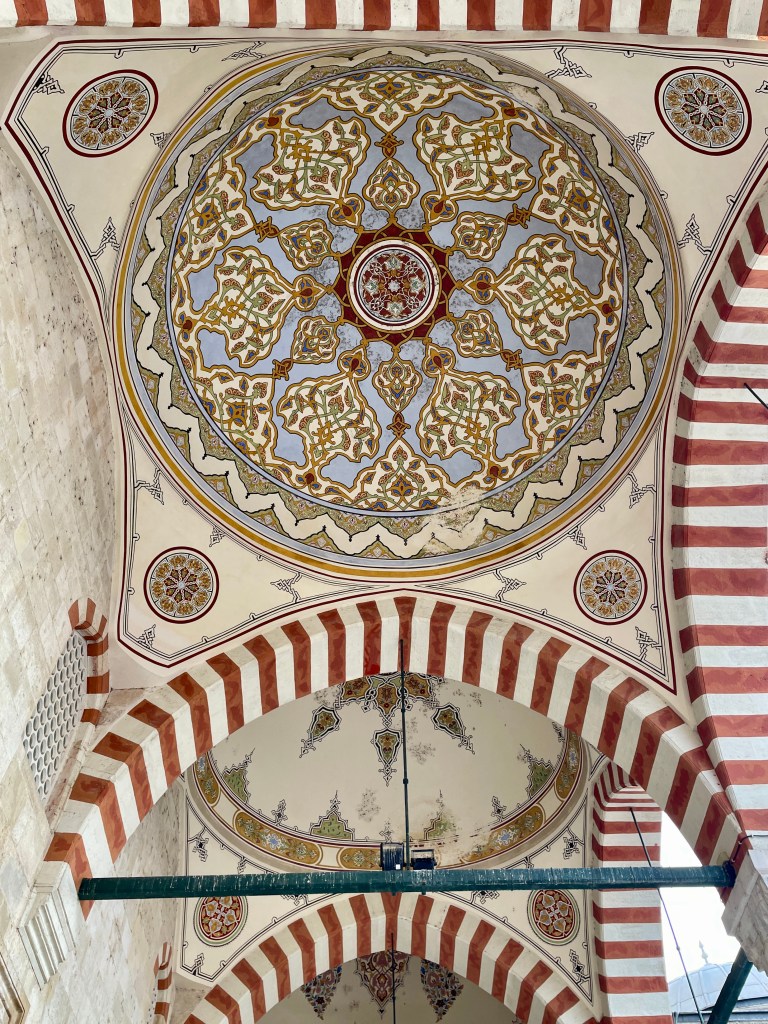
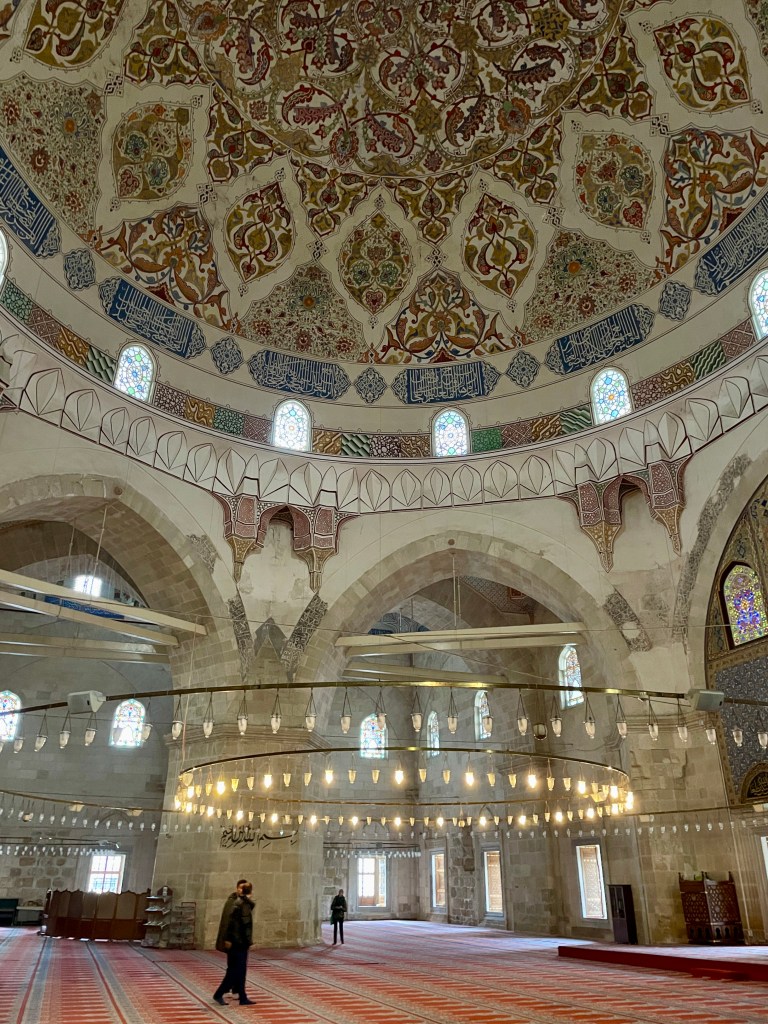
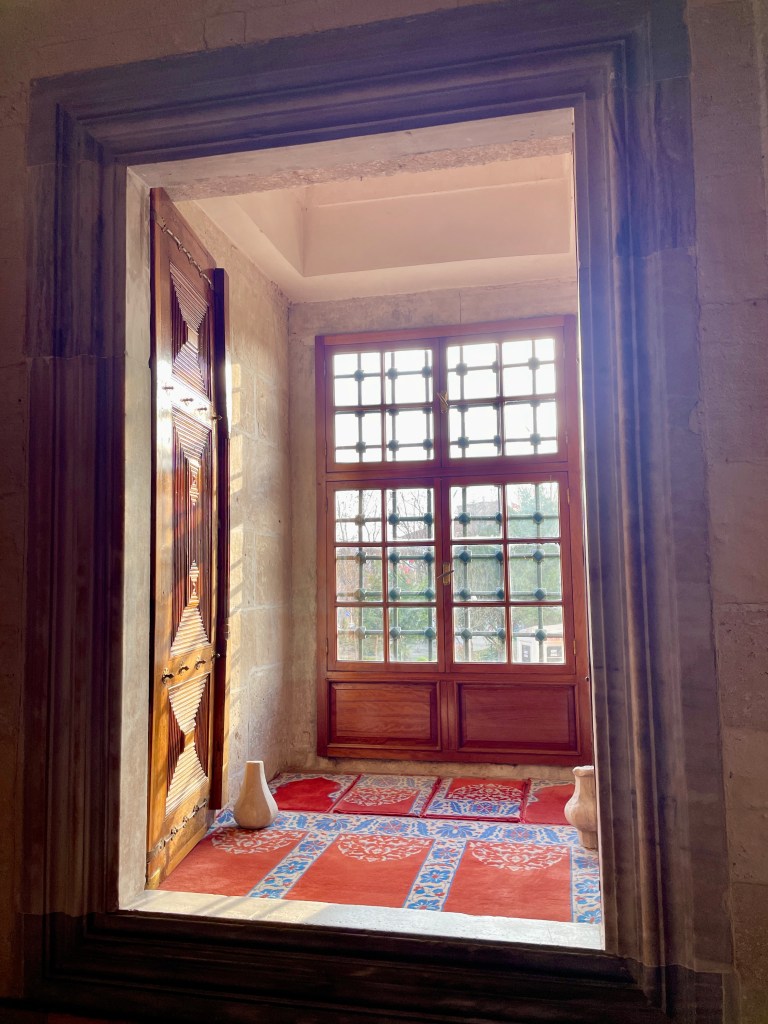
The Selimiye Mosque – truly stunning in its geometric tiles and vaulted ceilings. Named a UNESCO world heritage site in 2011, much of the mosque remains under renovation. Even so, the intricate craftsmanship and sweeping elegance was readily apparent.

The Selimiye Mosque was designed and executed by Imperial architect Mimar Sinan between 1568-1575. A prolific architect, Sinan completed projects all over the Ottoman Empire, including the Kanuni Sultan Suleiman Bridge located in Büyükçekmece (close to my school).

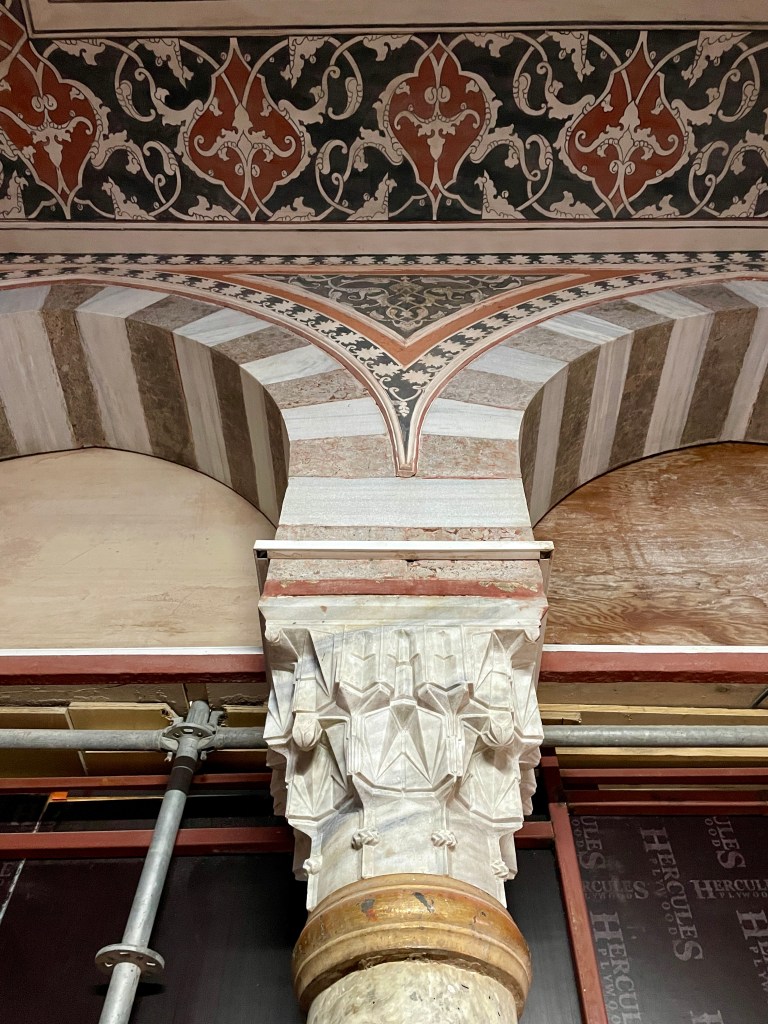
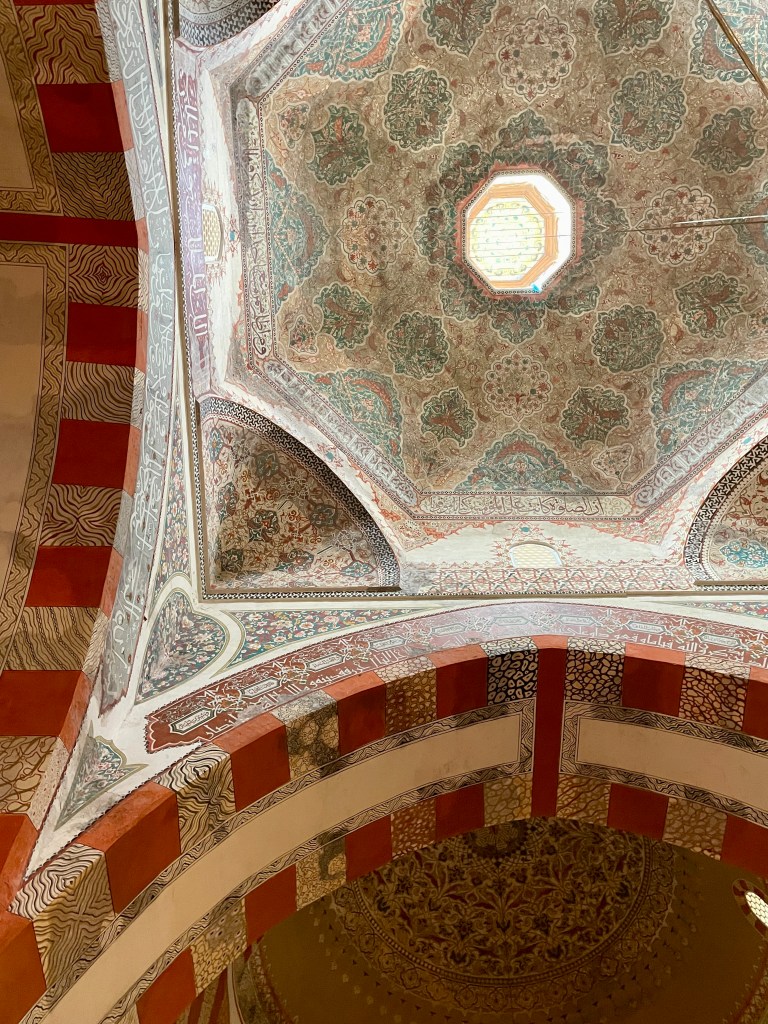
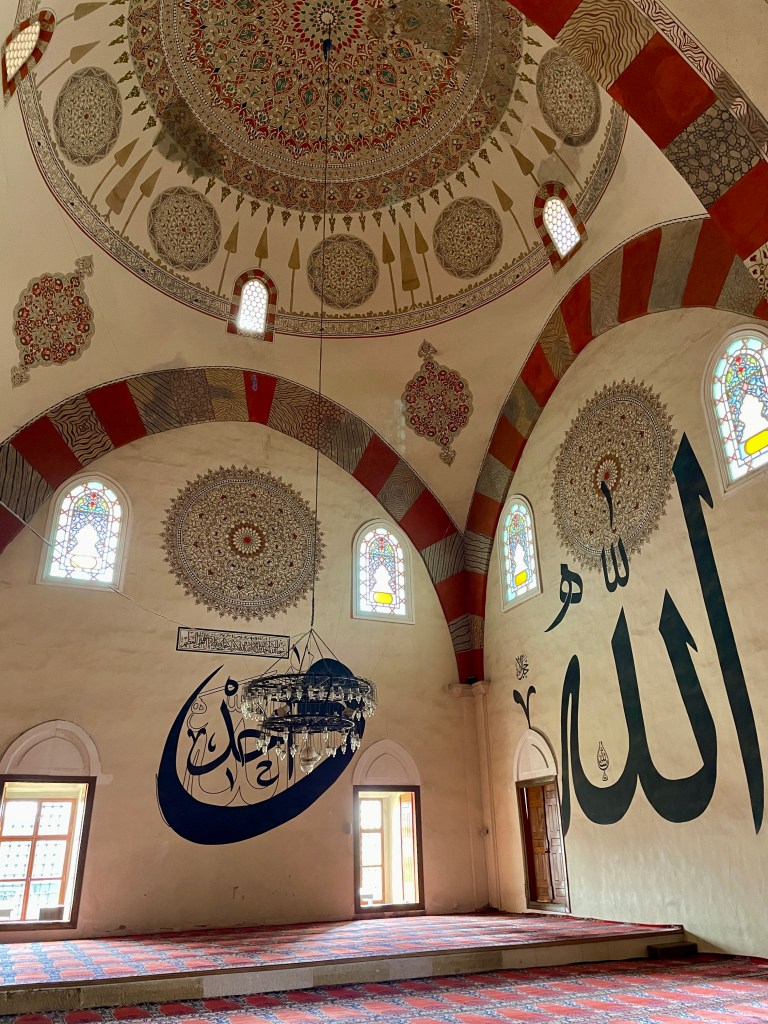
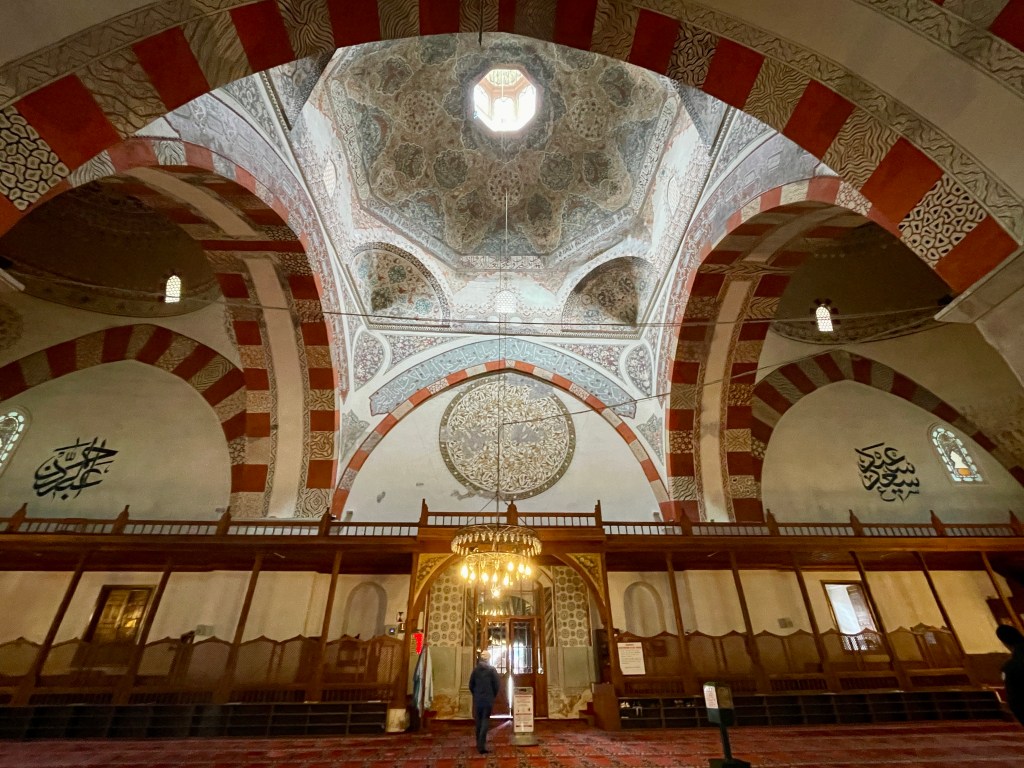
The Eski Camii (ie. mosque, pronounced “ja-mee”) boasts one of the most unique mosque interiors I’ve ever experienced. Almost contemporary in appearance, the ground level features the eight names of Islam in huge calligraphic scroll. The “W”-like inscription on the left translates to “Allah”, or God.
Drawing the eye upwards from the darkness and into the light, the mosque features an oculus representing the vault of heaven.

In 1453, Edirne lost its title when the Ottoman capital was moved to Constantinople (present day Istanbul) but the city remained a summer sanctuary for sultans and rulers. In 1828, Edirne was occupied by the Russians. Next came occupation by the Bulgarians in 1913, then the city was ceded to the Greeks in 1920, and finally restored to Turkish control in 1922.

Today Edirne is a tourist destination, known for its mosques, fruit soaps, liver (tava ciğer), and keçecizade, an almond paste (featuring twice as many almonds as marzipan). I felt particularly lucky to visit Edirne on the cusp of Ramadan, a month of fasting, prayer, and reflection.

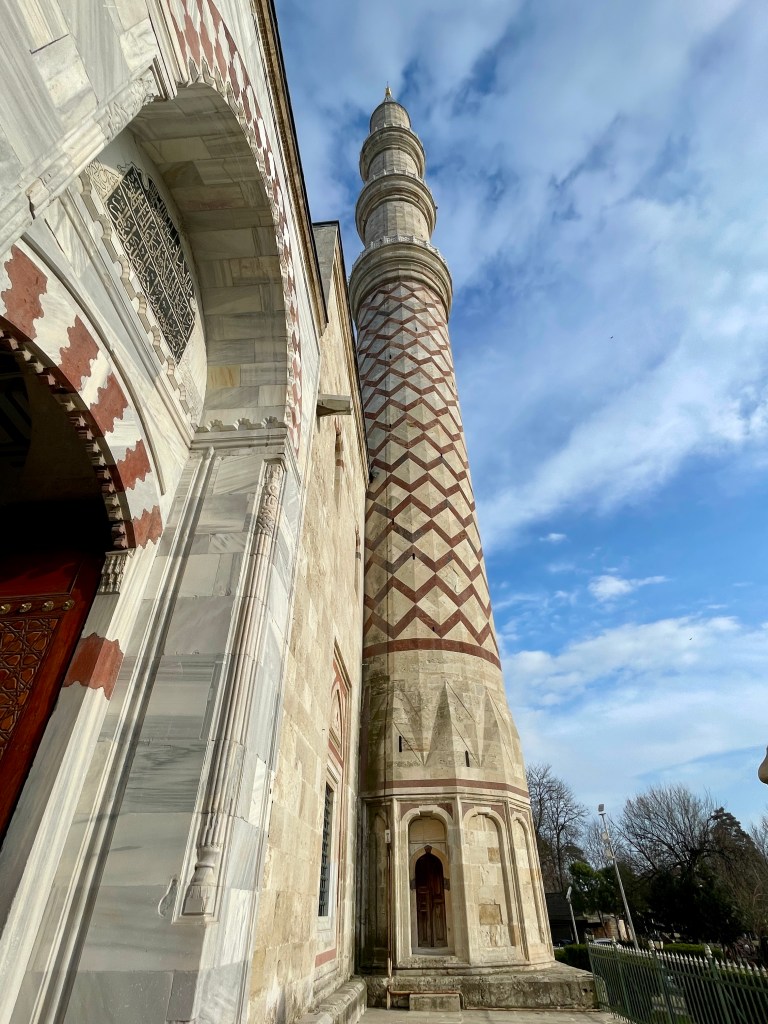
The last stop on our “Camii Tour” took us to the Üç Şerefeli Mosque (“three balconies”, as seen on the minaret above right). The gorgeous floral patterns evoke a Chinese influence and bricks of limestone highlight the unusual designs on the structure’s four minarets.

After a day of camii-hopping, we searched for a spot to enjoy a drink. Hard to find in a fairly dry Turkish town, we hit a few roadblocks before discovering Woodhouse around the corner from Papa’s Cafe Bar. As we walked home, the streets were calm once again, devoid of the afternoon tourists seeking their fix of the famous Edirne ciğer.
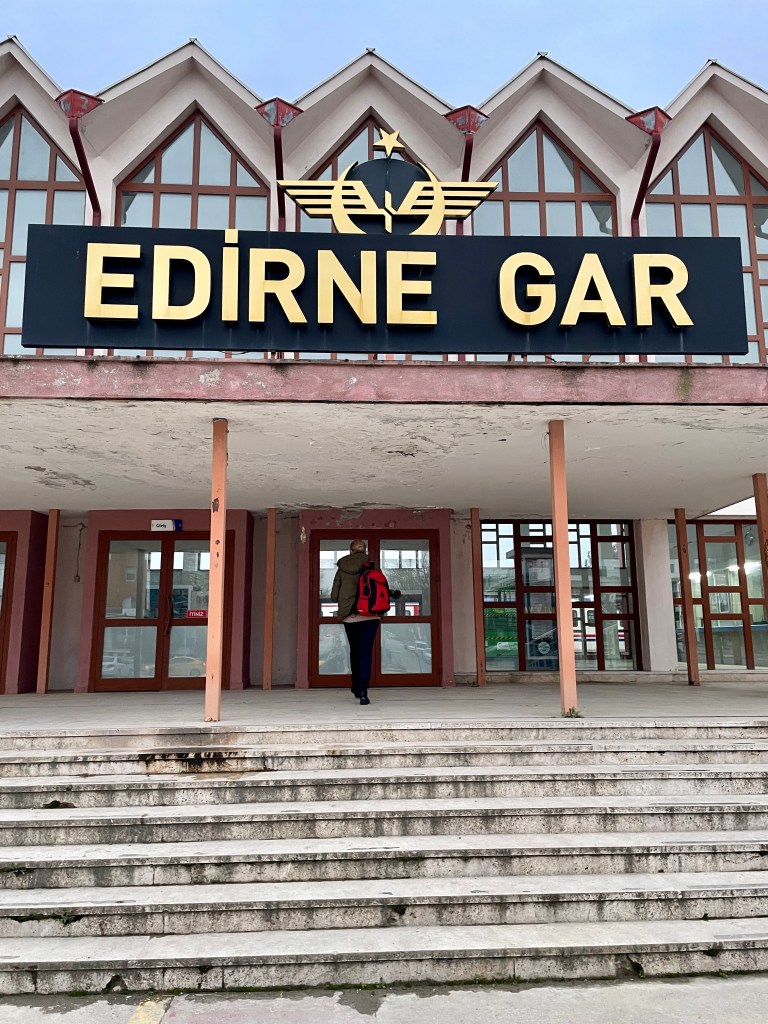
All too soon, it was time to head back to Bahçeşehir. On Sunday morning, we caught our train at the Edirne Gar and enjoyed pastoral views of the Turkish countryside. I am so happy we were able to take this weekend visit to Edirne, leaving me with an even greater appreciation for the accomplishments of the Ottoman Empire. Up next… a visit to Bursa and Iznik with my aunt Susan!

24 Hours in Istanbul

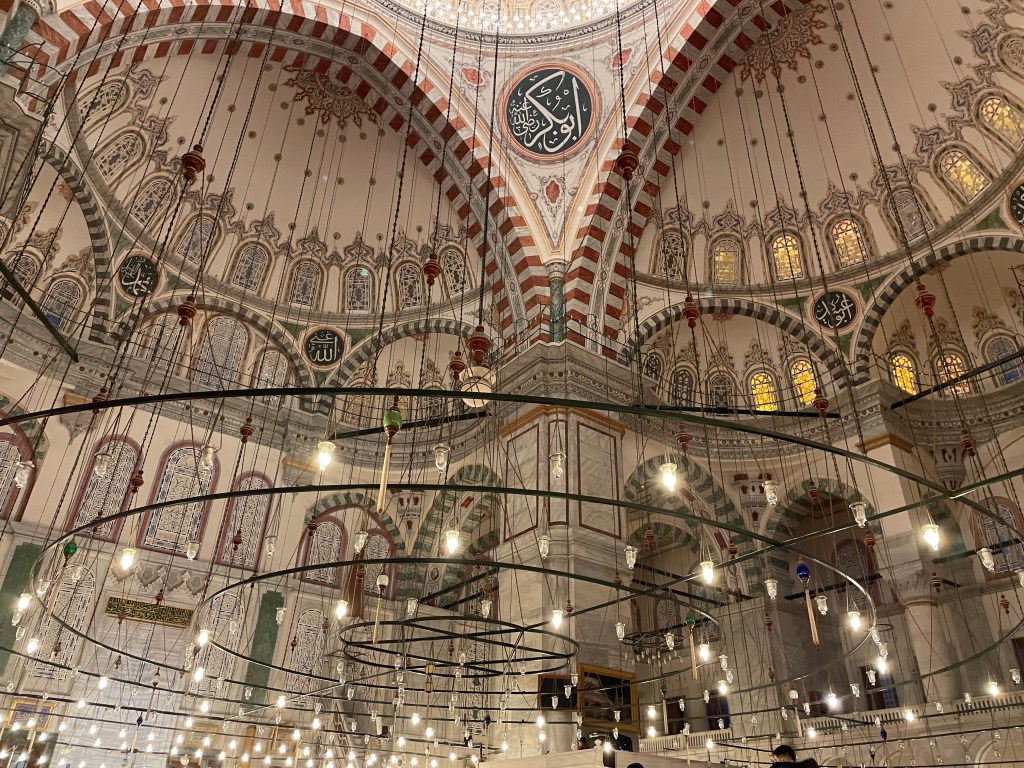
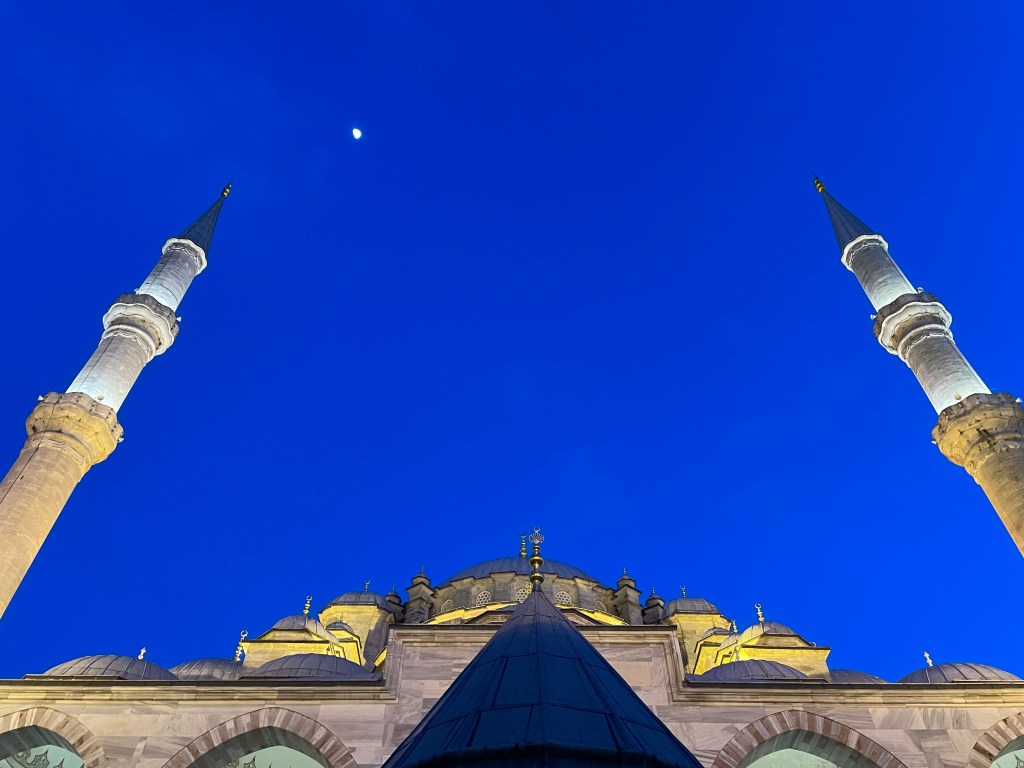
The Fatih Mosque

I’ve been lucky enough to be visited by three visitors in recent weeks. My uncle Doug joined me for the start of my February break. My former student (now an employed college graduate!) stopped by on his way to Seoul. And most recently, I met up with my college roommate’s sister-in-law from Maine. Exploring Istanbul is always fun but it’s even better to see it through fresh eyes.

Galata Airbnb

My Top Ten Istanbul (in no particular order):

  1. Cafe Privato
  2. Galata Tower
  3. Arada Cafe (Turkish-Lebanese breakfast)
  4. Balat
  5. The Grand Bazaar
  6. Roundtrip ferry ride to Kadıköy (Güven Sanat, Coffee Pots, Seven Sanat Galerisi) and a return to Karakoy
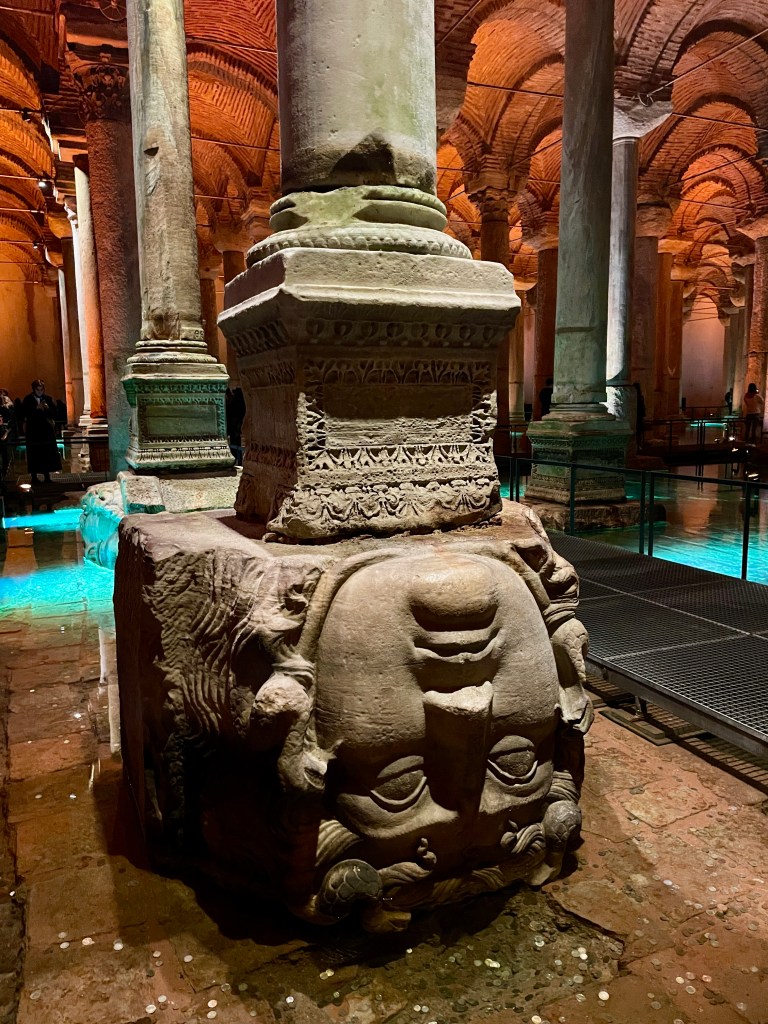
  7. Basilica Cistern (Yerebatan Sarnıcı in Turkish)
  8. Hagia Sophia (now costs 25 euro/ticket), guided tour then lunch at Dubb
  9. Minoa Akaretler (bookstore and cafe in Beşiktaş and Pera)
  10. The Fatih Mosque (dinner at Buuzecedi Restaurant)

Sea bass at Cafe Privato

Doug and I saw the sights, from the Basilica Cisterns to Balat. He tried salep (a resounding yes), enjoyed Syrian food, and quizzed our tour guide at the Hagia Sophia. We explored a lot in just a few days and, all too soon, he was off to Bangkok.

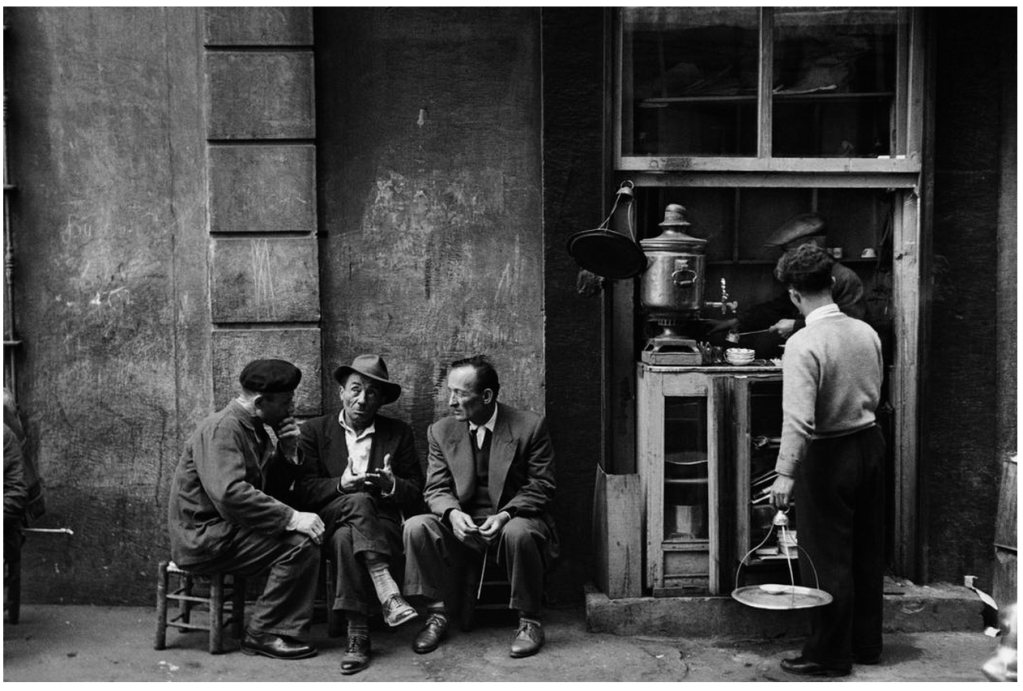
All this touring has me thinking about what I would still like to see in this city of seven hills. A meal at Çiya Sofrası tops the list (traditional Turkish cuisine on the Asian side). A visit to the Sabatchi Museum during tulip season is a definite must. I did check one thing off the list that week – after Doug departed, I visited the Bomonti neighborhood and finally made it to the Ara Güler Müzesi.

Ara Güler, People sitting talking beside a coffee bar in Beyoglu, 1958

Just a few days later, another visitor arrived in town. David, my former student from APIS, came through for a long layover. Like something out of Anthony Bourdain, we made the most of the 24 hours David was on the ground. Dinner on the George’s Hotel Terrace (elevator to Floor 5) with dessert at Mahizer’s sidewalk cafe off Taksim. A trip to Sultanahmet and the Arasta Bazaar. Even a stop through the Pera Museum to see the contemporary and historic mix of arts and culture of the region.

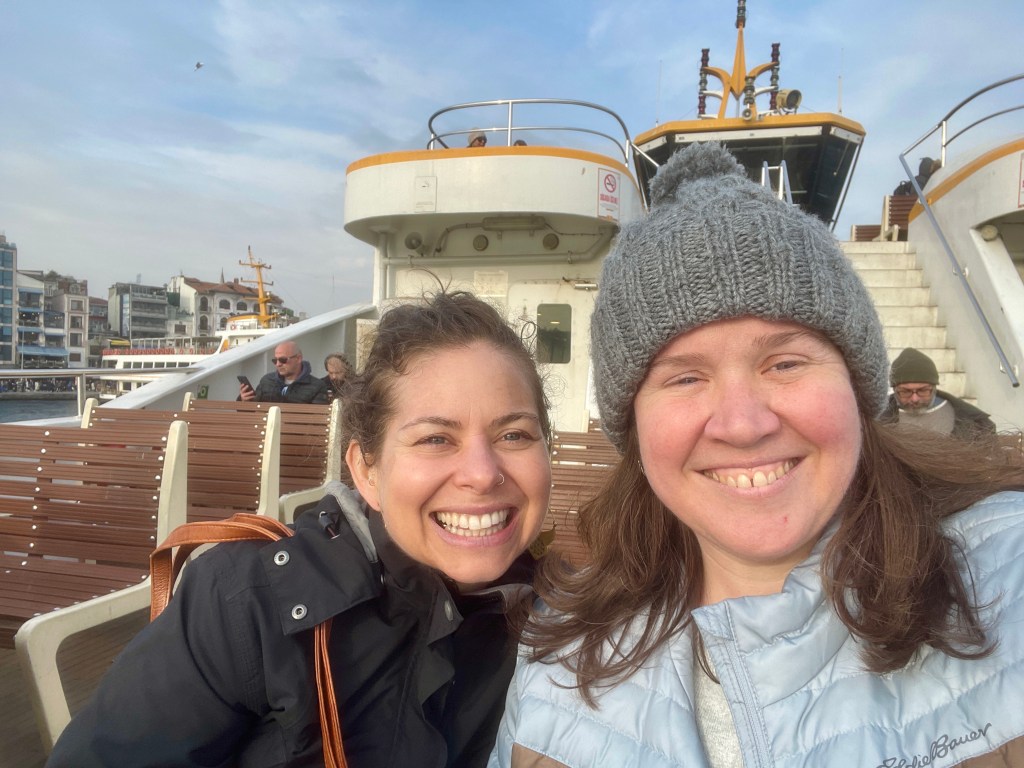
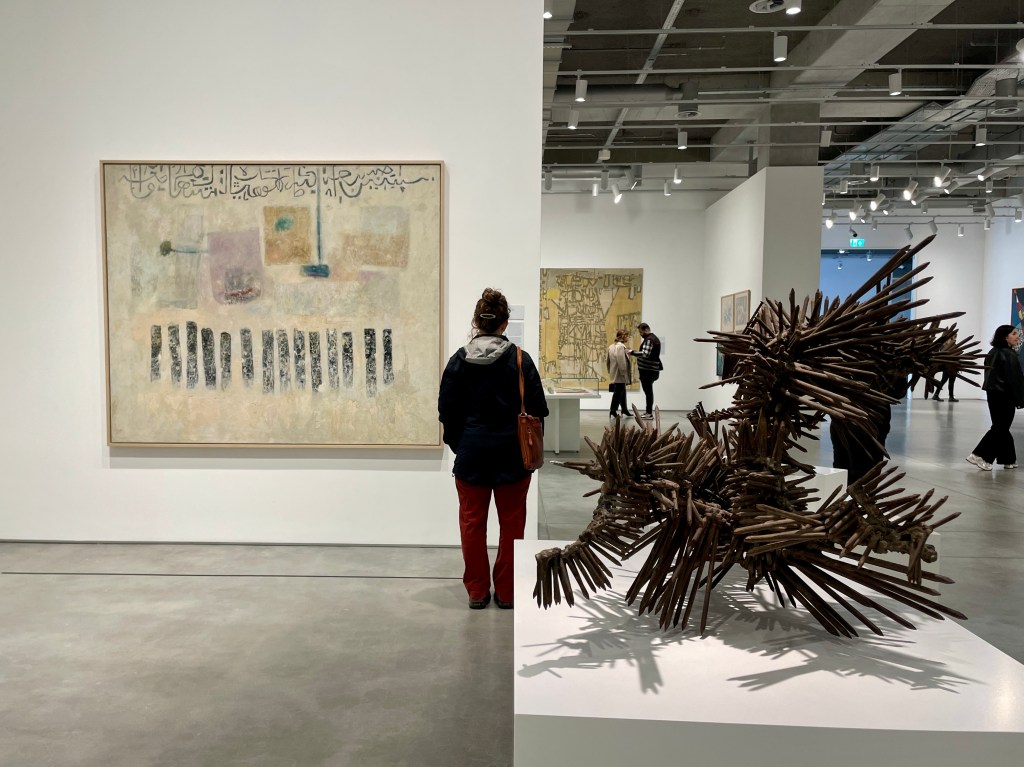
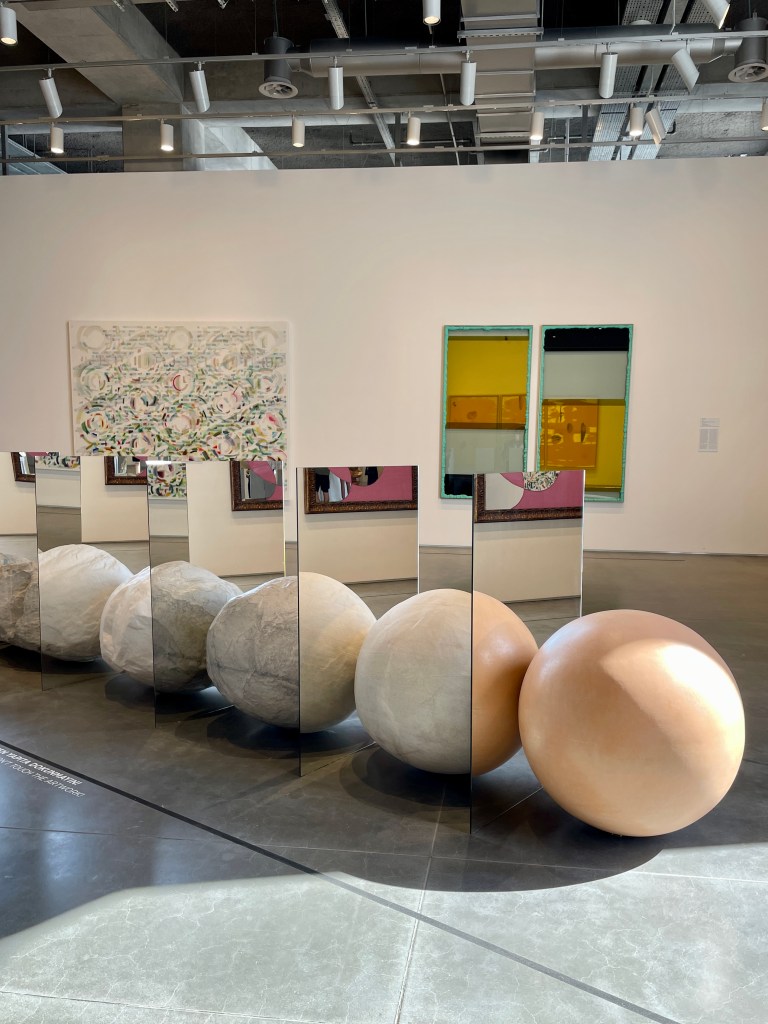
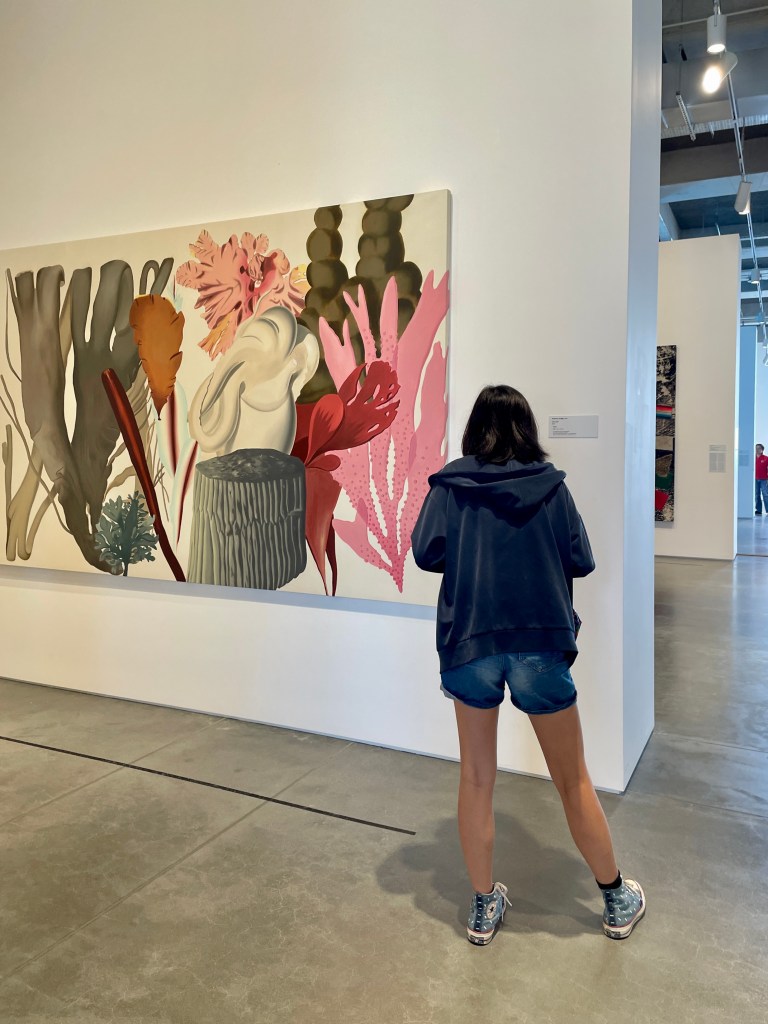
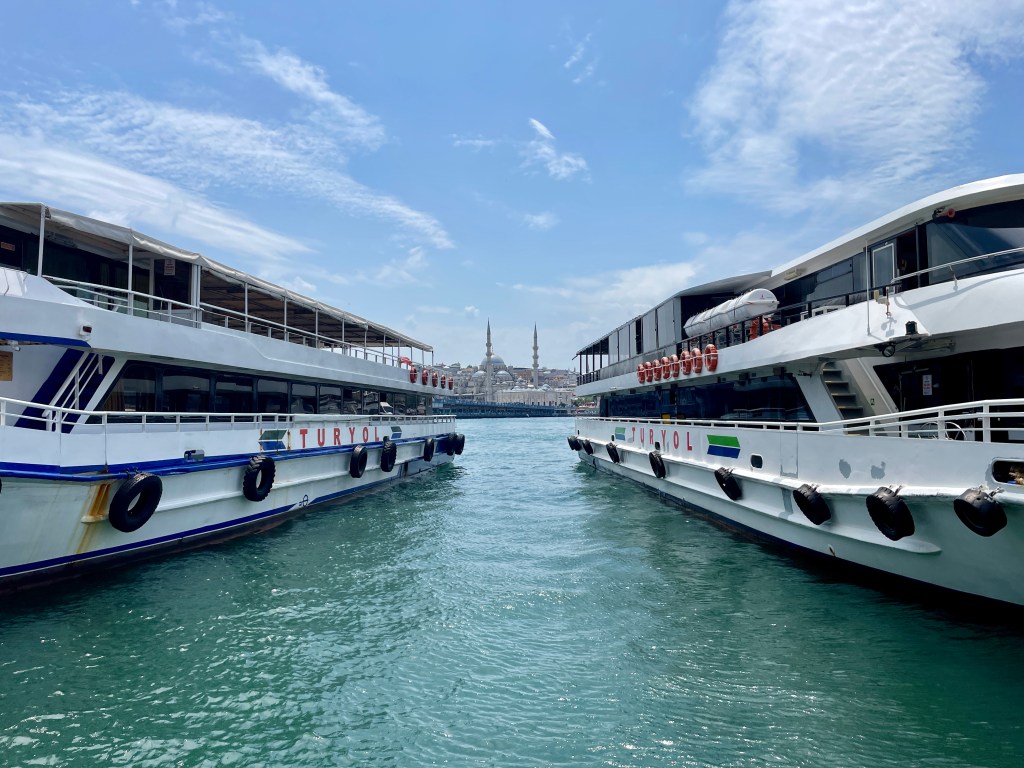
After meeting up with Rachel, we headed to the Istanbul Modern and took in the new exhibitions. As Rachel is a boatbuilder from Rockland, Maine, it seemed only natural to get out on the water. We took the Karakoy/Eminonu/Kadikoy ferry loop, enjoying the views from the top deck. Dinner at Karaköy Gümrük capped off the evening and soon Rachel was on her way.

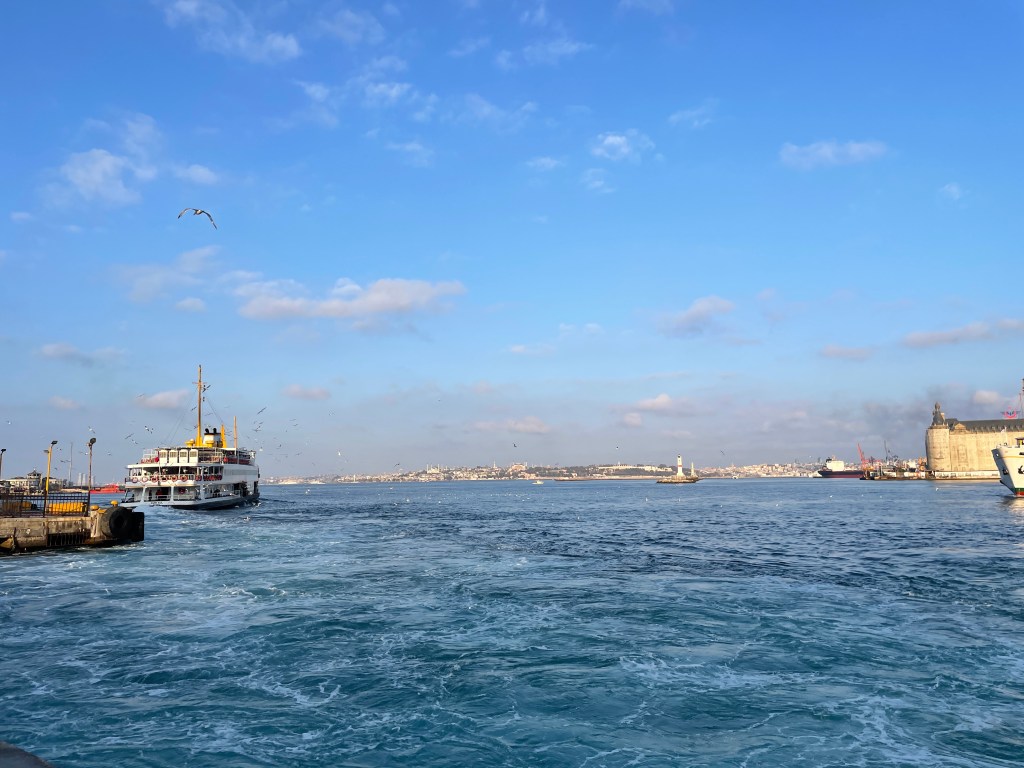
Ferry ride on the Bosphorus

More visitors are on their way this spring, with more sights to be seen. This city certainly has a special hold over all who are lucky enough to visit – the essence of which was beautifully captured by the poet Orhan Veli (translated by Talat Sait Halman). I leave you with his poem, I Am Listening to Istanbul, a recent recommendation from a friend.

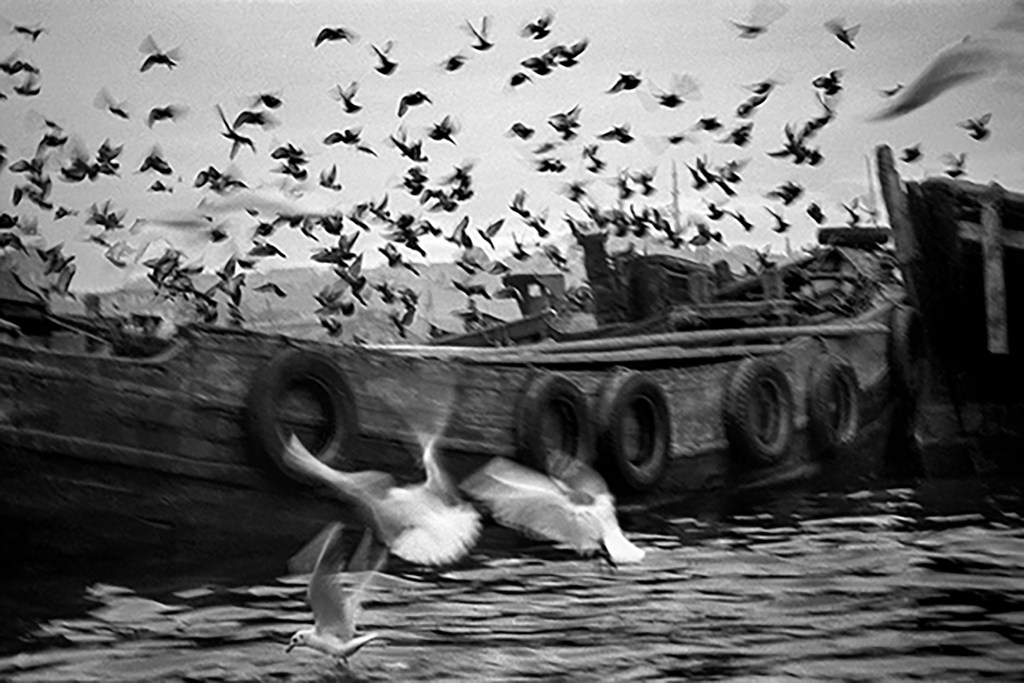
Ara Güler, The Golden Horn, Istanbul

I am listening to Istanbul, intent, my eyes closed:

At first there is a gentle breeze

And the leaves on the trees

Softly sway;

Out there, far away,

The bells of water-carriers unceasingly ring;

I am listening to Istanbul, intent, my eyes closed.

I am listening to Istanbul, intent, my eyes closed;

Then suddenly birds fly by,

Flocks of birds, high up, with a hue and cry,

While the nets are drawn in the fishing grounds

And a woman’s feet begin to dabble in the water.

I am listening to Istanbul, intent, my eyes closed.

I am listening to Istanbul, intent, my eyes closed.

The Grand Bazaar’s serene and cool,

An uproar at the hub of the Market,

Mosque yards are full of pigeons.

While hammers bang and clang at the docks

Spring winds bear the smell of sweat;

I am listening to Istanbul, intent, my eyes closed.

I am listening to Istanbul, intent, my eyes closed;

Still giddy from the revelries of the past,

A seaside mansion with dingy boathouses is fast asleep.

Amid the din and drone of southern winds, reposed,

I am listening to Istanbul, intent, my eyes closed.

Fairyland

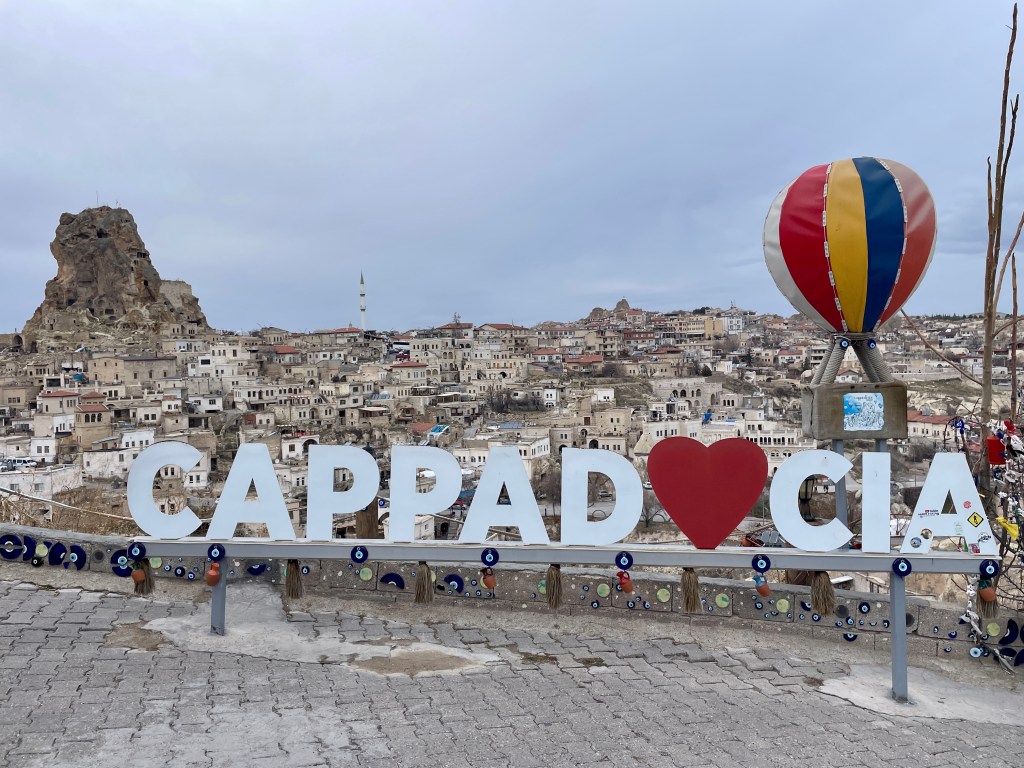
Cappadocia. Now that my time in Türkiye has an expiration date, I want to make the most of the time I have left. With my good friend on board, we hopped a Turkish Airlines flight to Kayseri and quickly found ourselves in a majestic foreign land.

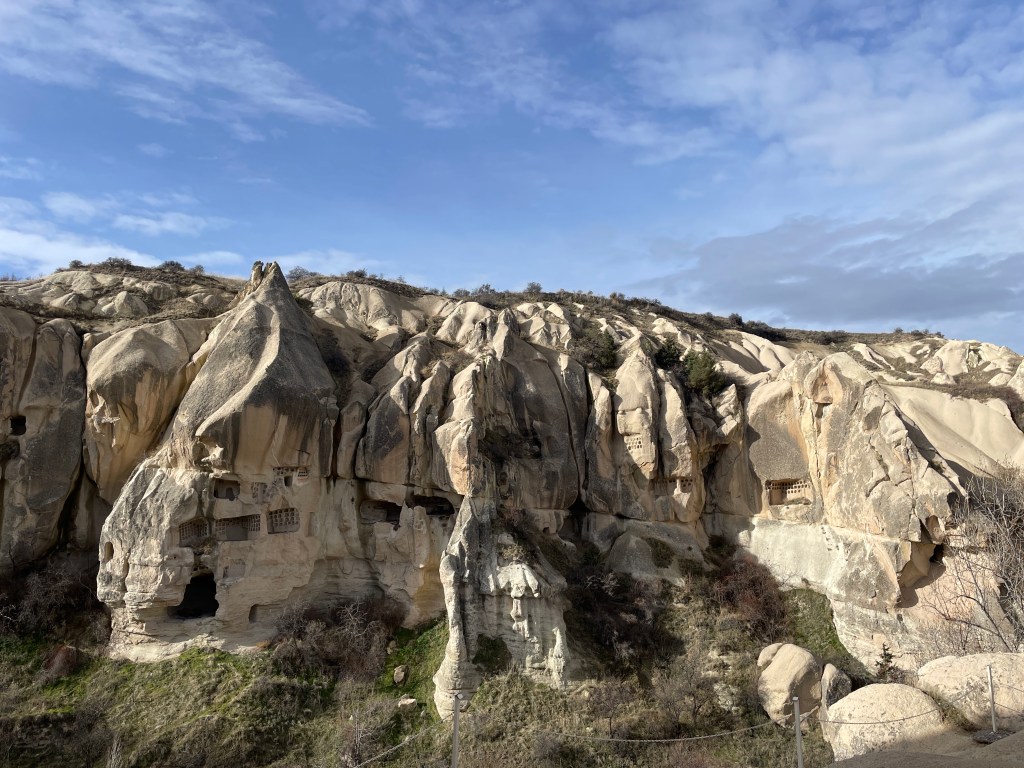
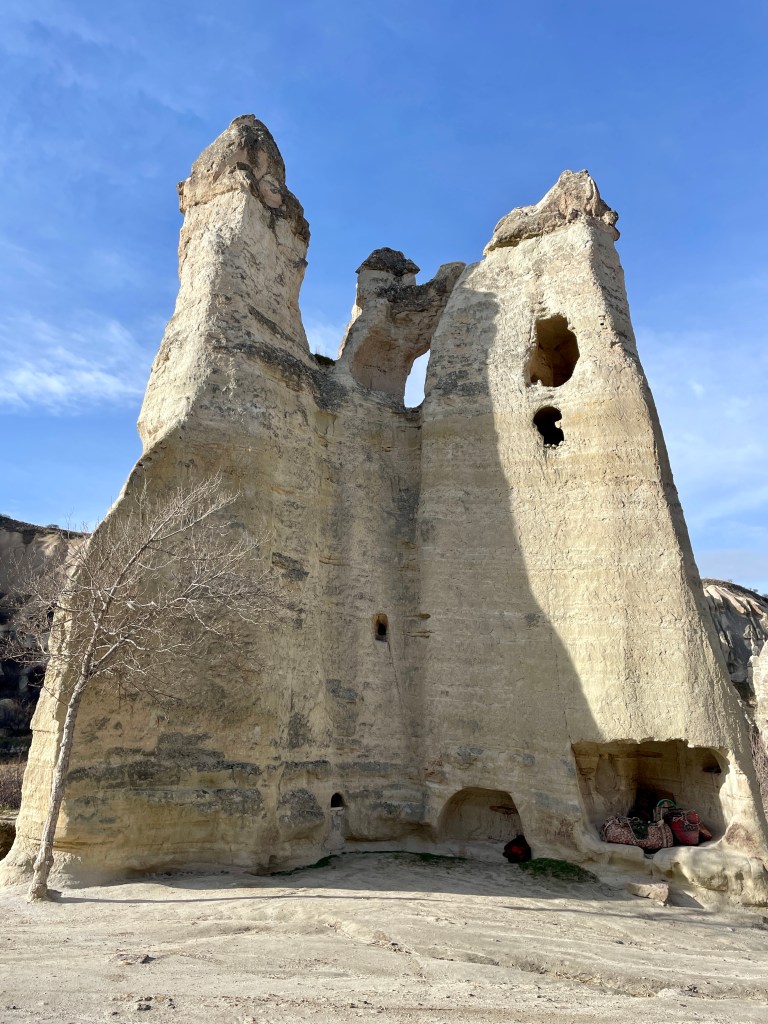
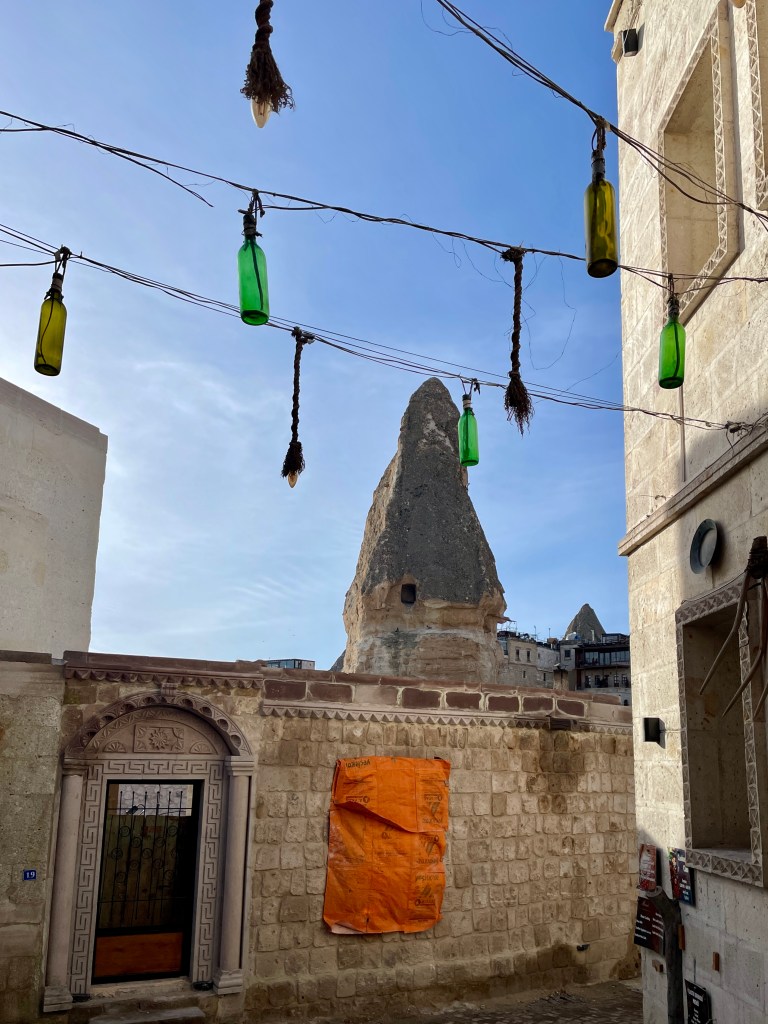
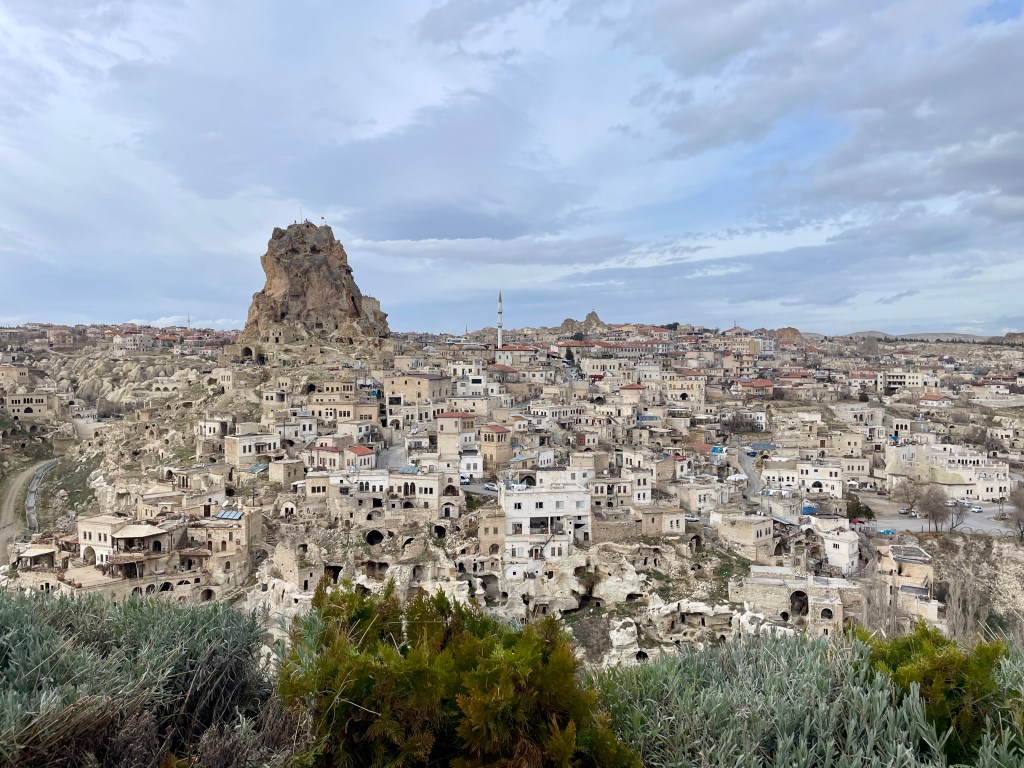
Cappadocia is located at altitude in central Turkiye. The area is known for unique rock formations often referred to as fairy chimneys. The fairy chimneys are a result of a geologic process that began millions of years ago, when volcanic eruptions rained ash across what would eventually become Turkey. That ash hardened into tuff, a porous rock, which was covered by a layer of basalt. Carved by centuries (millennia?) of wind and water flow, these rock formations blanket the landscape like something out of a Dr. Seuss book.

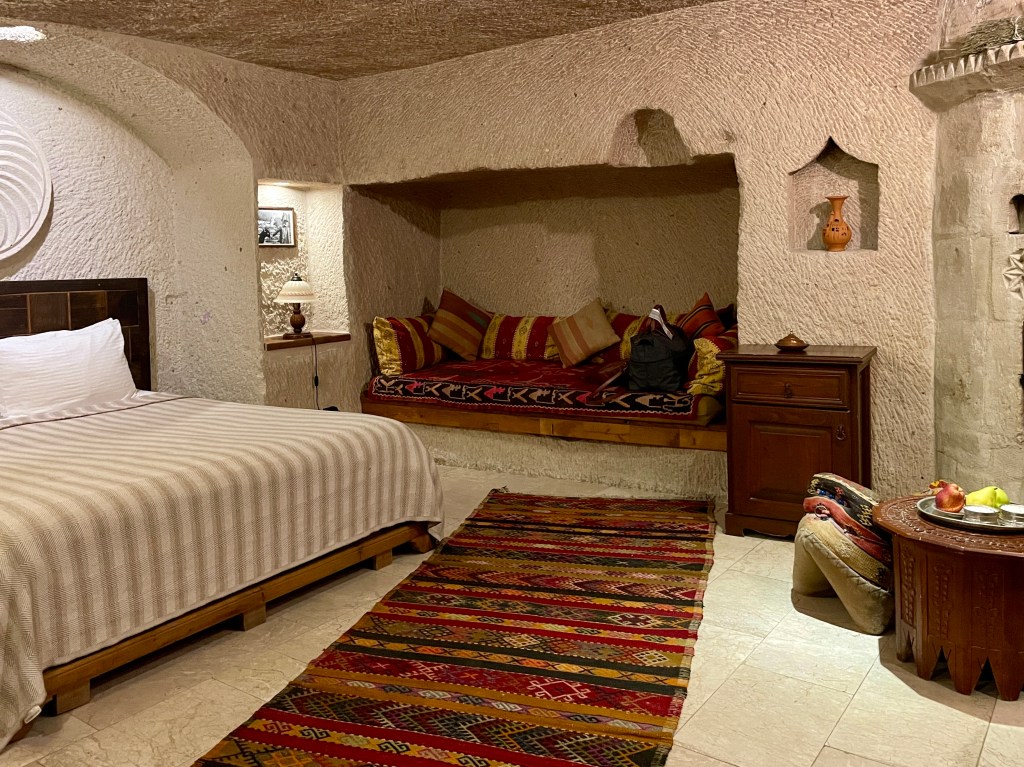
The Kelebek Special Cave Hotel came highly recommended and featured rooms carved into the fairy chimneys themselves. My room was surprisingly warm and toasty inside. Draped in textiles and texture, it proved an insulated spot for a great night’s sleep.

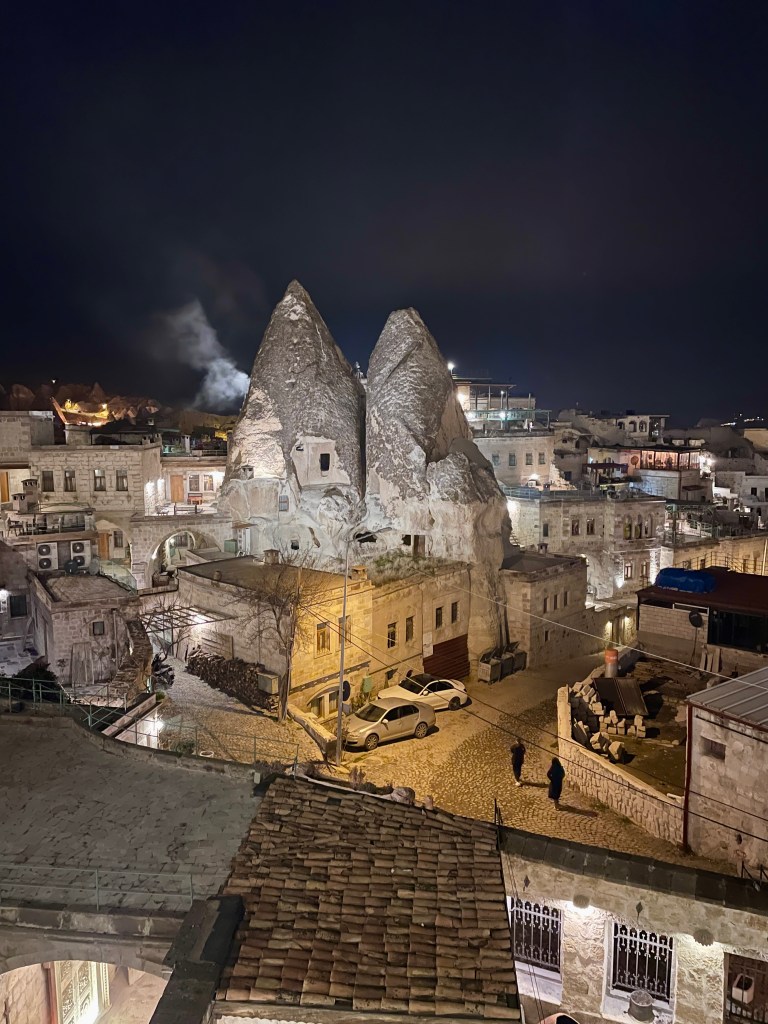
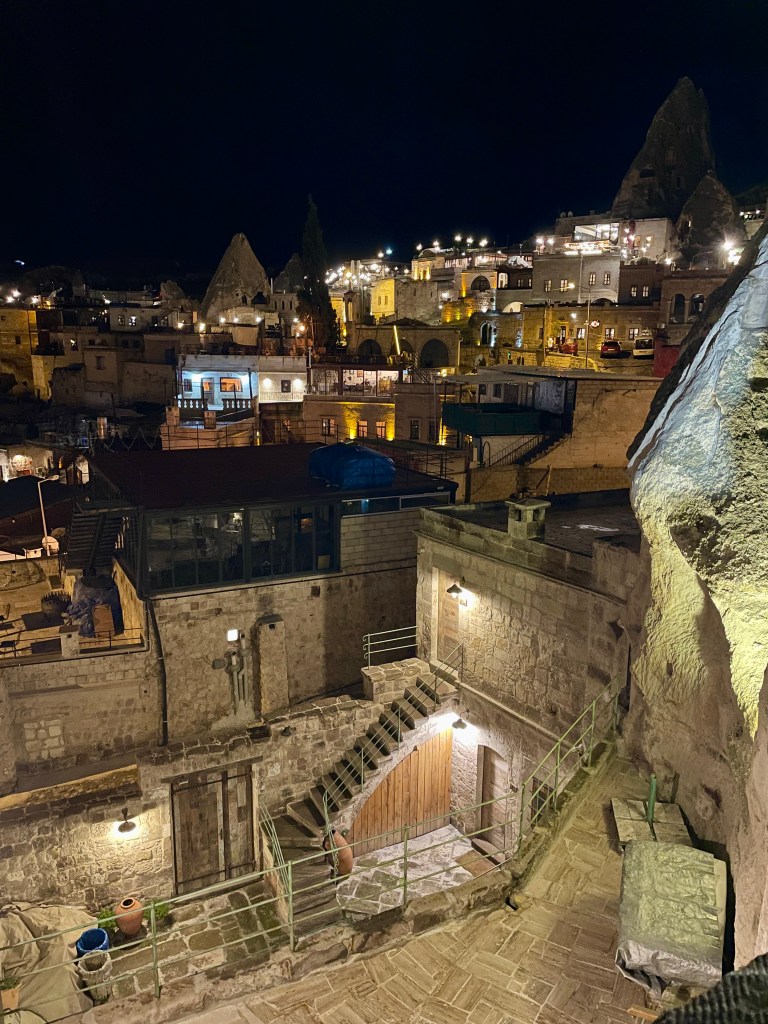
From Kelebek’s mountain top location we were treated to a beautiful vista featuring the lights of the surrounding valley. Like a game of shoots and ladders, hotels and homes were stacked and folded into the stone pathways willy-nilly. The landscape was punctuated by smoke from the fairy chimneys rising in the air, providing a mystical vibe against the inky night’s sky.

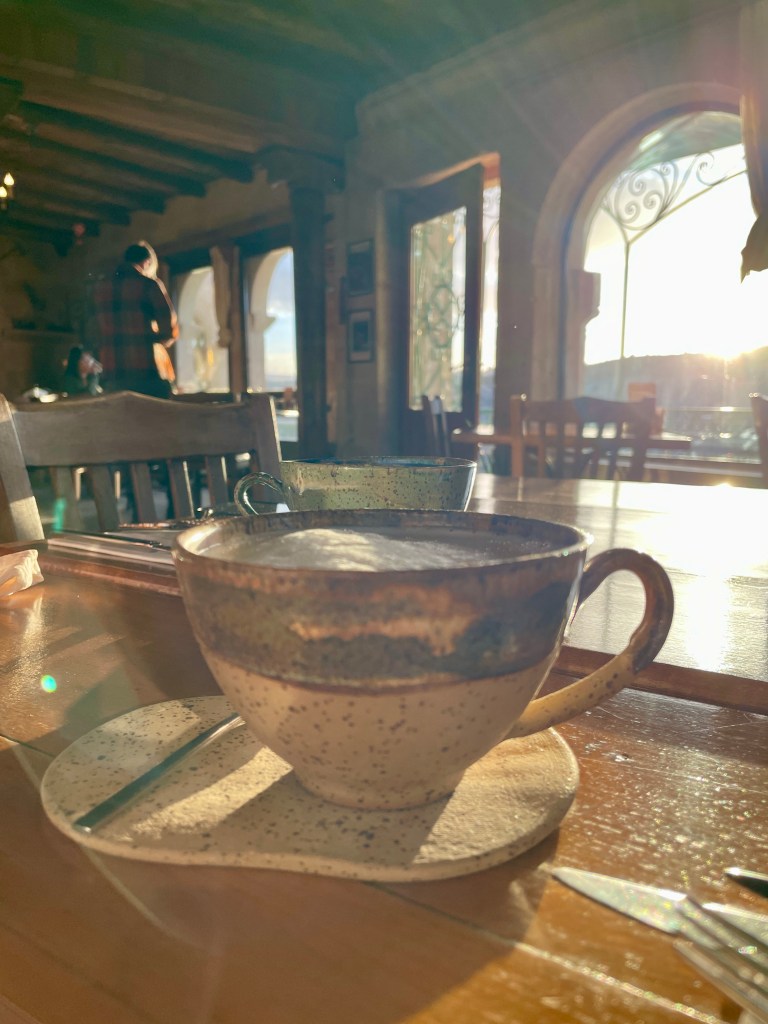
We awoke Saturday morning to blue skies and no wind. Enjoying in a sun-soaked Turkish breakfast, we made a plan for the day ahead.

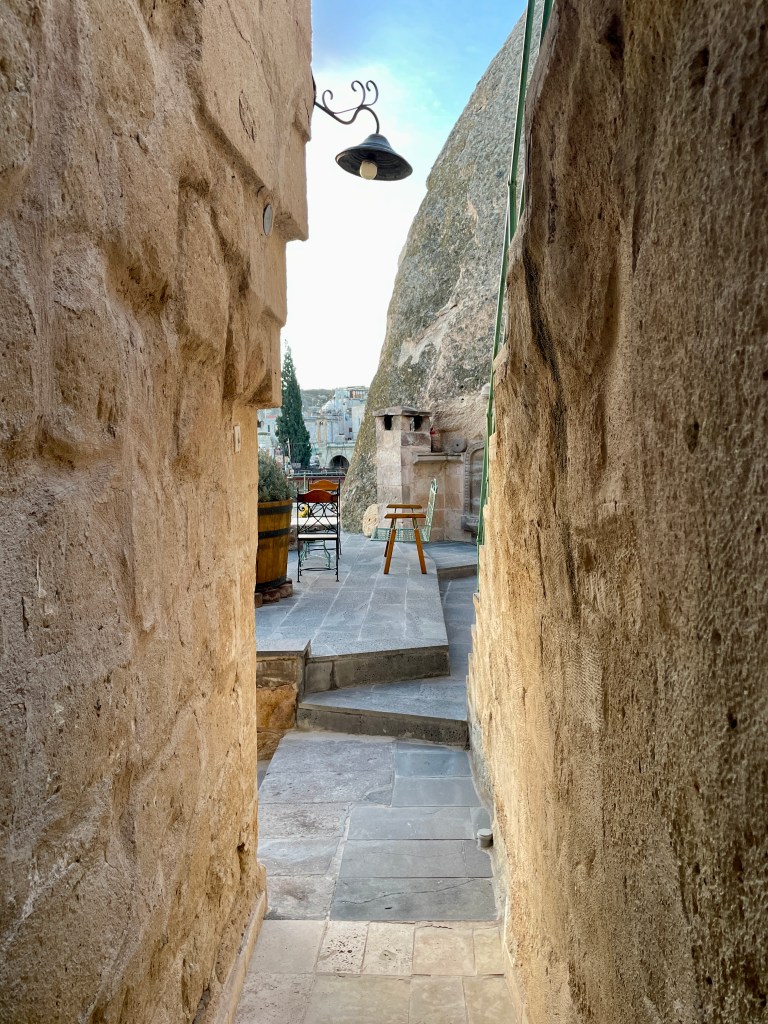
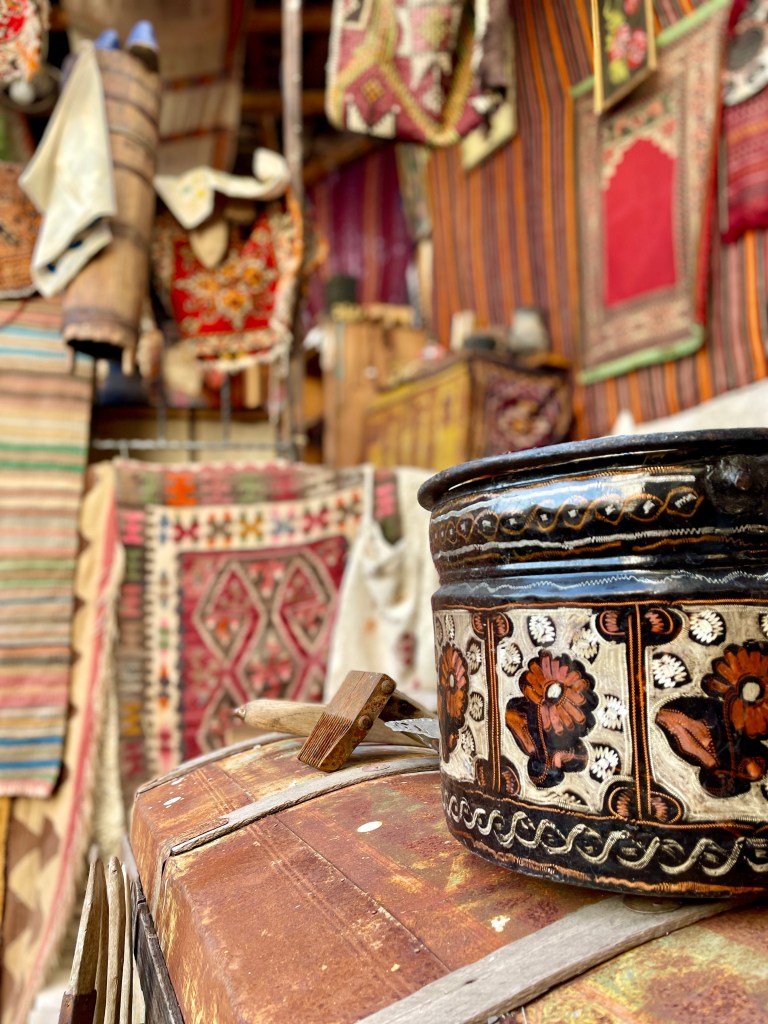
Opting to make our way slowly down the mountain towards town, we stopped to take photographs and explore little alleyways along the way. A funky antique shop lured us in and we were happily lost in the labyrinth for a while.

Just outside of downtown, the Goreme Open Air Museum offered the chance to enjoy the cliff dwellings up close and alongside the fairy chimneys.

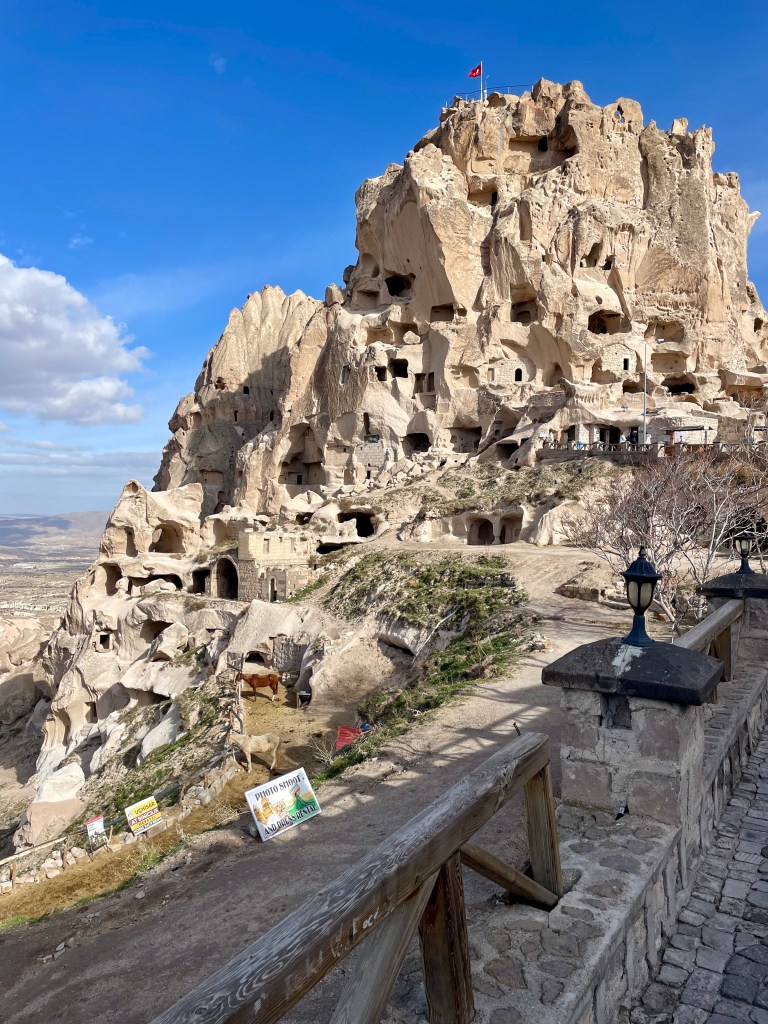
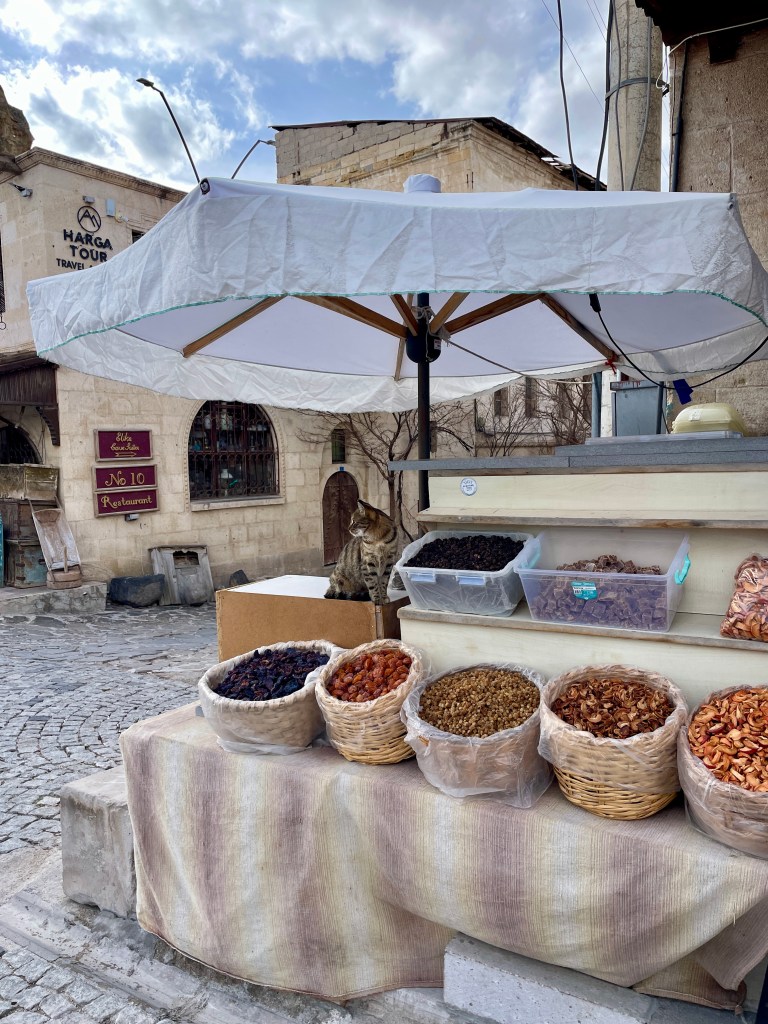
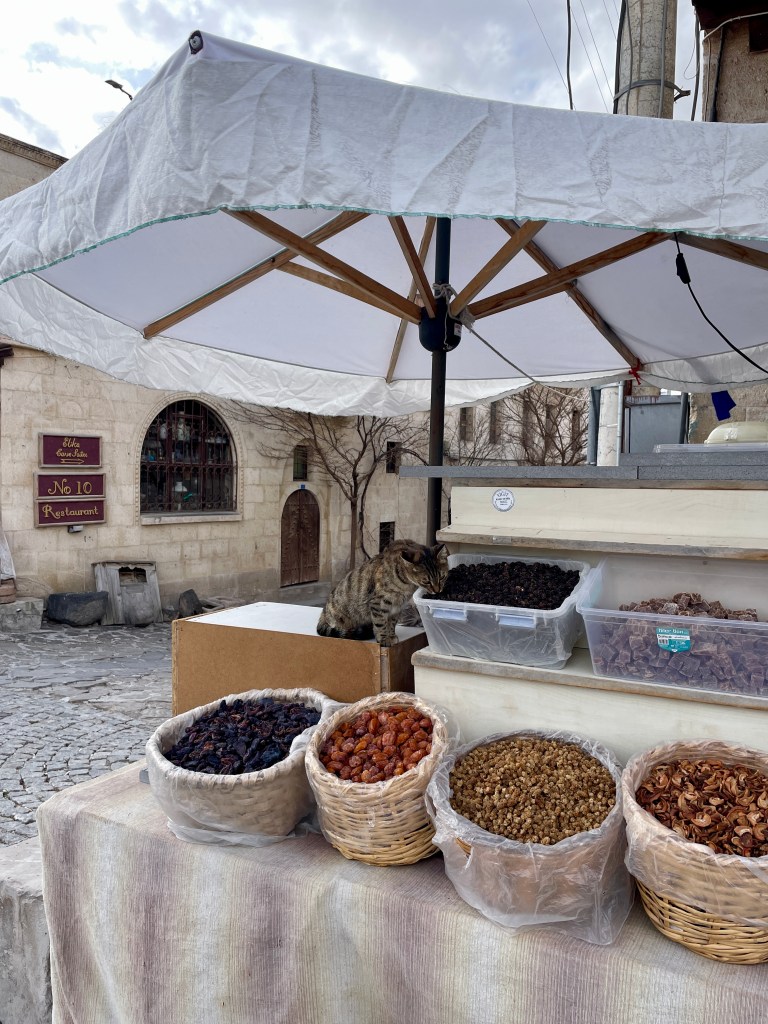
We visited a number of neighboring towns, moving from valley to valley via quick 10-minute taxi rides (Uchisar and Ortahisar were highlights). Each town featured a monolithic castle formed out of the volcanic rock, a small marketplace, and plenty of cheeky cats.

Cappadocia is also known for hot air balloon rides. Much like you’d find a ski conditions chart at the front desk of a ski resort, the daily balloon status chart is located behind the reception desk at the Kelebek. Guests are encouraged to reserve a balloon ride for the first morning of your trip, as cancellations for inclement weather are common (safety first in an unexpected twist). You can always bump your reservation to the next day in hopes of enjoying a sunrise flight. My balloon was cancelled both days but I was just as pleased to explore the valleys from the ground. Would love to go back someday and see the balloons fly.

Turkey is such a friendly country to explore. Despite rising inflation, travel here is still in the visitor’s favor. The shopkeepers we met were all hospitable and kind, proudly showing their wares and eager to ask us about our country of origin.

Each town brought beautiful views. We soaked them in as best we could, stopping at little cafes along the way.

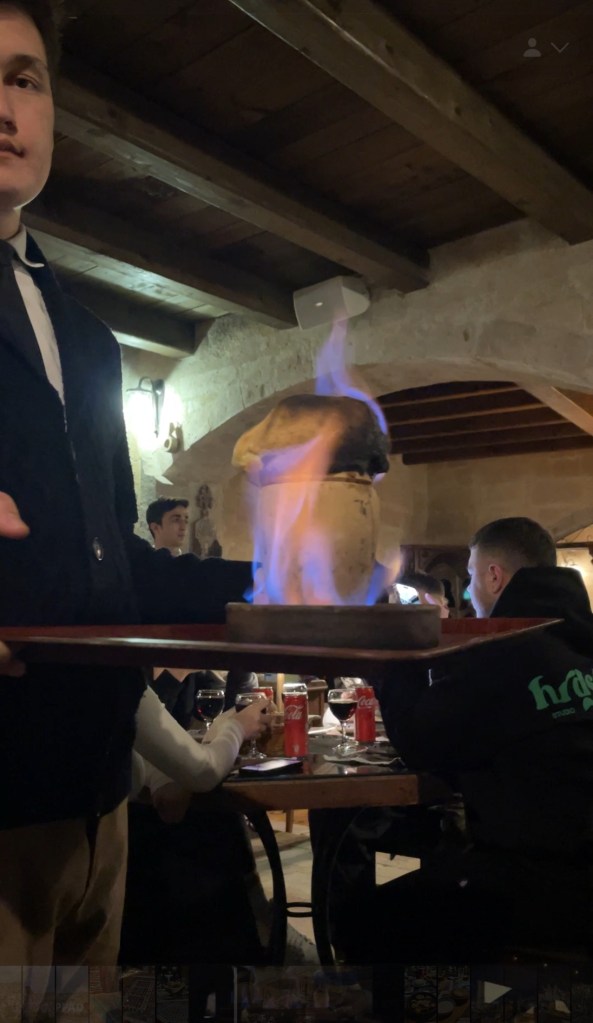
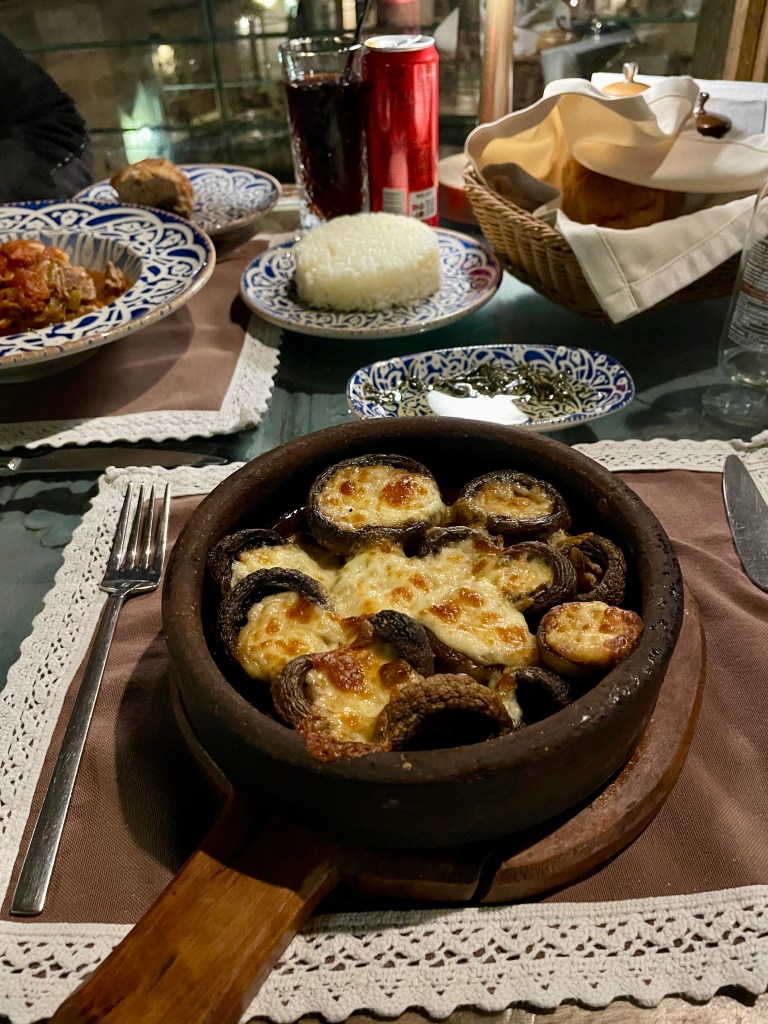
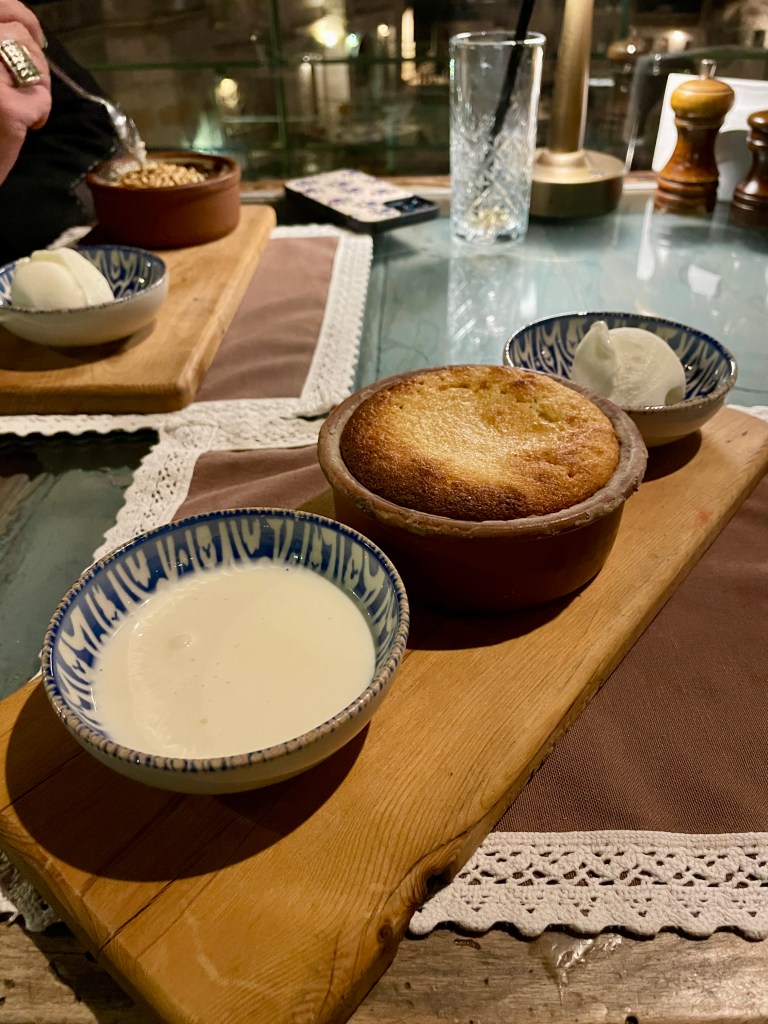
On our final night in Cappadocia, we decided to find a dinner spot with a view. Seten Restaurant, right up the road from the Kelebek Hotel, proved the perfect spot. Featuring Anatolian specials, Michele enjoyed the flaming local dish known as Testi Kebabı, or “pottery kebab”. Veal, tomato, pepper, garlic and onion slow-cooked inside of a clay pot in the wood fire and served with rice. The clay pot is cracked open at the table after being delivered on fire. Quite a sight! I’ve found Turkish desserts featuring tahini delicious, a juxtaposition against the sweetness of a typical dish. At Seten, I enjoyed a decadent tahini soufflé. Here’s the menu if you’d like to take a look.

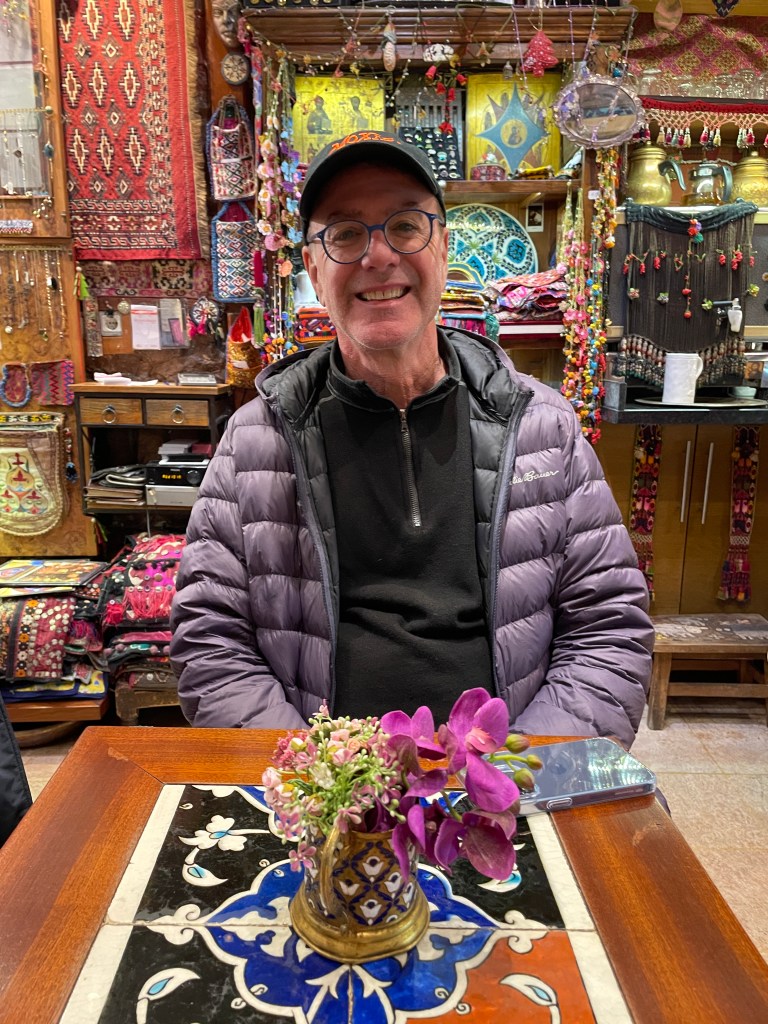
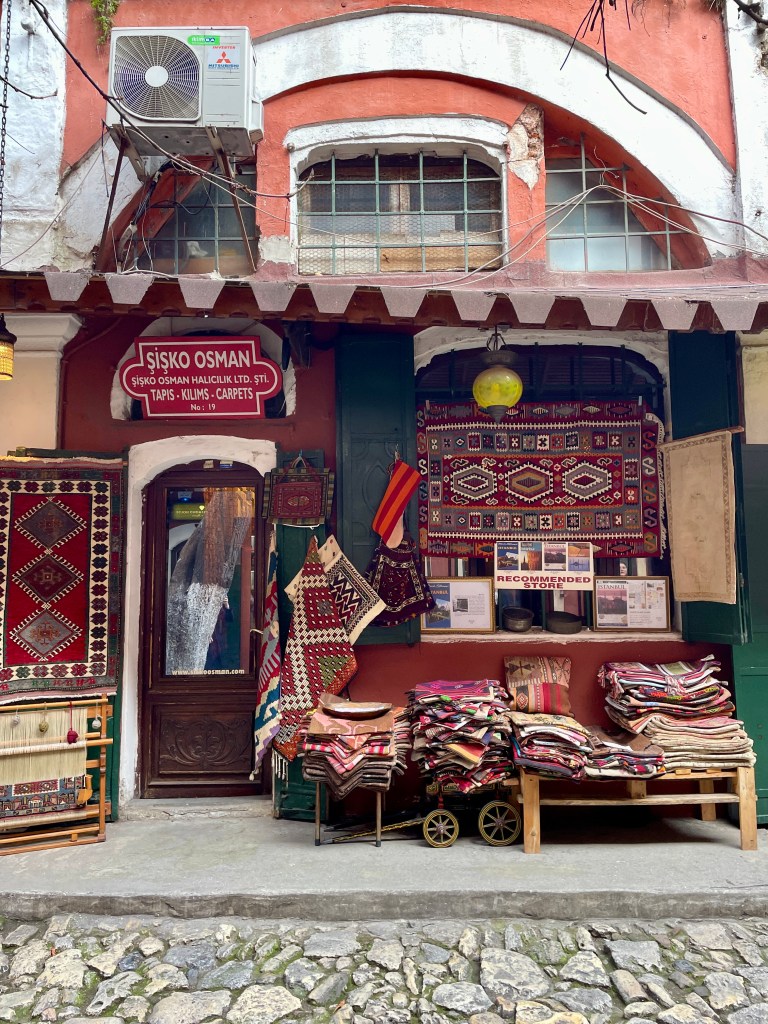
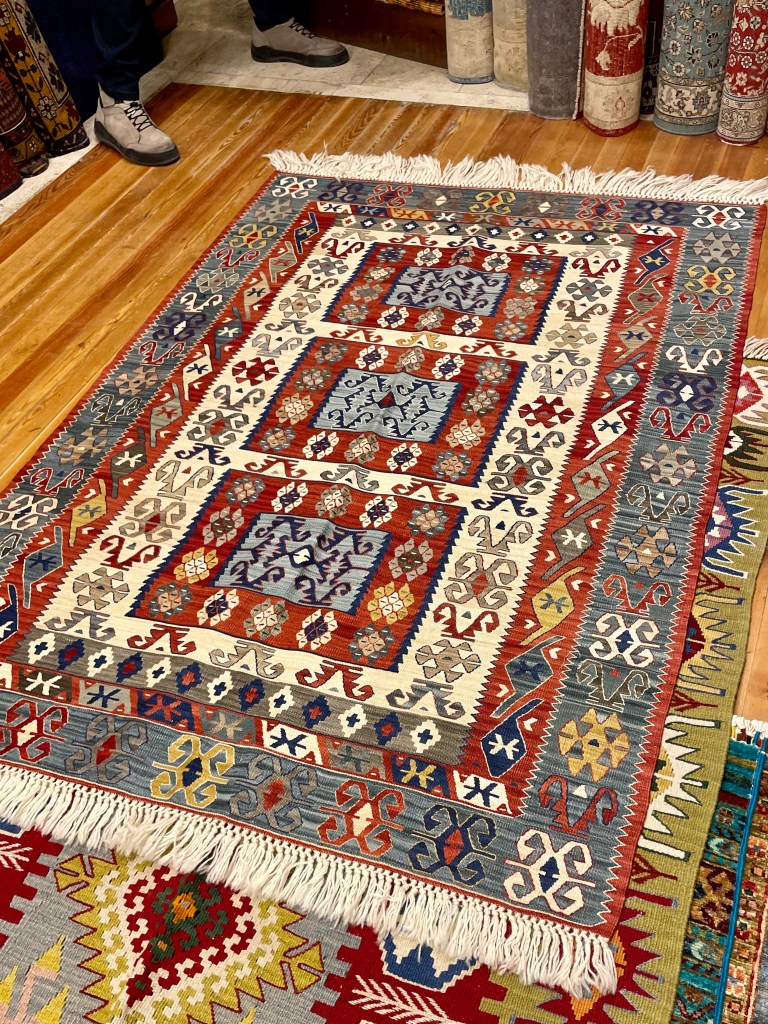
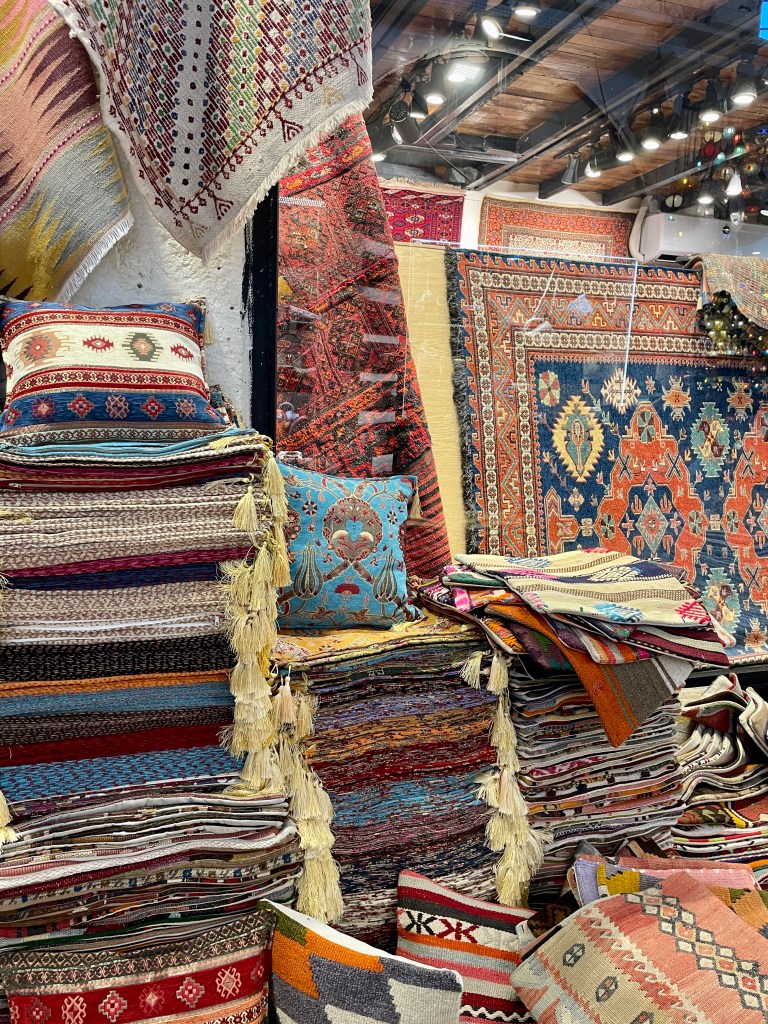
One last treat of Cappadocia is the beautiful textile shops. My friend Tracey has known Ali, the owner of Sultan Carpets in downtown Göreme, for many years and he welcomed us warmly.

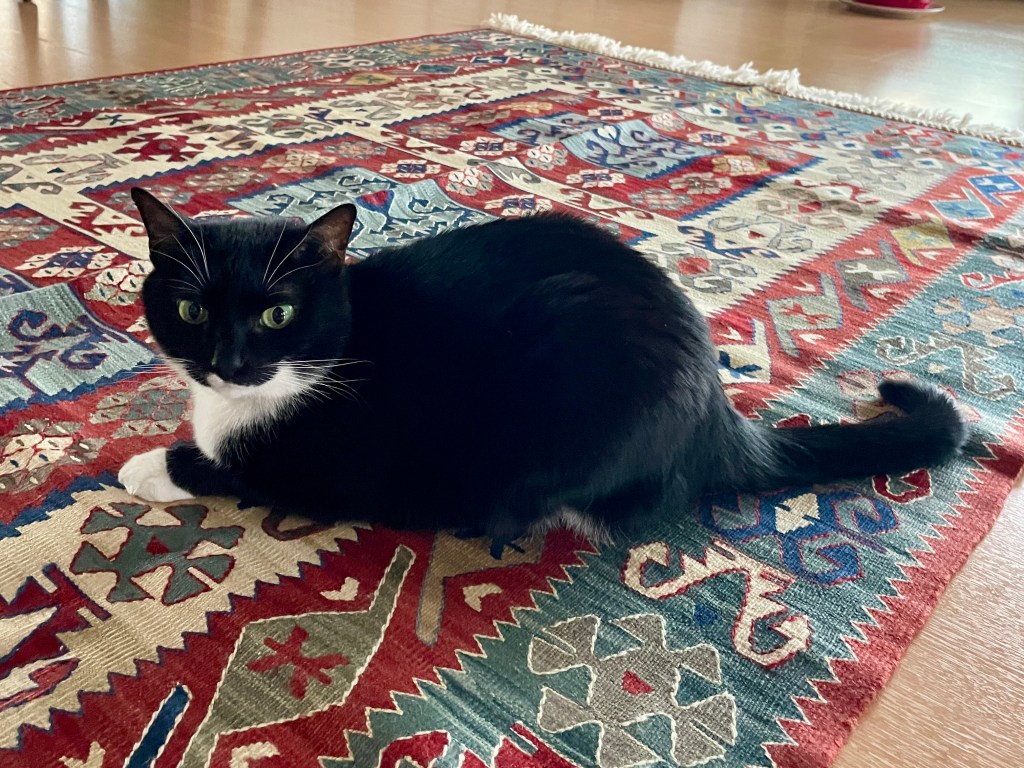
Both Michele and I brought large souvenirs home (Michele’s on the left, mine on the right), a memory of Cappadocia to last. Seen here, Moloko breaking in my new carpet which we’ll take to Switzerland.

It boggles my mind that such a landscape is located only a short flight from Istanbul. A wonderful reminder of how restorative a weekend away can be and all that I still wish to see during my time in Turkey. Luckily, I have a few visitors on the way to join the fun…

Lodos

Happy New Year, everyone. Winter has arrived, with January bringing us rain and much cooler temperatures here in Turkey. We’ve had snow flurries here and there but nothing has stuck quite yet. Winter in Turkey really runs from January through March and the lead up can bring some pretty intense winds. These winds are known as lodos.

View of the Bosphorus from the terrace of the Istanbul Modern Museum of Art

The lodos are strong winds originating in the Aegean Sea to the south of Istanbul. These winds are strong enough to redirect currents and can wreck havoc on shipping in the Bosphorus, with winds at the level of a strong gale or 50 knots (a 9-10 on the Beaufort scale, so I read).

Lodos winds step beyond the realm of a natural phenomenon, arriving replete with their own folklore in Turkish culture. When the lodos blow, headaches, sleeplessness, and overly emotional thinking may all occur.

In the spirit of the new year, I’m choosing to view lodos as winds of change. As the Scorpians sang (or the CIA wrote?), “The future is in the air, I can feel it everywhere”. They may have been referring to the approaching end to the Cold War, but, for me, these lines refer to potential changes in latitude in 2024.

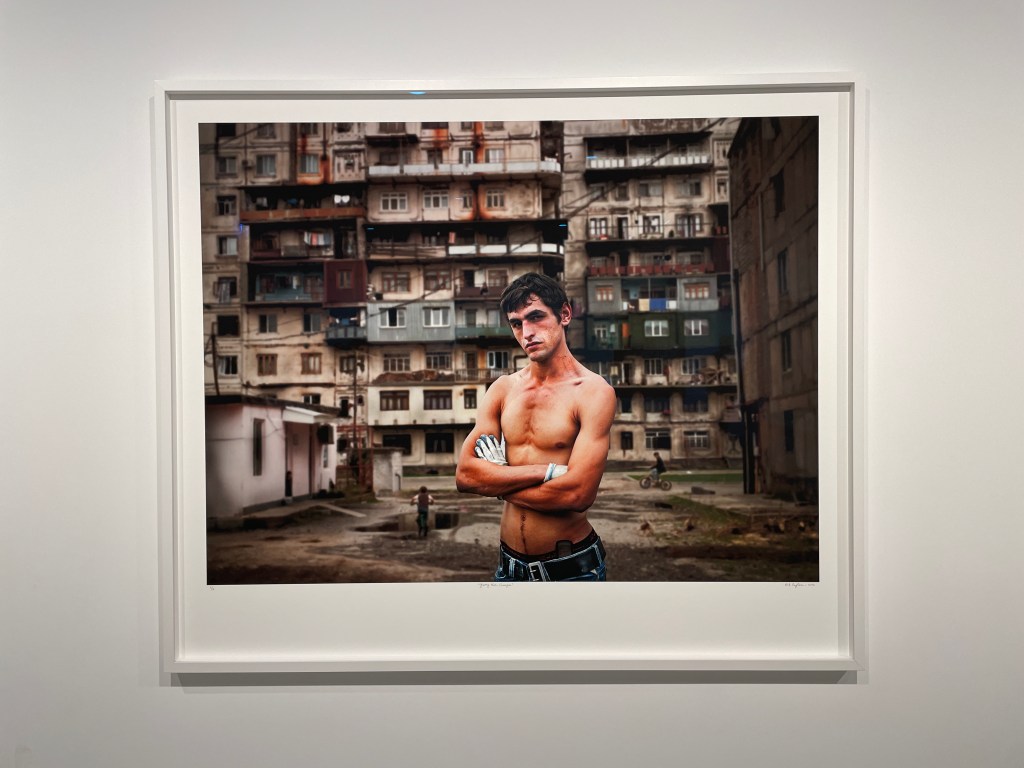
Portrait from Tbilisi, Georgia

Back in late October I had to grapple with the choice of continuing my time here in Turkey or setting my sights elsewhere, to another international post. As those of you who have been reading this blog are likely aware, my time in Turkey brought incredible opportunities my way – from fantastic new friends to unique travel destinations such as Georgia and Romania. The international school timeline means a teacher could go months between deciding to turn down a contract to securing a new position, and that’s if you’re lucky enough to receive an offer. It’s quite a cliff to dive off – not one I take lightly.

In the end, I have decided to bring my time in Turkey to a close. Moloko and I will depart Istanbul in June 2024, having enjoyed a dynamic two years in this exciting ancient city.

I’m excited to share that I have taken a position at the American School in Switzerland (TASIS), my alma mater of sorts from my camp counselor days. The school is nestled in the foothills of the Swiss Alps, on a small mountain called Montagnola. As a twenty-something, I spent four summers at TASIS, becoming acquainted with international life. I met friends and campers from all over the world, soaked in the gorgeous views of Lake Lugano, and took trains into the mountains on my days off.

I am very excited to return to TASIS, this time as a faculty member of the Visual Arts Department. I will continue teaching IB Visual Arts, and also have the chance to teach drawing, painting, and the like. This new chapter in Lugano will begin in August 2024. Visitors are most definitely welcome!

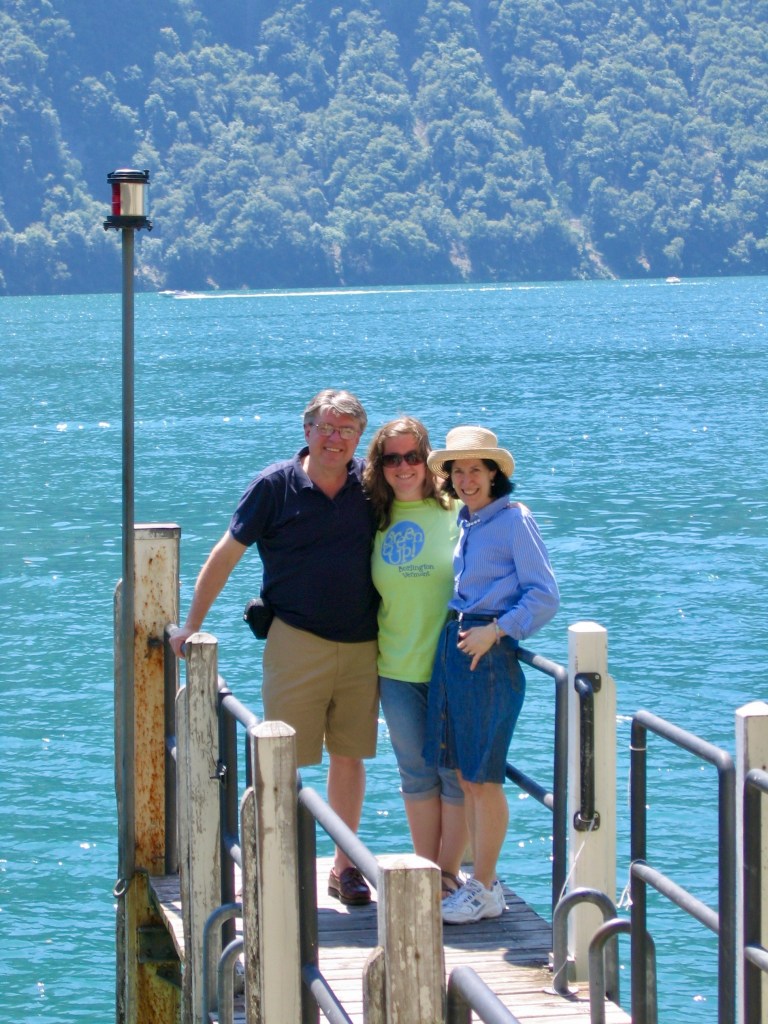
Mom and I on Montagnola, overlooking Lake Lugano

A new year brings the promise of change. It is never easy to depart from a place where meaningful relationships run deep. However, I do believe that there is a beauty in the time and place where our lives cross with others. I will take the next few months to relish these relationships amidst the backdrop of Istanbul. I have a few visitors from home headed my way and I remain a devoted tourist in this land of surprises. The next stop on my tour of Turkey… Cappadocia!

Balat

One of Istanbul’s oldest and most charming districts, Balat has a long history as the center of the city’s Jewish, Armenian, and Greek Orthodox communities. Balat today is overwhelmingly Muslim, with most minority populations having left the district or been forced to leave. Colorful two- and three-storey houses line the streets, making the neighborhood a hotspot for those drawn to the charm of “Insta-nbul” 😉

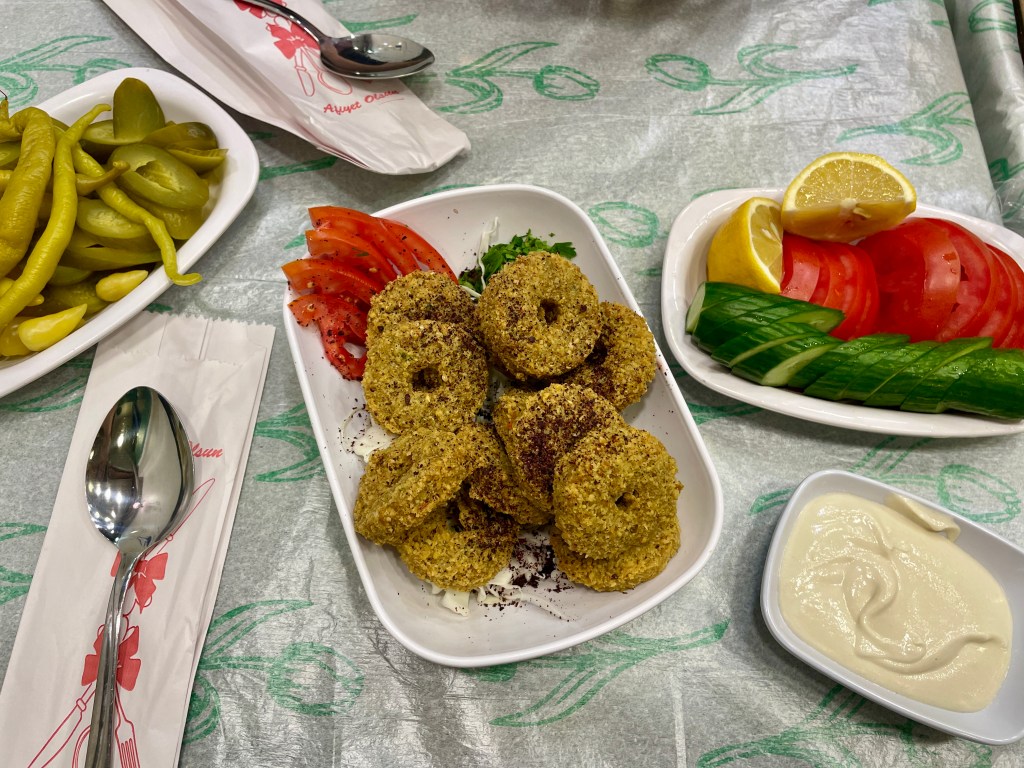
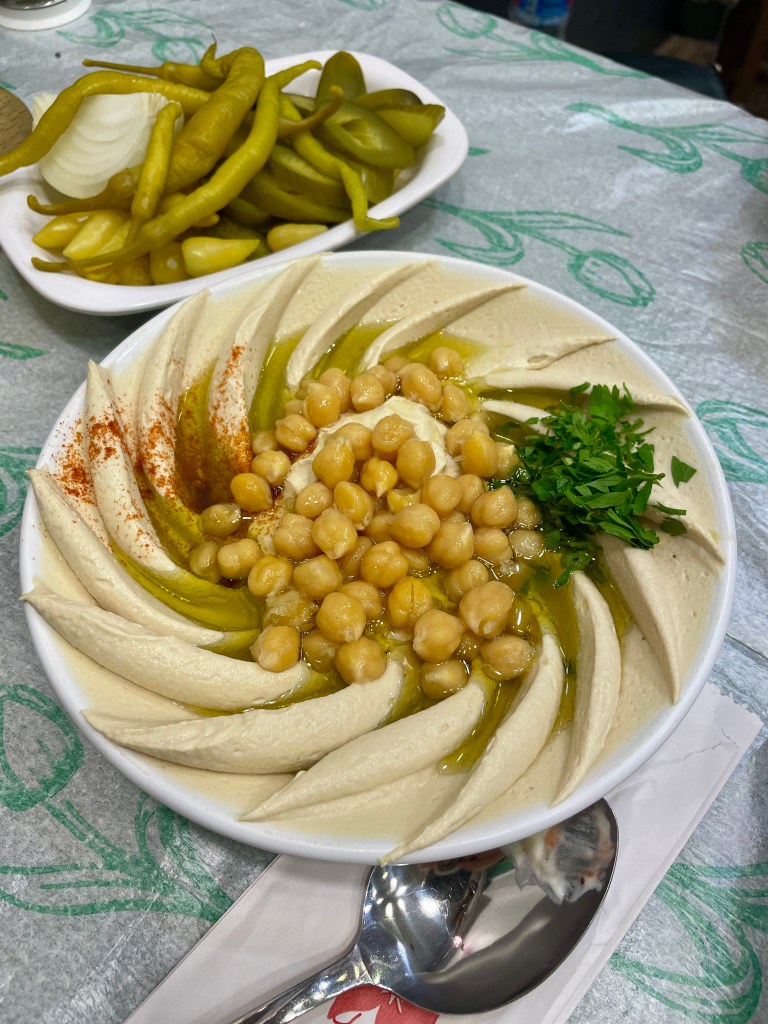
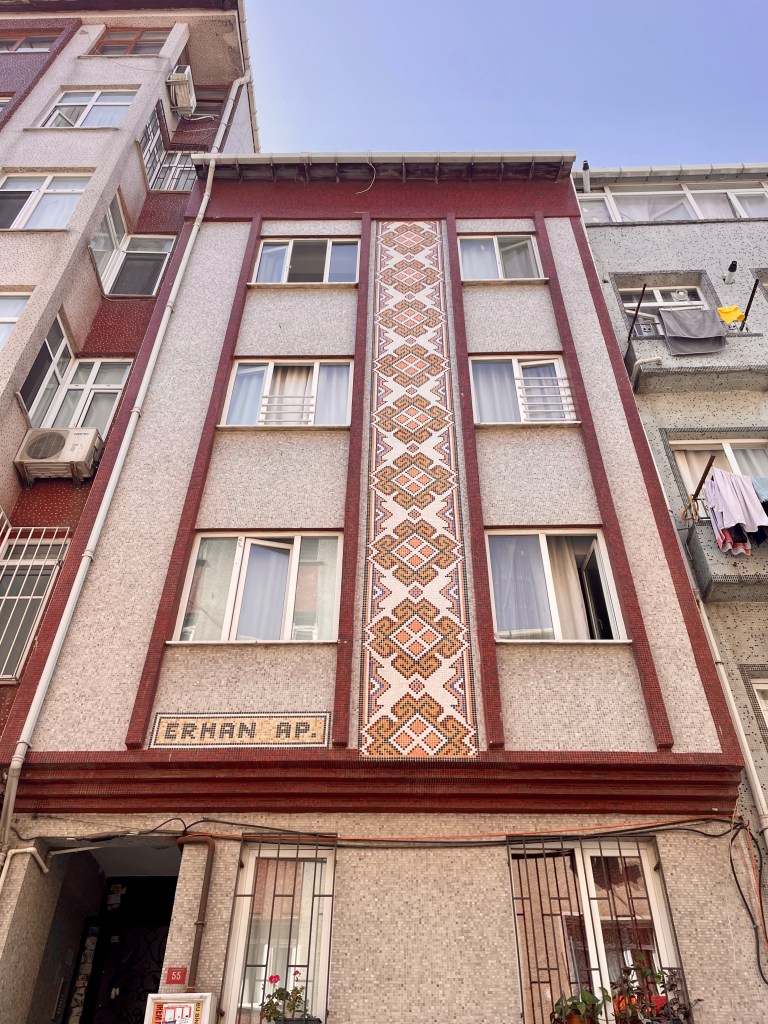
We started the day in central Fatih, retracing the path of my Syrian food last winter. Fortified by a brunch of hummus, falafel, and pickled vegetables, we walked past the Fatih Camii (mosque) and through the hilly backstreets to Balat. Ornate architectural touches dotted our path.

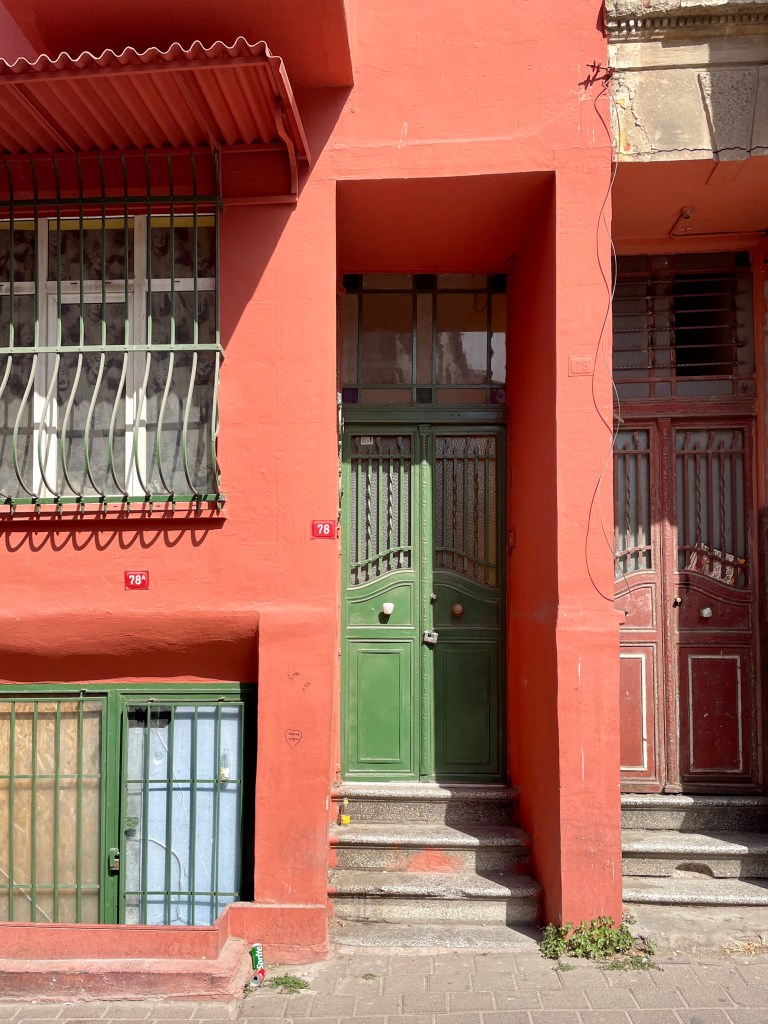
Pops of color beckoned around each corner alongside crumbling sidewalks and structures. This dichotomy of beauty and detritus is woven into the fabric of Istanbul, and it certainly something I’ve come to appreciate. You can’t have one without the other – they enhance each other.
We knew we’d reached Balat when the cafes spilled out into the street and cute boutiques appeared at every turn. After an iced coffee at Artlocalist, we went on a little hunt for treasures to bring back to friends and family in the States.

Balat proved just as charming as promised. As autumn makes its way towards Istanbul, I look forward to the chance to walk the streets far from the madding crowd that is tourist season here. I will return to see the beautiful painted ceiling of the Yanbol Synagogue and take in a new cafe someday soon.

I would be remiss to not mention that this post was delayed due to the passing of my Uncle Dick. It’s hard to believe that he has left us but I’m also thankful that dementia no longer holds a grip on his keen intellect.

I love this picture of all of us down the Cape years ago. We spent many a summer in East Dennis, famously tagging downed trees together after Hurricane Bob in 1991. He taught me how to play chess and never let me win at Scrabble – not even once 😉 He was always a supporter of my life abroad, eager to discuss foreign affairs and current events when I returned to the States for a visit.

I’m very thankful for the opportunity to be with my family and honor his memory. My time in Maine was peaceful, spent along the Kennebec River where he and my aunt made their home. His legacy of service to the state of Maine lives on in the stories told by those who knew him best. He will be missed.

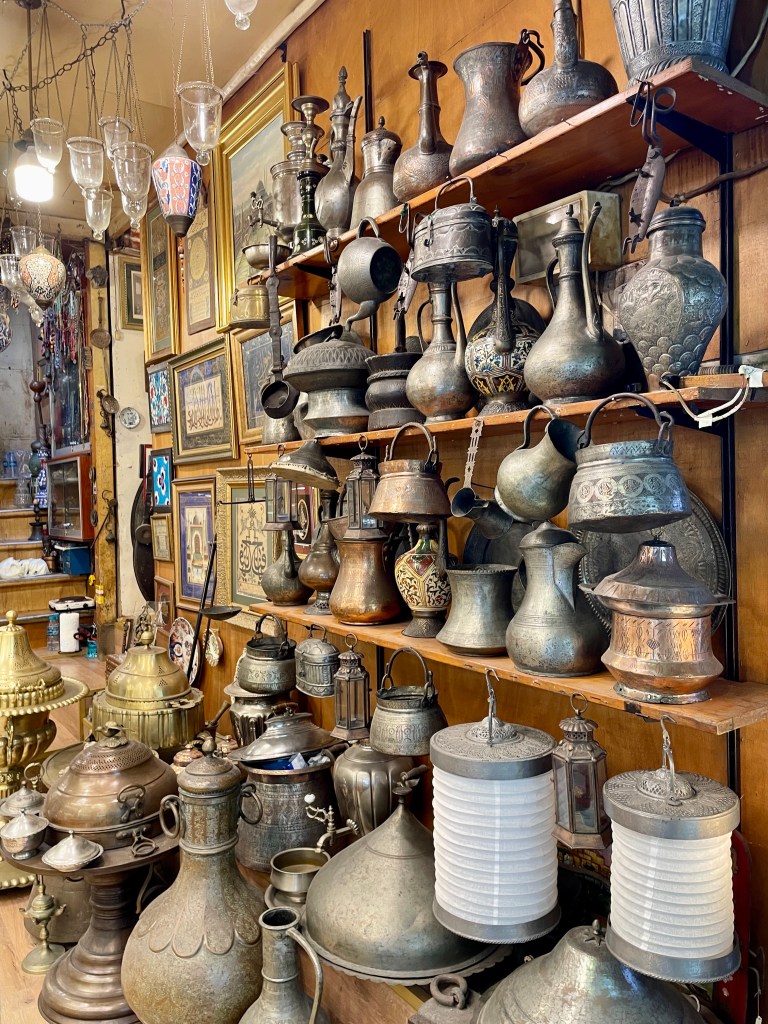
The Grand Bazaar

Today’s tale begins with a quest – my friend Karen wished to purchase a few lamps. My friend Michele knew someone (Mandy) who knew a lamp guy. Enter: a trip to Istanbul’s Grand Bazaar. We decided to make an afternoon of it and it turned into quite an adventure. Hard to put into words but I’ll try…

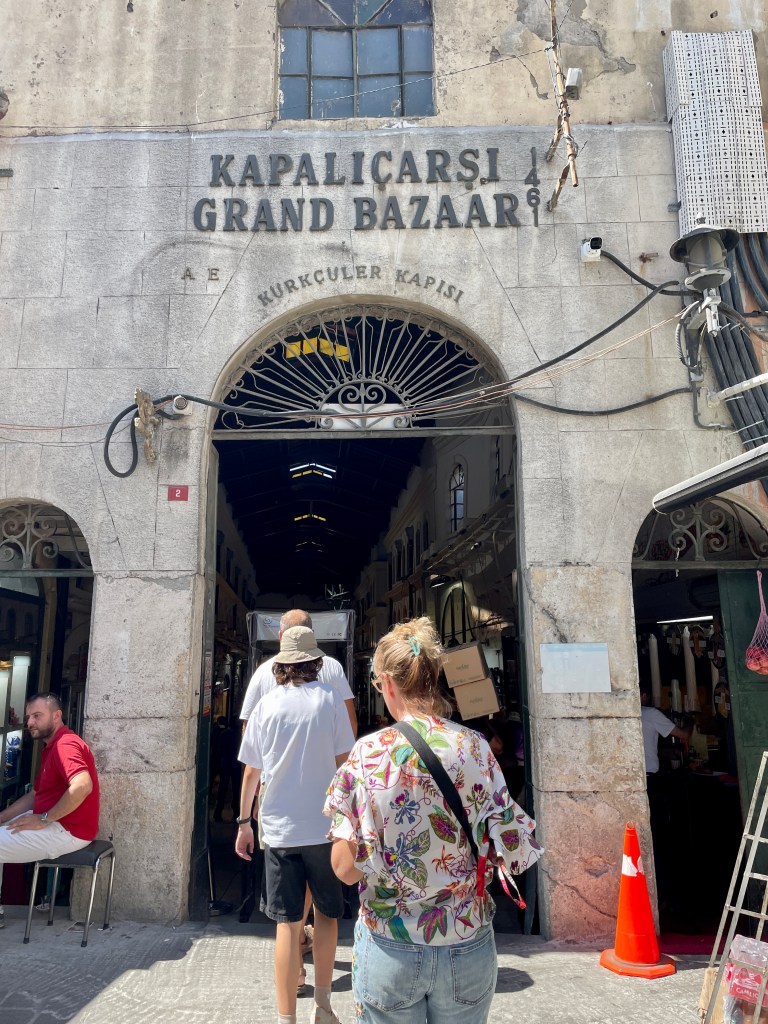
The Grand Bazaar (Turkish: Kapalıçarşı, meaning ‘Covered Market’; also Büyük Çarşı, meaning ‘Grand Market’) in Istanbul is one of the largest and oldest covered markets in the world, with 61 covered streets and over 4,000 shops on a total area of 30,700 m2, attracting between 250,000 and 400,000 visitors daily. In 2014, it was listed No.1 among the world’s most-visited tourist attractions with 91,250,000 annual visitors. (Wikipedia) The Bazaar opened during the winter of 1455/56, shortly after the Ottoman conquest of Constantinople.

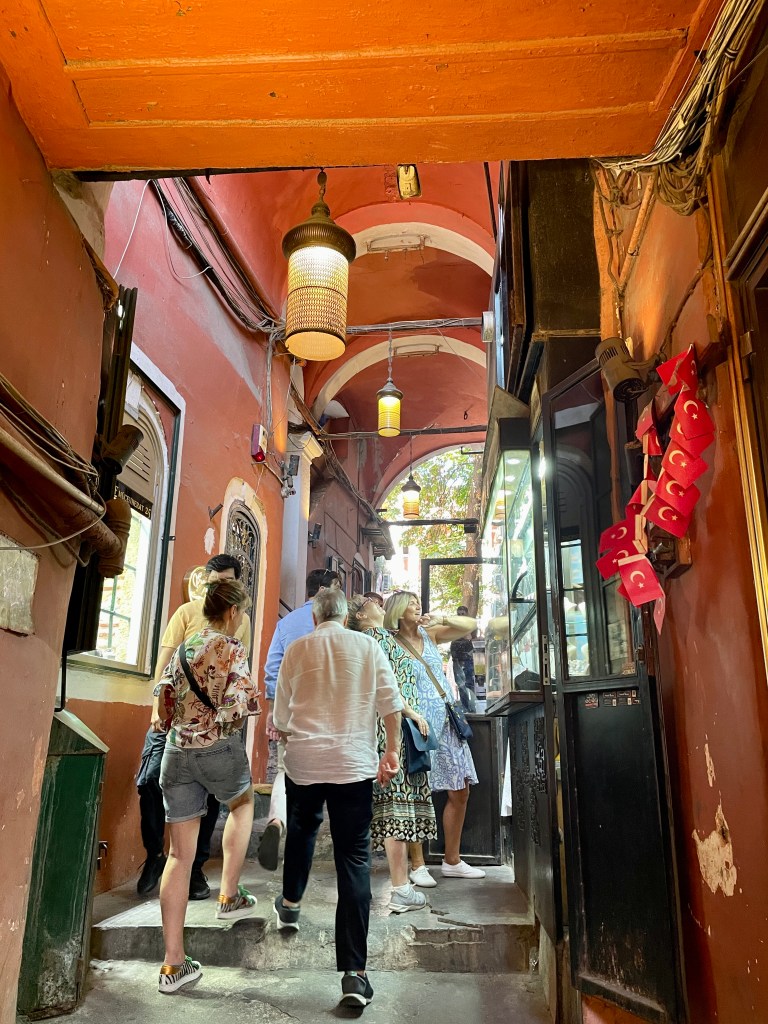
Quite simply, this maze of alleyways and covered corridors is intimidating. Thankfully, we had Mandy, who knows everyone. A septuagenarian who has entertained a multitude of entrepreneurial endeavors over her decade in Istanbul, Mandy knows everyone. Vendors shouted out her name in greeting as we passed. They ushered us into their stores, plying us with leather jackets and hilarious complements. She asked about their mothers, their nephews, and their personal health. It was quite an sight to behold.

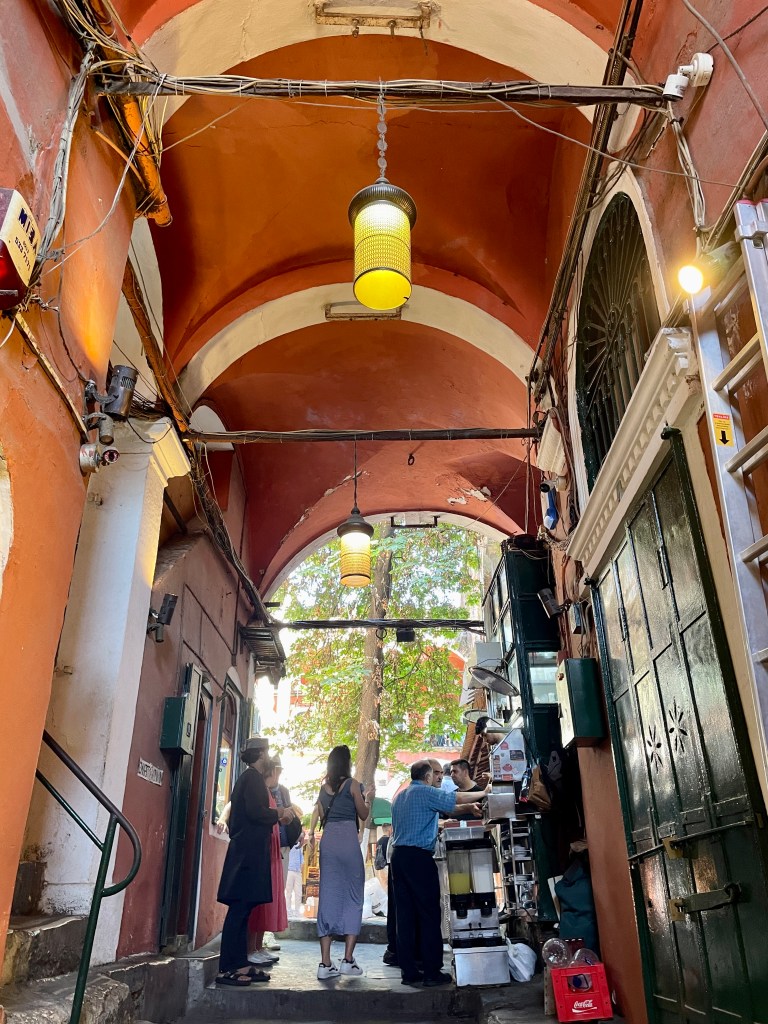
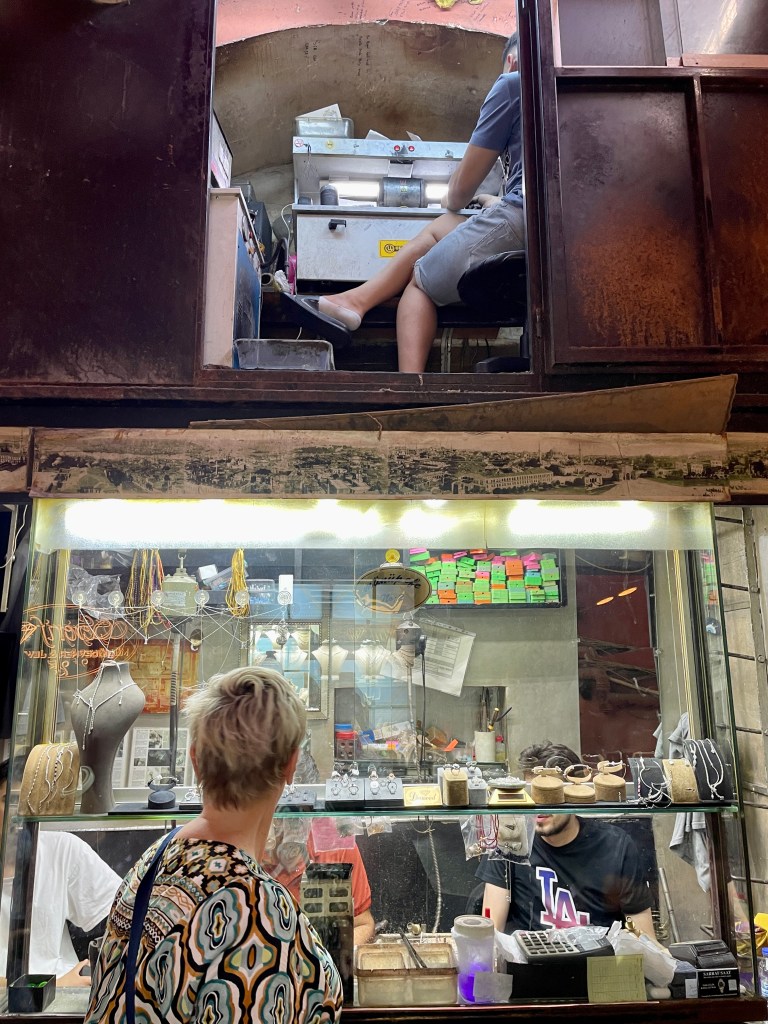
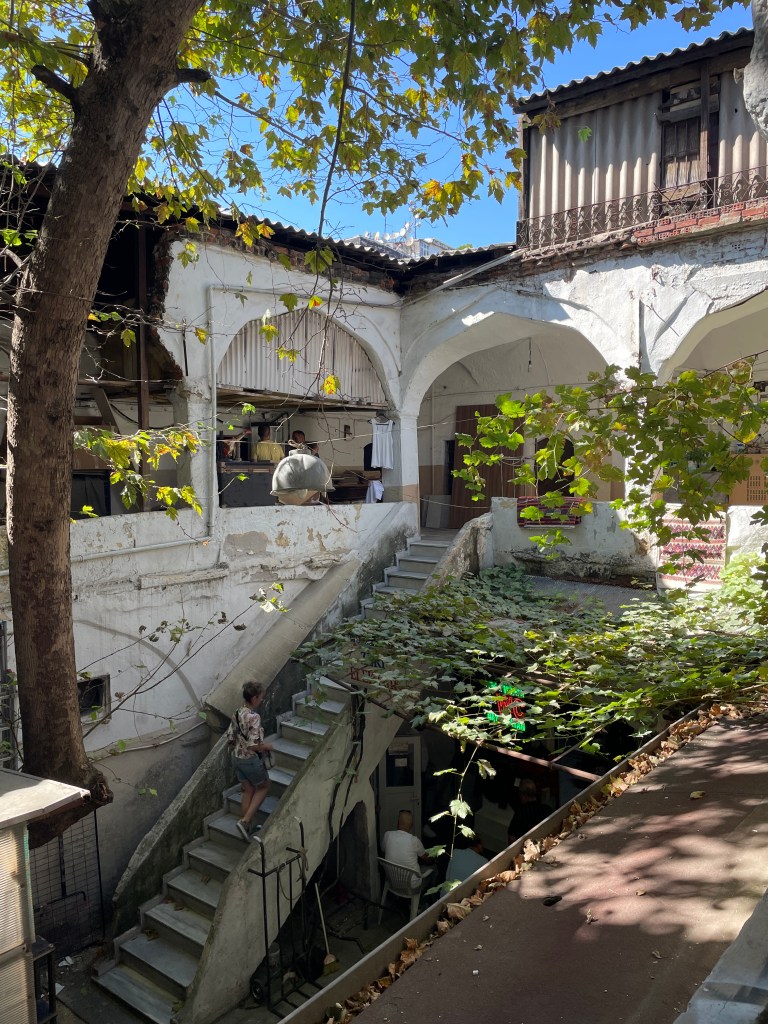
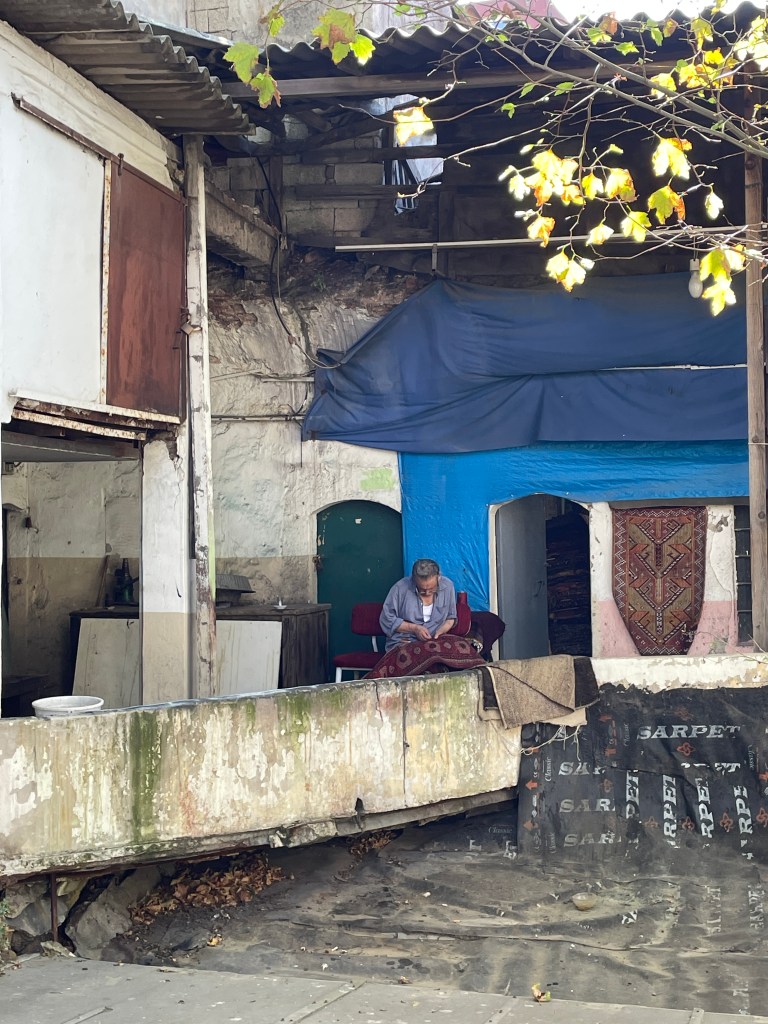
Mandy and Michele deftly led us through the Bazaar, eventually through an alleyway which opened into a courtyard where men sat on stools sipping chai below a leafy green arbor. A cat slept under the shade of a grape leaf while a textile artist shaved a rug up on the roof, seemingly light years above from the hustle and bustle of the Bazaar.

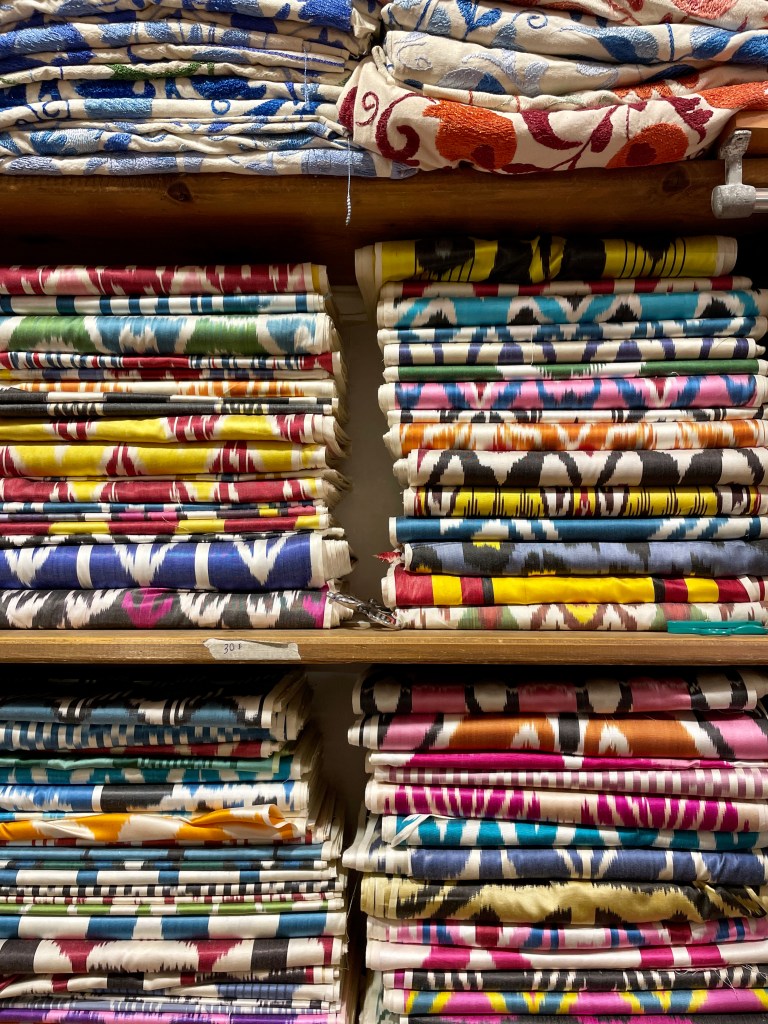
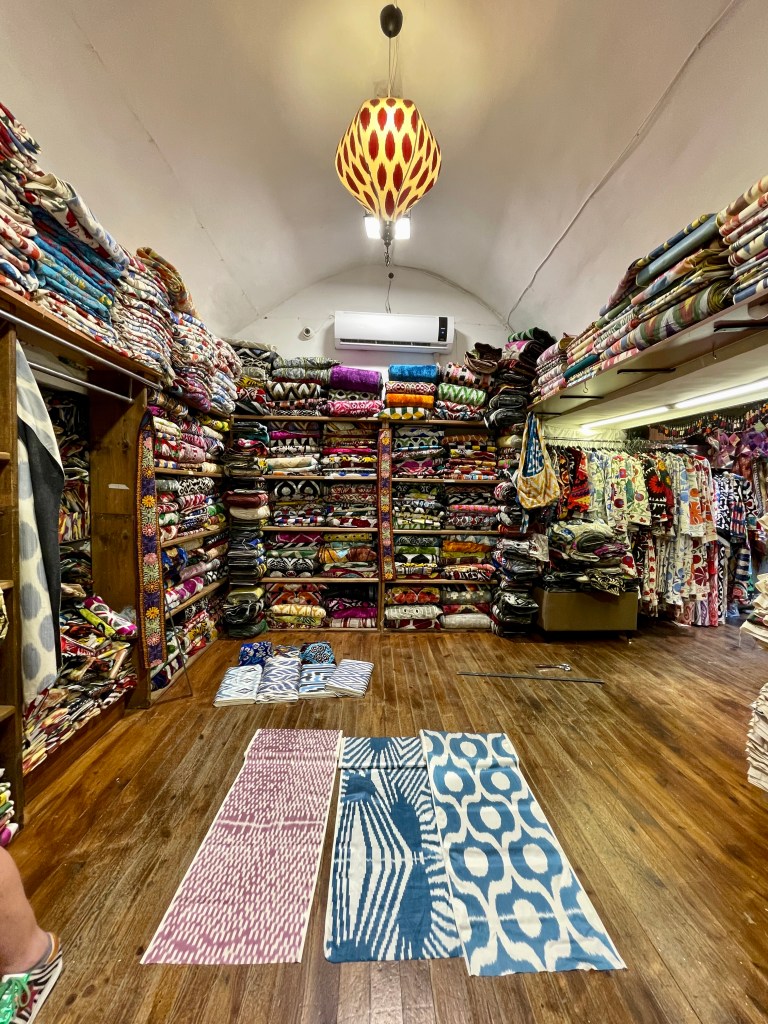
We were ushered into a shop filled floor-to-ceiling with Uzbek fabrics of every pattern and color imaginable. The shopkeepers immediately offered us tea (“chai”), coffee, or water (“su”), as is customary. It was so bloody hot that we gladly accepted a cool drink. Owing to their faith in Mandy’s choice of company (as well as, no doubt, our foreign change purses), we were left alone to make the store our personal closet.

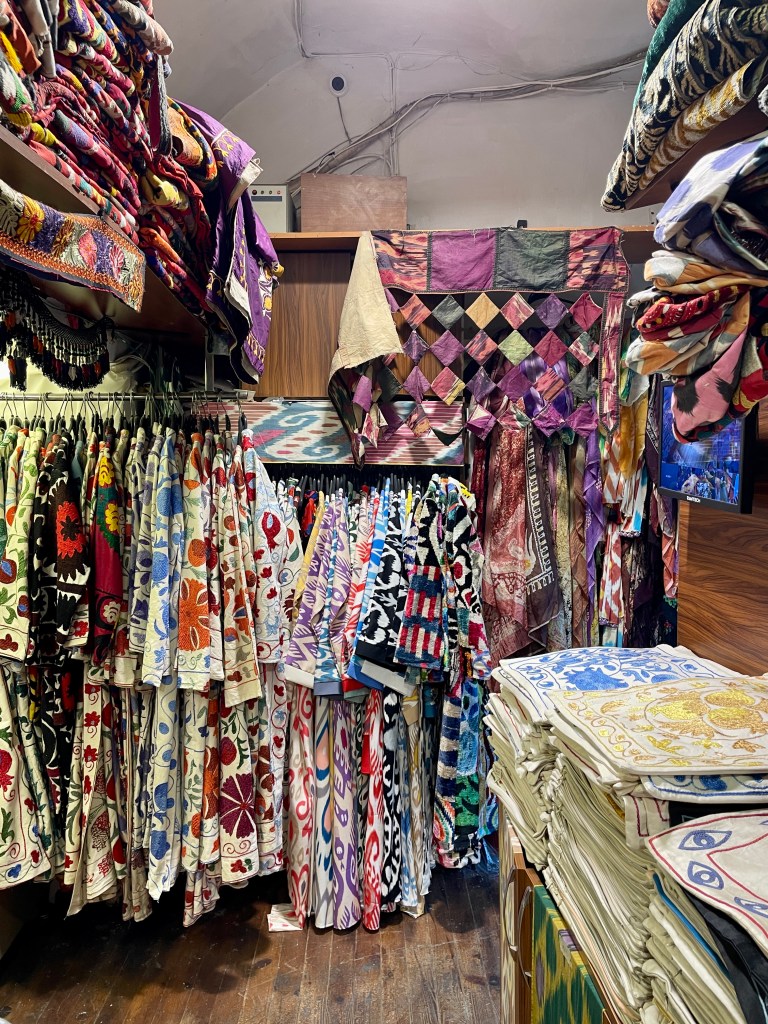
We tried on coats of technocolors rivaling Joseph’s own. Mandy and Michele searched for pillow fabric (front, back, and piping). I helped Karen choose three suitable lampshade fabrics to suit her new apartment with great views on the Bosphorus.

Near the door, I spotted a unique tapestry featuring squares of fabric sewn in diamond formation (above right). It reminded me of something that might hang over a doorframe and, in fact, it was. Over 80 years old, an antique from Uzbekistan. Frayed at the edges and in need of a little TLC, the colors were beautiful and I knew they would do perfectly over my headboard. You see, in the land of the moving fault lines, you don’t hang framed artwork above your bed. The tapestry was too good to pass up.

Everyone made their purchases, with a bit of a comedy ensuing. Each of us checking our Turkish bank accounts to sell dollars for lira, using credit cards from New Zealand and Australia, or a fresh $100USD from the States. Quality goods do not come cheap! Even in Istanbul. We walked out a couple hours later, our pockets a little lighter, but each with treasures to cherish.

In the steamy August heat, we were in need of another cool drink. Strolling the Bazaar, Michele spotted a favorite cafe (Çinili Cafe) and we scored a corner table. Over an iced chocolate and sweet pastries, we relished our purchases and the kindness of the shopkeepers who had taken good care.

We got to talking with our waiter, who turned out to be the cafe owner’s son. Mandy asked a question about a Muslim sect and the young man replied that he didn’t know, his family was Christian. So unusual! In this land of Islamic faith, only 0.2% of the population is Christian. I taught a few cousins last year from Mardin, an ancient town in eastern Turkey which was founded in the 11th century BC. They were passionately proud of their Assyrian Christian heritage.

Turns out Mandy, too, knows a family of Christians from this area, who turned out to be good family friends of the cafe owner. The world really seemed a little smaller in that moment. Catching up on their mutual friends (someone got married last year), the cafe owner also shared that he has worked in the Grand Bazaar for 54 years.
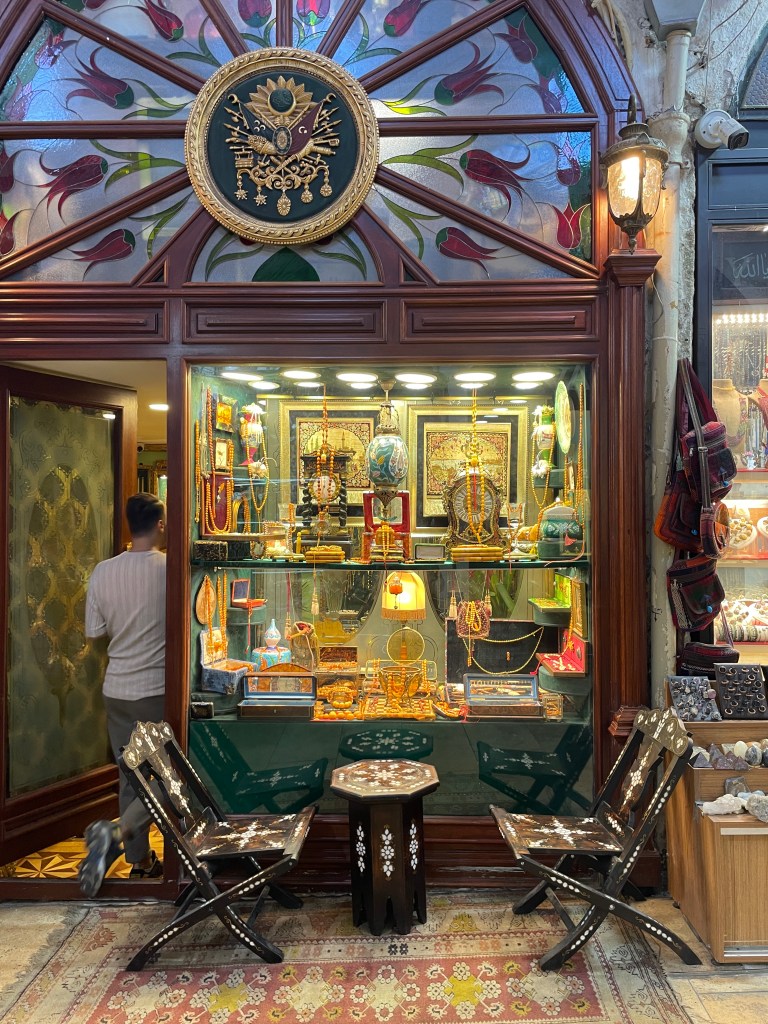
A fascinating and intimate subculture lives within the passageways and alleyways of the Bazaar, one I only caught a brief glimpse of that day. I look forward to going back in the future and bringing guests to Mandy and Michele’s favorite haunts. It does not seem quite so intimidating anymore, instead more of a new city to explore. With a quarter to half a million visitors per day, this concept tracks.

Back at home, I made quick work of hanging the tapestry. I was quite pleased that it looked exactly as I had hoped, pulling all the colors in the room together. A memory of our day at the Grand Bazaar, a seminal experience I will surely never forget.
Grand Bazaar vendors:

Nurem (Uzbek textiles, lampshades, clothing, and pillows)

Sermon Almaz (wooden handicraft, board games)

Adnan & Hasan (carpets, kilims)

Gian Mori (leather goods)

Çinili Cafe (cold chocolate, apple pie, treats)

That’s a wrap

Hard to believe but my first school year in Turkey is coming to a close. It’s been quite a ride and I’m thankful to be on the other side. Thank you all for following along! It’s so great to hear from you and share these adventures, too. Here’s a couple from the last few weeks, wrapping up the year out on the water.

First up is Bodrum. An hour south of Istanbul by plane, it’s a waterfront town with lots of fun for tourists to enjoy.

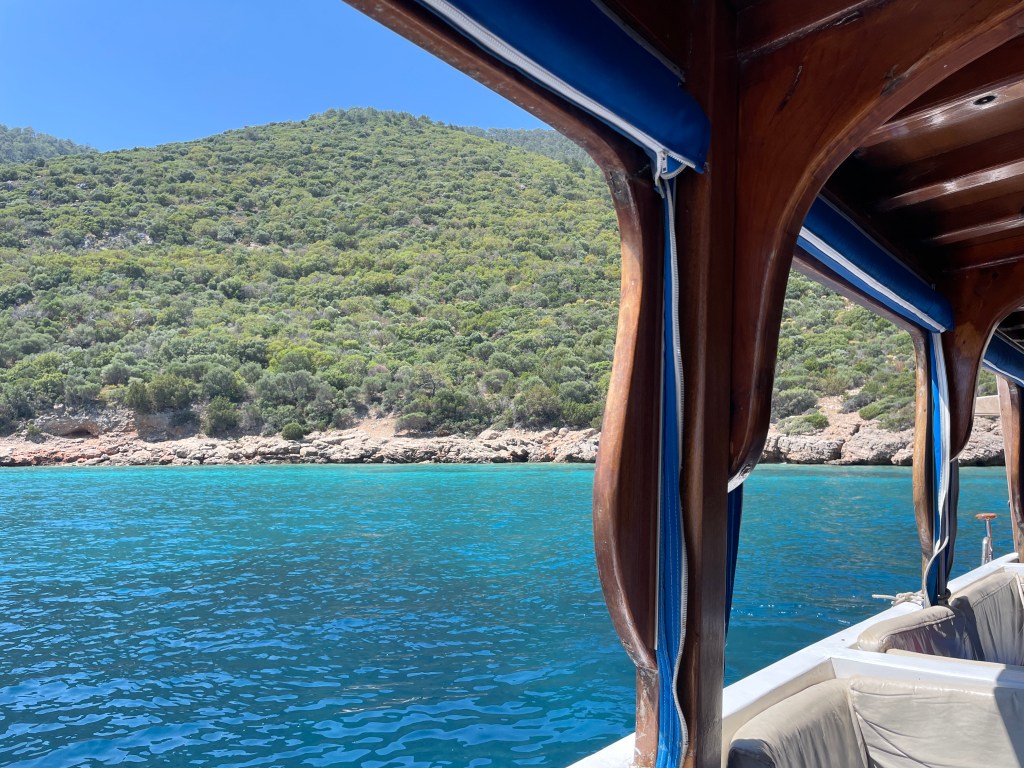
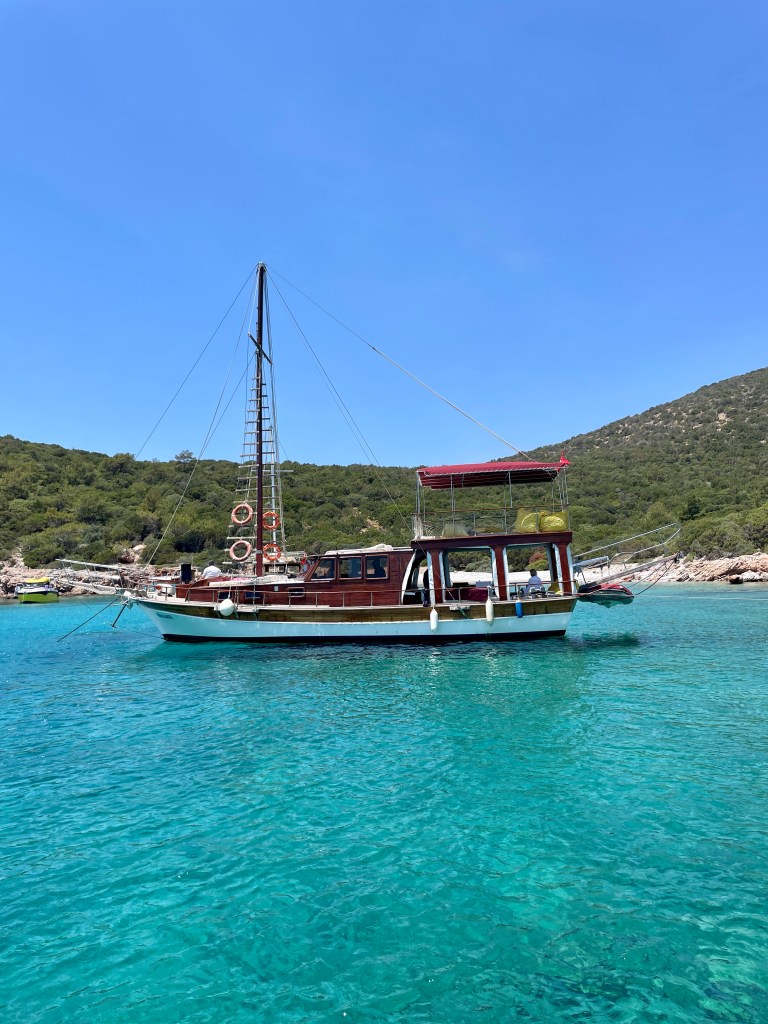
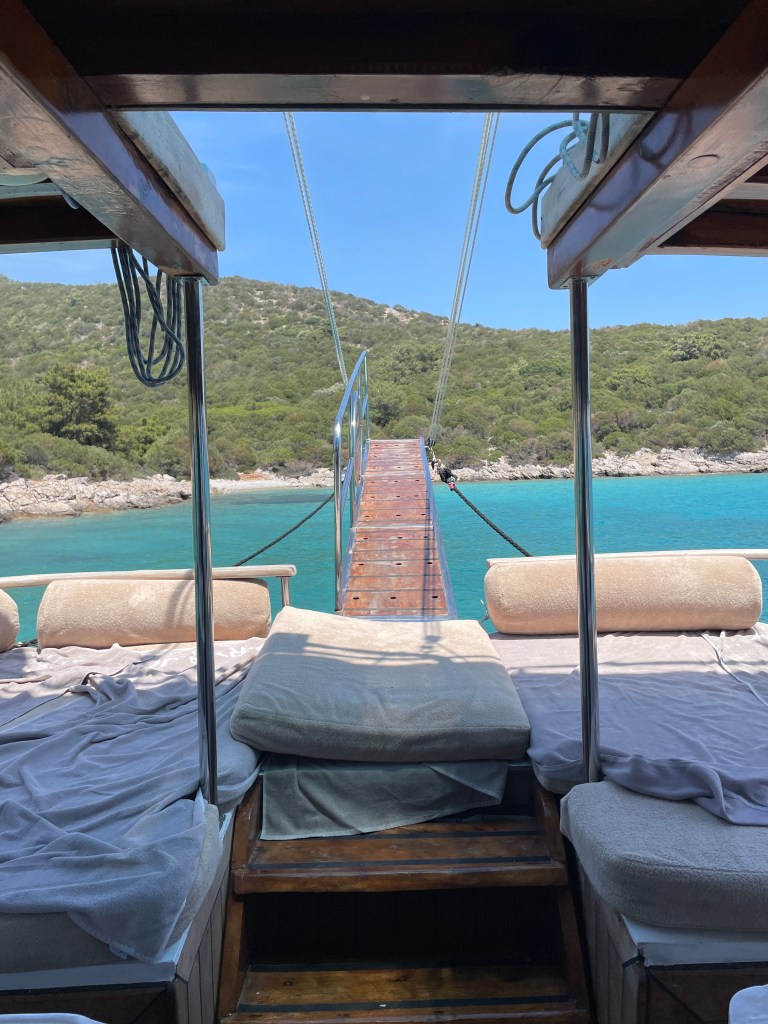
On Saturday, we rented a boat for the day to do some cove hopping. The water is just stunning here – so clear you can see all the way to the bottom. Quite chilly in June but the salt of the Mediterranean lets you float for hours.

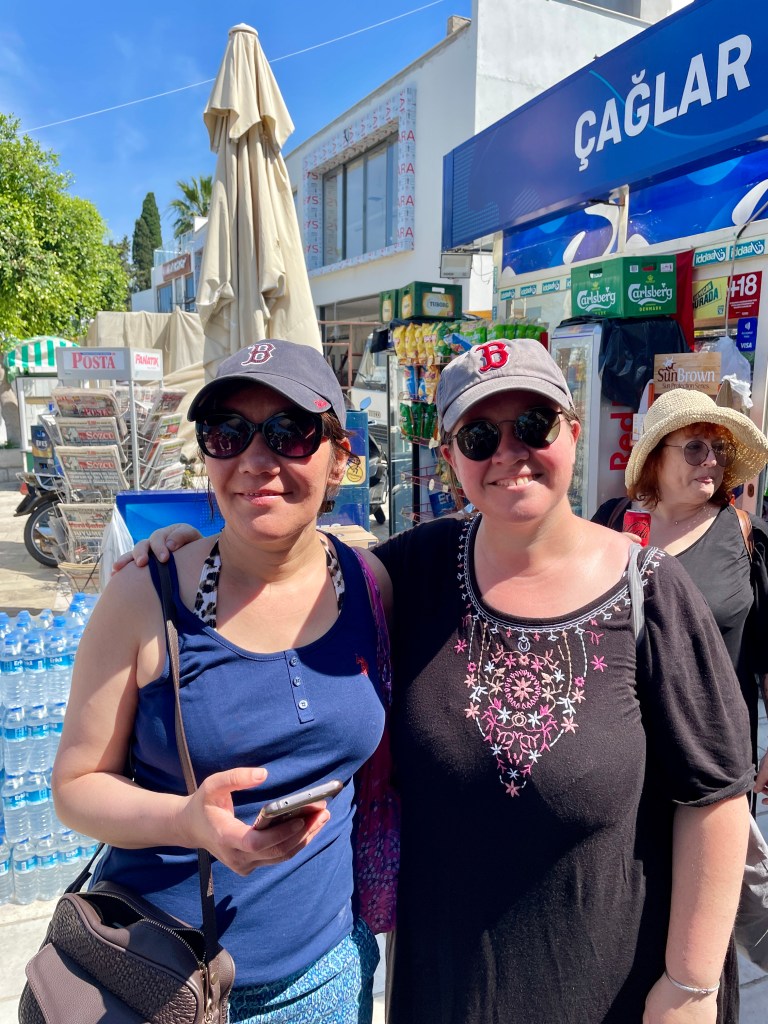
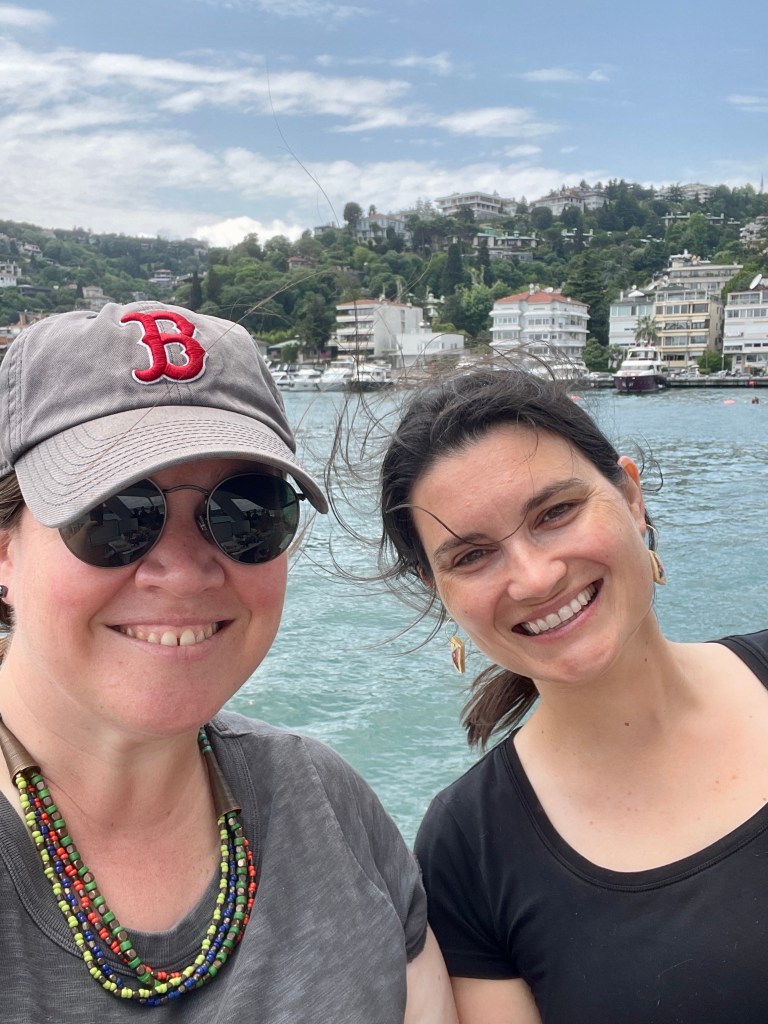
Here’s Dina and I repping the Sox. Her husband is from Salem, Mass.

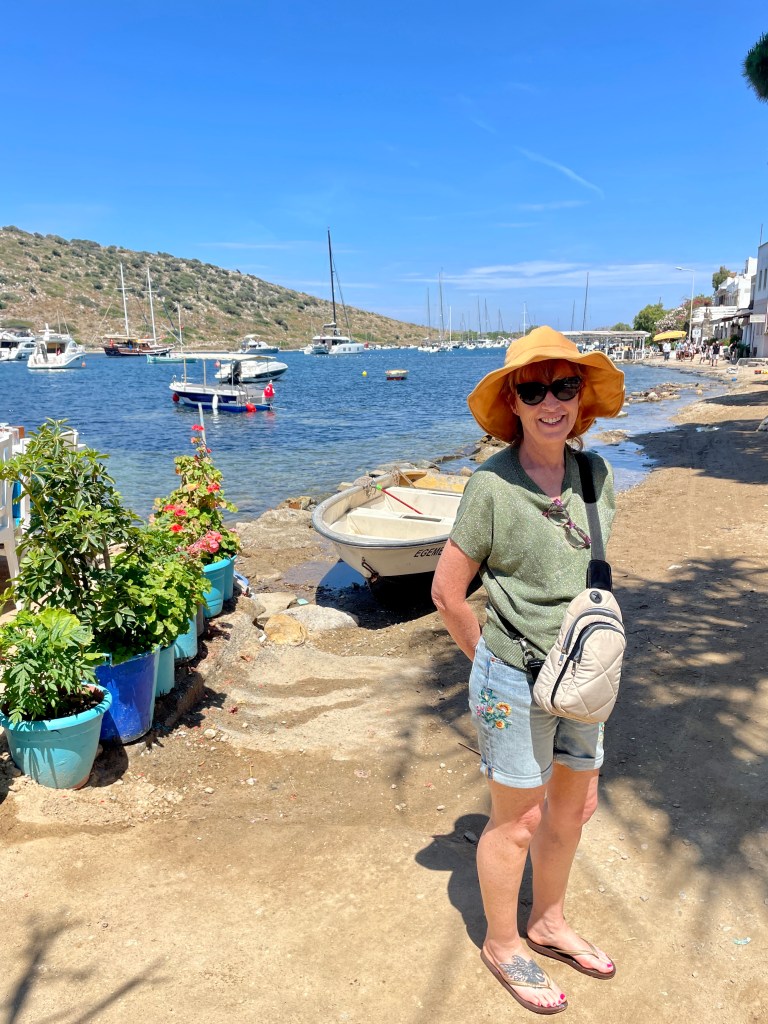
On Sunday, my wonderful friend Michele took a few us to a little village called Gümüşlük on the other side of the Bodrum peninsula.

We took a dolmuş to get there. A dolmuş is a mini bus and the word translates to “it’s full” in Turkish. The van only departs when it has enough passengers and takes you to destinations at a fraction of the cost of a private taxi.

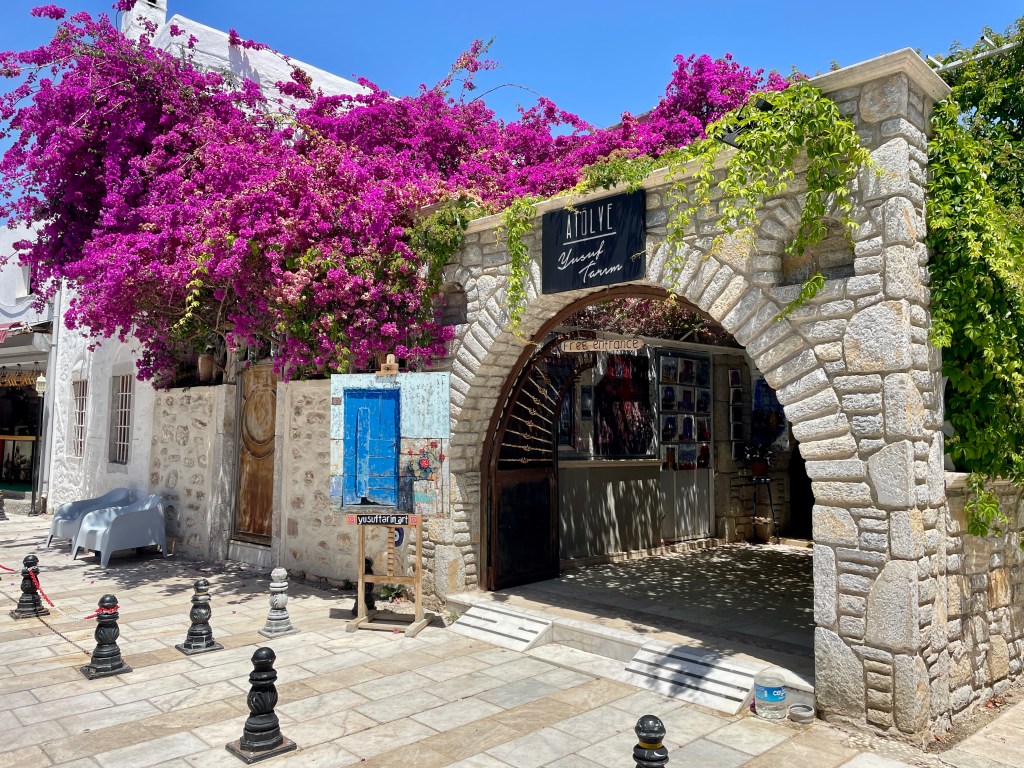
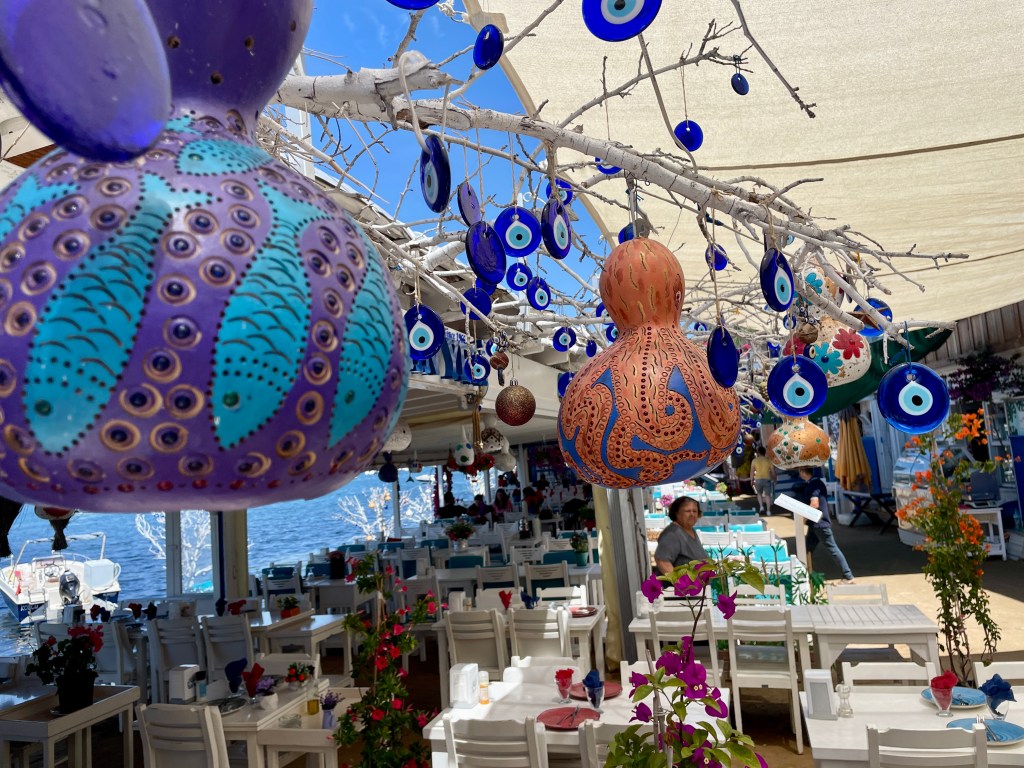
We wandered around the shops and checked out the a waterfront cafes. Evil eyes are a staple of Turkey and this village also featured gourds decorated by hand.

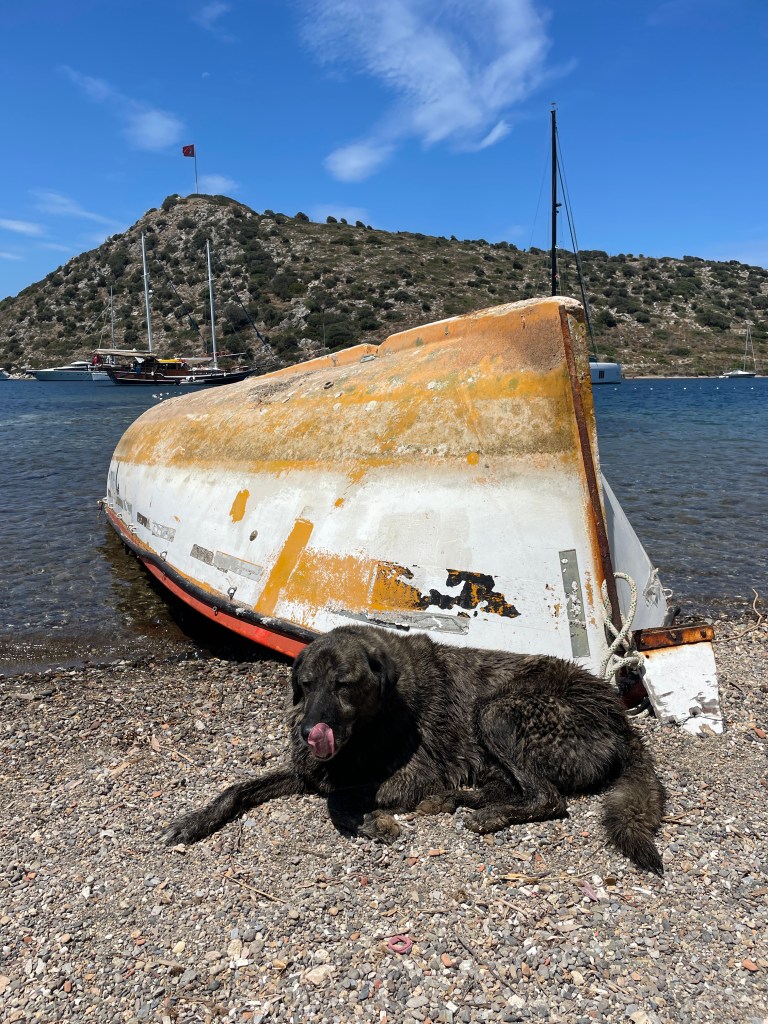
We met a sweet pup taking a dip and joined him, putting our feet in to cool off during the heat of the day.

All too soon it was time to return to Istanbul for another week of exams and end-of-the-year activities. Thankful for such a wonderful group!

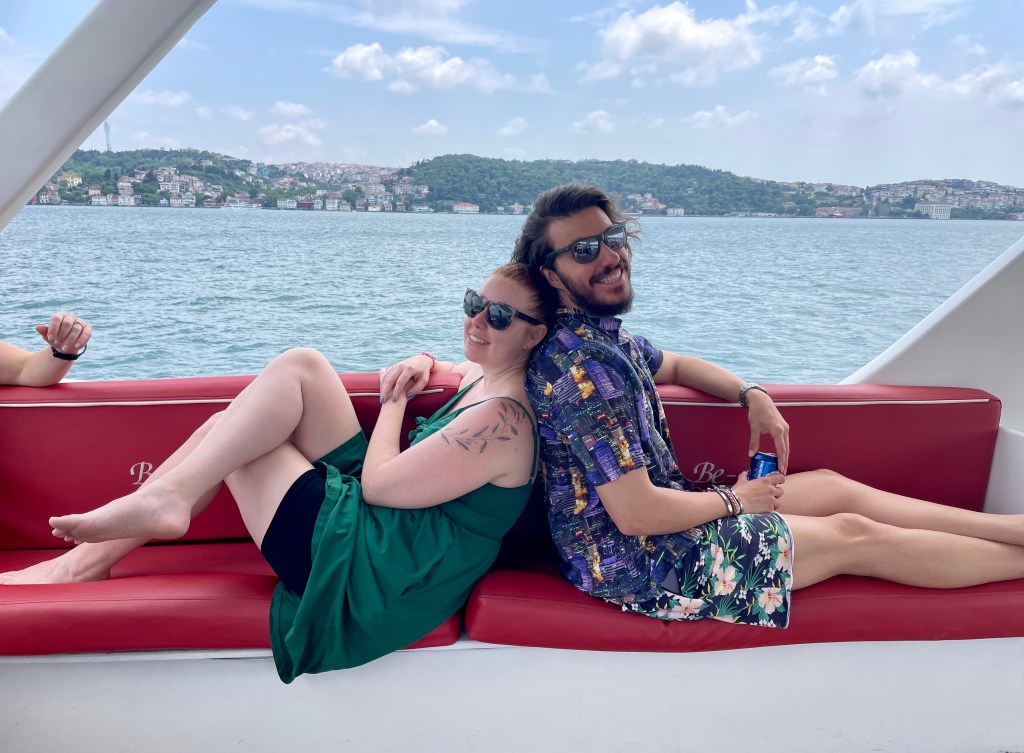
Back in Istanbul, my friend Kelly arranged a boat trip to celebrate our colleagues and friends who are leaving this year. Goodbyes are a given in ex-pat life but it’s great to go out on a high note.

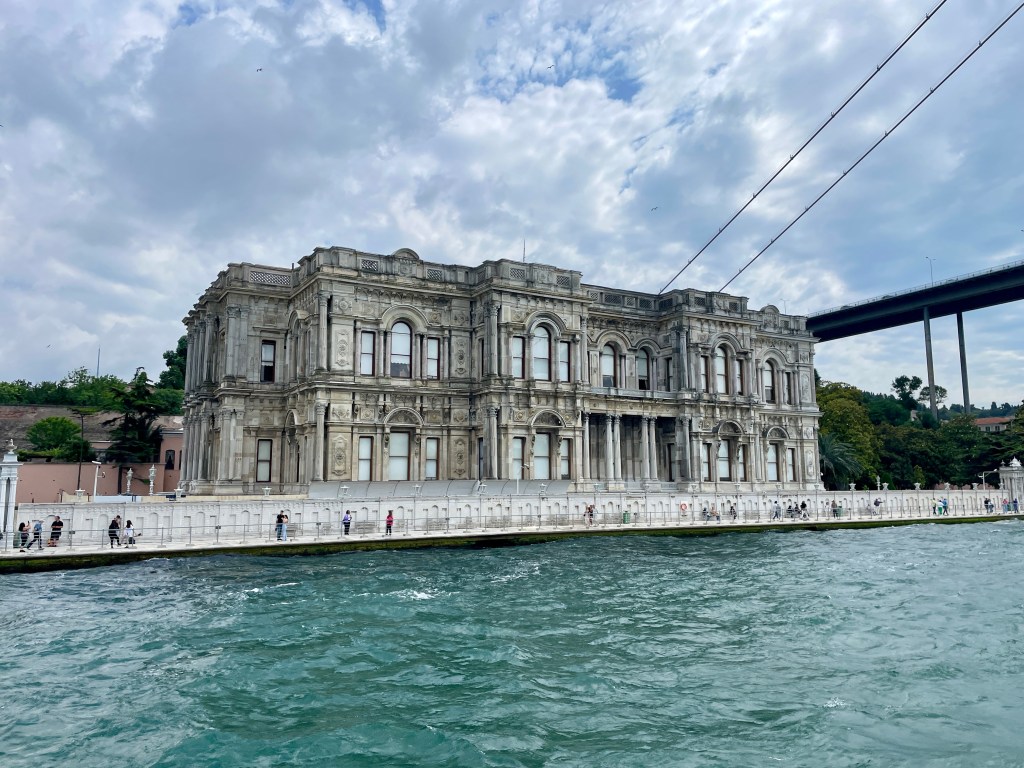
We headed north on the Bosphorus Strait, skirting the banks and taking in the stone palaces dotting the shoreline. These stone giants are memorials from the Ottoman age and many are decorated in the Baroque style of their original age.

The day was such a lovely break from exam marking and the craziness that marks the end of the school year. The Bosphorus is really something special.

I fly back to Boston in a week. Fun plans in store for the summer. Give a shout if you’re in New England – would love to see you 🙂